
- Puntuación BGG
- 7,9
John Prados' Third Reich: Deluxe Map
- Complejidad 3,0/5
- 2004
2001
Ayuda con las reglas de John Prados' Third Reich
Explicaciones claras de turnos, efectos de cartas y situaciones dudosas, con referencias a fuentes oficiales e historial de preguntas guardado.
Para 2 jugadores
¿Qué quieres saber?
Las respuestas salen del reglamento oficial, con la página para comprobarlo.
John Prados' Third Reich es un juego de mesa publicado en 2001 para 2–5 jugadores, con partidas de 360 minutos y a partir de 12 años. Fue diseñado por John Prados y Brian L. Knipple y sus mecánicas principales son Dice Rolling, Hexagon Grid y Simulation.






En inglés
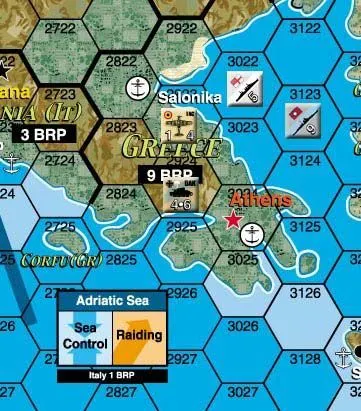
(from Avalanche Press website:) Third Reich interweaves not only the land, naval and air struggles, but also the equally important economic and political battles. Players must guide their nation to victory by capturing key objectives while making sure no one else — in particular their allies — gets there first. Players take on the leadership of Britain, France, Italy, Germany, the United States or the Soviet Union. Each of these major powers, in turn, can influence smaller countires like Turkey, Greece or Romania to join the war on their side. They can offer bribes or territory, and sometimes it’s more important to decrease someone else’s influence than to build up your own. The currency of the game is the Basic Resource Point, or BRP. This represents the financial, industrial and agricultural production needed to wage war. BRP’s are used to build new units, to pay for offensives, to replace losses suffered in battle, to bribe minor countries, and for a host of other purposes. Each country’s production can be affected by conquering or losing territory, or through strategic warfare (chiefly, attacks by submarines and bombers). Once activated (usually at a cost in BRP’s), land, naval and air units can move and attack enemy units. Combat is resolved by rolling dice, with a result of 6 usually equalling a hit. There are no Combat Results Tables; every factor counts and there are no “perfect numbers” of units to commit to battle as in some wargames. When a land unit is hit, BRP’s can be used to absorb some of the damage, but too many hits and it is reduced in strength or destroyed. Naval and air units pack a greater punch, but don’t bounce back from damage as easily. Scenarios, or game situations, begin the game in 1938, 1939, 1940, 1941, 1942, 1943, 1944 or 1945. Political markers are randomly chosen to determine what events might take place outside the players’ control: Poland might capitulate to Germany in 1939, Mussolini, Churchill or Hitler might unleash some stupid scheme the Italian, British or German player will have to execute, oil could be found in Libya, the French navy could rally to the Allies or the Axis, jets can be developed, good Germans might kill Hitler — dozens of such events are possible. As one of the most popular games of all time, our edition of Third Reich has also spawned a sequel, Great Pacific War. The two games can be played together or separately. (BGG description:)Avalanche Press' re-release of the original classic. This is a significant overhaul based on the Avalon Hill Third Reich, and has nothing to do with the later Advanced Third Reich. There has been dramatic simplification and streamlining, however. Gone is the CRT, replaced by a Columbia-esque "roll lots of dice" combat resolution system. The whole front/option system has been revised with an "HQ activation marker" system: each nation buys activation markers for HQs, land, and air units, and puts them in a cup. Turn order is then determined by draws. Naval and air systems have been overhauled and simplified: sea zones now regulate movement. Tactical air support is now limited to being equal to the strength of the attacker/defender, not three times. Also includes 1938 (Spanish Civil War boils over to a general European conflict) and 1945 scenarios (Western Allies and Russia fall out after collapse of Germany).
Según el catálogo, John Prados' Third Reich admite de 2 a 5 jugadores. Este intervalo corresponde al número de jugadores indicado por la editorial, así que el juego puede prepararse para cualquier grupo dentro de ese margen. La preparación, algunas reglas y la puntuación pueden variar según el número de jugadores; consulta la configuración exacta en el reglamento de tu edición.
La duración indicada para John Prados' Third Reich es de 360 minutos, la estimación de la editorial para una partida completa. El tiempo real depende del grupo, del número de jugadores y del conocimiento de las reglas: las primeras partidas suelen alargarse y los grupos con experiencia terminan antes. La preparación y la explicación de las reglas no están incluidas.
El catálogo indica John Prados' Third Reich a partir de 12 años. Es la recomendación de la editorial y refleja la lectura necesaria, la complejidad de las reglas y las piezas pequeñas, no solo el tema. Los más pequeños a menudo pueden jugar con ayuda de un adulto: comprueba la edad recomendada en tu edición y la experiencia de tu grupo.
John Prados' Third Reich tiene una puntuación de complejidad de 4,0 sobre 5 según los jugadores de BoardGameGeek, lo que lo convierte en un juego exigente. La puntuación refleja cuánto conocimiento de reglas, planificación y toma de decisiones exige una partida típica. Los juegos exigentes requieren una explicación inicial más larga, así que conviene usar una guía de preparación.
John Prados' Third Reich pertenece a estas categorías: Economic, Wargame y World War II. Sus mecánicas principales son Dice Rolling, Hexagon Grid y Simulation. Las categorías describen el tema y la ambientación de un juego, mientras que las mecánicas describen lo que los jugadores hacen realmente en su turno. Cada mecánica lleva a una página del catálogo con juegos similares.
Los autores acreditados de John Prados' Third Reich son: John Prados y Brian L. Knipple. Estos créditos proceden de los datos publicados del juego y nombran a las personas responsables de su diseño, no a ilustradores ni editoriales. Las páginas de autor de MeepleRules reúnen otros títulos de los mismos autores, algo útil cuando un juego te gusta y buscas otros parecidos.
El catálogo clasifica John Prados' Third Reich como juego base. Se juega por sí solo con los componentes de la caja y no requiere ningún otro título. Las expansiones, si existen, añaden contenido o reglas nuevas y aparecen por separado en el catálogo con un enlace a este juego base.