- Puntuación BGG
- 7,5
Karnag: The Congregations
- 2–5 jugadores
- 100 min
- Complejidad 3,5/5
- 2012
2012
Ayuda con las reglas de Karnag
Explicaciones claras de turnos, efectos de cartas y situaciones dudosas, con referencias a fuentes oficiales e historial de preguntas guardado.
¿Qué quieres saber?
Las respuestas salen del reglamento oficial, con la página para comprobarlo.
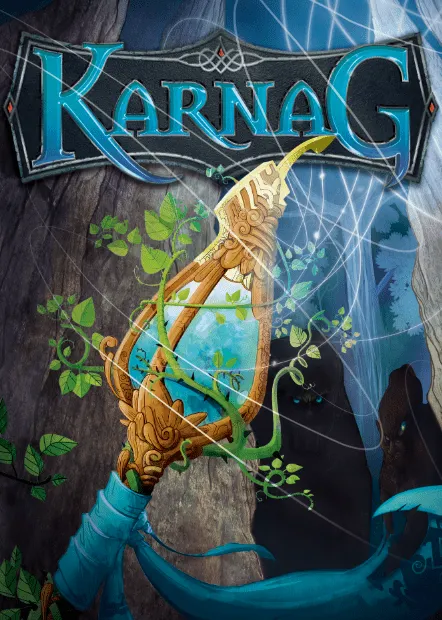
Karnag es un juego de mesa publicado en 2012 para 2–5 jugadores, con partidas de 120 minutos y a partir de 14 años. Fue diseñado por Pascal Cadot y sus mecánicas principales son Enclosure, Action Queue y Worker Placement.








En inglés
AIM OF THE GAME Obtain magical points (MP) by preventing evil creatures from invading the human world. These creatures come from the underwater Ker-Ys city. PREPARATION In turn, the players place all elements of the game area (wall ruins, swamps). Four creatures are introduced in the game and will progress from the door (in the centre of a glade) towards either side of the game board (representing the druids’ path surrounding the glade). Creatures’ moves are pre-defined and happen automatically. The players place their team of three druids whose role is to prevent the creatures from invading the human world. Energy markers are set at the start level and the knowledge track markers are set under the tracks. The pile of Power cards is shuffled and placed near the board. THE GAME The game consists of a defined number of rounds (depending on number of players). Every round is composed of the following phases: The creatures progress. The creatures already on the board progress towards the side of the board using a totally automatic way of moving. New creatures (1 to 3, depending on a dice roll) arrive on the board and start to progress too. Preparation of the Action tiles. The six Action tiles are shuffled and placed one by one forming a line, face up. These tiles represent all possible actions, each tile being separated into a major and a minor action. The number of places available on the tiles depends on the number of players. Choice of actions. Each druid team carries out 5 actions a round, represented by Action markers. Players, in the reverse order of their position on the score track, choose their actions one by one by setting their Action markers on the available places on the Action cards. Actions can be: moving the druids (they only move on the path surrounding the glade), setting a magical stone (a magical stone is set at the intersection of the magical beams emitted by two druids looking at the glade, this costs energy; the magical beams do not cross obstacles), capturing creature(s) (a druid may capture a creature in front of him with his magical beam; this costs energy but gives MP and sometimes special properties), progressing in knowledge tracks (to increase the capacity of moving, or to increase the influence at the druid council, for instance), preparing magical beverages (to increase knowledge but also to recover energy), moving a magical stone (it is possible to move a magical stone), acquiring Power cards (they give special powers, such as allowing the magical beam to pass through a wall), and influencing a creature (allows to move a creature). Actions are performed. Actions are performed marker by marker, from left to right, starting with the major actions before doing the minor ones. If the same colour of marker is encountered a second time on the same action, this action is not carried out. The actions on the next Action tile are then carried out and so on, until all major or all minor actions have been performed. Then, the players come back to the stopped action to perform it. Druids must inform the council about all their actions. After they have set a stone, captured a creature, or prepared a magical beverage, druids are placed at the druid council. Any druid can start from the council to enter back the path, but he can also stay at the council to influence it and gain MP at the end of the round. Activation of magical stones. At the end of each round, all stones that are aligned and of the same colour automatically become menhirs. MP are attributed to the corresponding players and depend on the distance between the stones that have been transformed, as well as their position in the glade. Menhirs have a special property that will be activated at the end of the game. Druid council. At the end of each round, the influence of each druid team on the council is evaluated. Players receive as many MP as their number of druids at the council. In addition, the team in majority can increase his knowledge in one of the knowledge tracks. Then, a new round can start. END OF THE GAME The game is finished after 5 or 6 rounds, depending on the number of players. In addition to the MP gained during the game, players receive MP according to the magical stones still on the board and the Power cards still in their hands. Also, the final menhir layout is important and can afford MP according to two different scenarios. If the central door (from which the creatures come) can be completely shut in by drawing a connecting line between menhirs, then MP are attributed to the players for the menhirs they have placed in the glade. If it is not possible to shut in the central door by connecting menhirs, then MP are attributed to the players for the creatures that they have captured. THE WINNER The winner is the player with the highest MP score.
Según el catálogo, Karnag admite de 2 a 5 jugadores. Este intervalo corresponde al número de jugadores indicado por la editorial, así que el juego puede prepararse para cualquier grupo dentro de ese margen. La preparación, algunas reglas y la puntuación pueden variar según el número de jugadores; consulta la configuración exacta en el reglamento de tu edición.
La duración indicada para Karnag es de 120 minutos, la estimación de la editorial para una partida completa. El tiempo real depende del grupo, del número de jugadores y del conocimiento de las reglas: las primeras partidas suelen alargarse y los grupos con experiencia terminan antes. La preparación y la explicación de las reglas no están incluidas.
El catálogo indica Karnag a partir de 14 años. Es la recomendación de la editorial y refleja la lectura necesaria, la complejidad de las reglas y las piezas pequeñas, no solo el tema. Los más pequeños a menudo pueden jugar con ayuda de un adulto: comprueba la edad recomendada en tu edición y la experiencia de tu grupo.
Karnag tiene una puntuación de complejidad de 3,4 sobre 5 según los jugadores de BoardGameGeek, lo que lo convierte en un juego de complejidad media. La puntuación refleja cuánto conocimiento de reglas, planificación y toma de decisiones exige una partida típica. Los juegos exigentes requieren una explicación inicial más larga, así que conviene usar una guía de preparación.
Karnag pertenece a estas categorías: Fantasy. Sus mecánicas principales son Enclosure, Action Queue y Worker Placement. Las categorías describen el tema y la ambientación de un juego, mientras que las mecánicas describen lo que los jugadores hacen realmente en su turno. Cada mecánica lleva a una página del catálogo con juegos similares.
Los autores acreditados de Karnag son: Pascal Cadot. Estos créditos proceden de los datos publicados del juego y nombran a las personas responsables de su diseño, no a ilustradores ni editoriales. Las páginas de autor de MeepleRules reúnen otros títulos de los mismos autores, algo útil cuando un juego te gusta y buscas otros parecidos.
El catálogo clasifica Karnag como juego base. Se juega por sí solo con los componentes de la caja y no requiere ningún otro título. Las expansiones, si existen, añaden contenido o reglas nuevas y aparecen por separado en el catálogo con un enlace a este juego base.