

- Puesto en BGG
- BGG #12.780
- Puntuación BGG
- 6,2
Drôles de Zèbres
- 2 jugadores
- 23 min
- Complejidad 1,5/5
- 2004
2018
Ayuda con las reglas de Kiwara
Explicaciones claras de turnos, efectos de cartas y situaciones dudosas, con referencias a fuentes oficiales e historial de preguntas guardado.
Para 2 jugadores
¿Qué quieres saber?
Las respuestas salen del reglamento oficial, con la página para comprobarlo.
Kiwara es un juego de mesa publicado en 2018 para 2 jugadores, con partidas de 30 minutos y a partir de 8 años. Fue diseñado por Bruno Cathala y sus mecánicas principales son Area Majority / Influence, Tile Placement y Square Grid.





En inglés
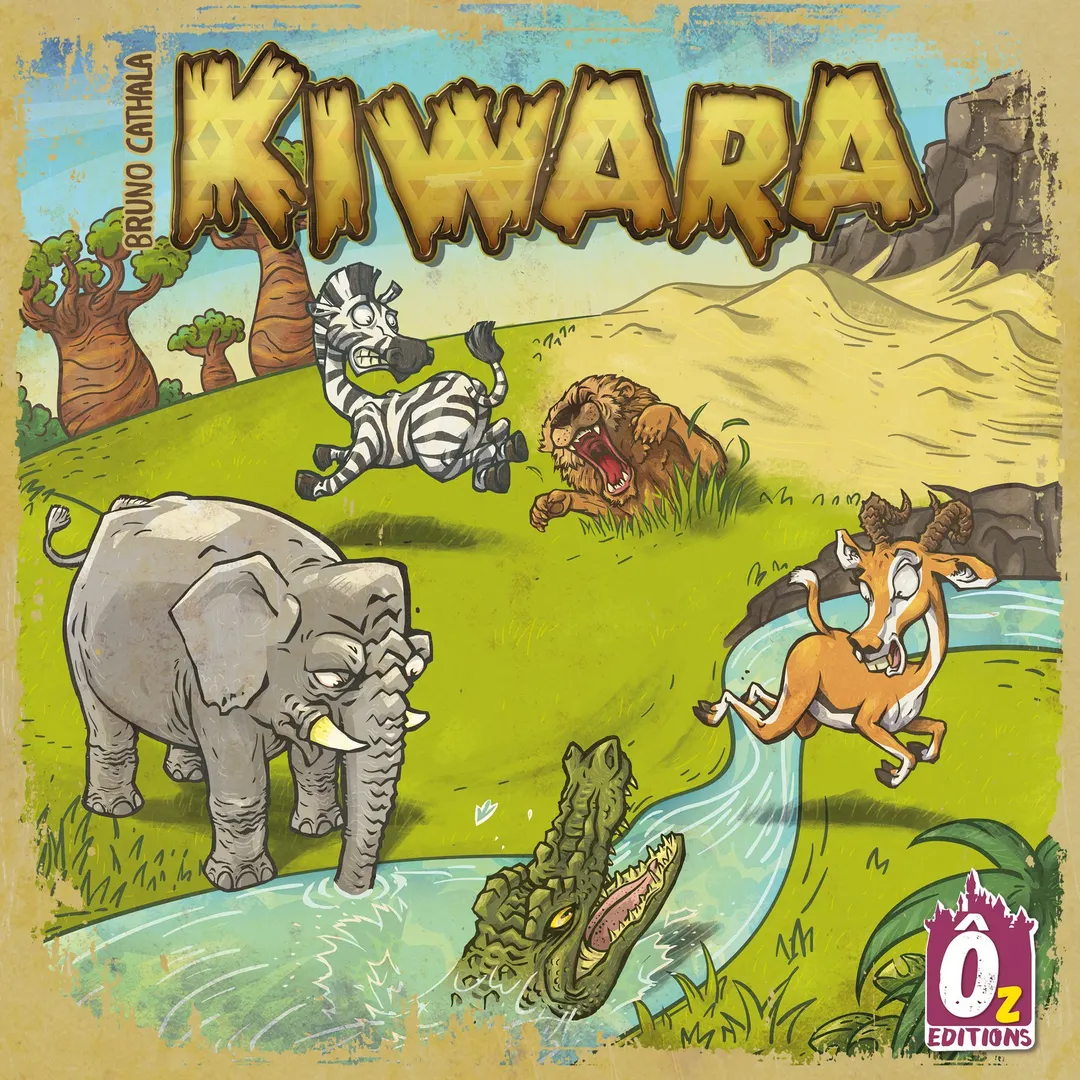
In Kiwara, two groups of animals compete for space in the savanna, claiming points when they dominate a territory, but the value of a space depends on who's in it! The game board features six territories — two each of three, five, and seven spaces — with rivers dividing all of the territories. Each player has fifteen animals tokens in their color. One player places the totem on a space outside the 6x5 board, then players alternate taking turns. On a turn, a player: • Places one of their animal tokens in an empty space in the row or column adjacent to the totem. • Moves the totem 1-3 spaces clockwise. (If all spaces in these rows or columns are full, the player moves the totem to the first row with an empty space.) If a lion is placed orthogonally adjacent to zebras or gazelles, then the zebras are turned face down (yum!) while the gazelles are returned to their owners. If a player must place a zebra or gazelle adjacent to a lion, these tokens are placed face down. If you place a crocodile across the river from a gazelle, you can exchange these tokens. (The crocodile attacks, and the gazelle bounds to safety.) You can swap the location of a crocodile many times this way. Whoever places the token that fills the first savanna claims the Okapi card, which is worth 5 points at game's end. Once the board is filled, determine who has the most tokens in each territory; face-down tokens are counted to determine majority. Whoever wins a territory scores points equal to the value of all face-up animals in this territory: zebras 6, gazelles 2, elephants 5, lions 1, and crocodiles 0. Whoever has the most points wins! While the base game of Kiwara is the same as the earlier Drôles de Zèbres, the game includes a double-sided game board. If you use the "free play" side of the board, to set up you use the river sticks included to create six territories of sizes 3, 5, 7 or 9, thereby creating a fresh layout for each game. Instead of using the Okapi, you can shuffle the ten-card reinforcement deck and give the player who completes the first savanna a random card; the player can use the bonus action on this card at any point during the game. With players of differing skills, the more inexperienced player can start with a card or two at random to level the odds.
Según el catálogo, Kiwara admite 2 jugadores. Es el número de jugadores indicado por la editorial, así que el juego está diseñado exactamente para esa cantidad de participantes. Las variantes para otros tamaños de grupo, si existen, se describen en el reglamento de tu edición; consúltalo antes de preparar otra configuración.
La duración indicada para Kiwara es de 30 minutos, la estimación de la editorial para una partida completa. El tiempo real depende del grupo, del número de jugadores y del conocimiento de las reglas: las primeras partidas suelen alargarse y los grupos con experiencia terminan antes. La preparación y la explicación de las reglas no están incluidas.
El catálogo indica Kiwara a partir de 8 años. Es la recomendación de la editorial y refleja la lectura necesaria, la complejidad de las reglas y las piezas pequeñas, no solo el tema. Los más pequeños a menudo pueden jugar con ayuda de un adulto: comprueba la edad recomendada en tu edición y la experiencia de tu grupo.
Kiwara tiene una puntuación de complejidad de 1,3 sobre 5 según los jugadores de BoardGameGeek, lo que lo convierte en un juego ligero. La puntuación refleja cuánto conocimiento de reglas, planificación y toma de decisiones exige una partida típica. Los juegos exigentes requieren una explicación inicial más larga, así que conviene usar una guía de preparación.
Kiwara pertenece a estas categorías: Animals y Abstract Strategy. Sus mecánicas principales son Area Majority / Influence, Tile Placement y Square Grid. Las categorías describen el tema y la ambientación de un juego, mientras que las mecánicas describen lo que los jugadores hacen realmente en su turno. Cada mecánica lleva a una página del catálogo con juegos similares.
Los autores acreditados de Kiwara son: Bruno Cathala. Estos créditos proceden de los datos publicados del juego y nombran a las personas responsables de su diseño, no a ilustradores ni editoriales. Las páginas de autor de MeepleRules reúnen otros títulos de los mismos autores, algo útil cuando un juego te gusta y buscas otros parecidos.
El catálogo clasifica Kiwara como juego base. Se juega por sí solo con los componentes de la caja y no requiere ningún otro título. Las expansiones, si existen, añaden contenido o reglas nuevas y aparecen por separado en el catálogo con un enlace a este juego base.