
- Puesto en BGG
- BGG #672
- Puntuación BGG
- 7,9
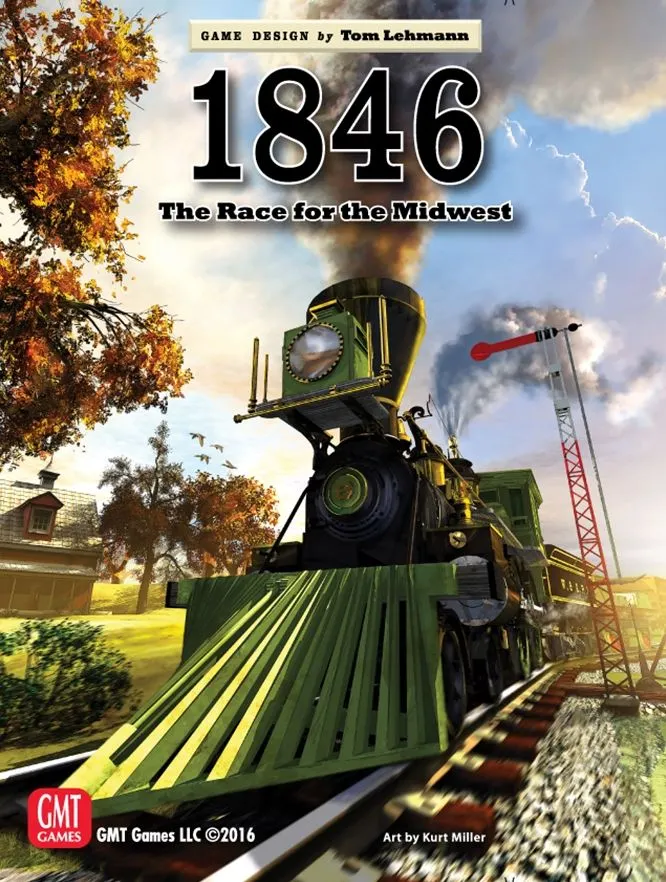
1846: The Race for the Midwest
- 3–5 jugadores
- 120–240 min
- Complejidad 4,0/5
- 2005
2003
Ayuda con las reglas de Magna Grecia
Explicaciones claras de turnos, efectos de cartas y situaciones dudosas, con referencias a fuentes oficiales e historial de preguntas guardado.
Para 2 jugadores
¿Qué quieres saber?
Las respuestas salen del reglamento oficial, con la página para comprobarlo.
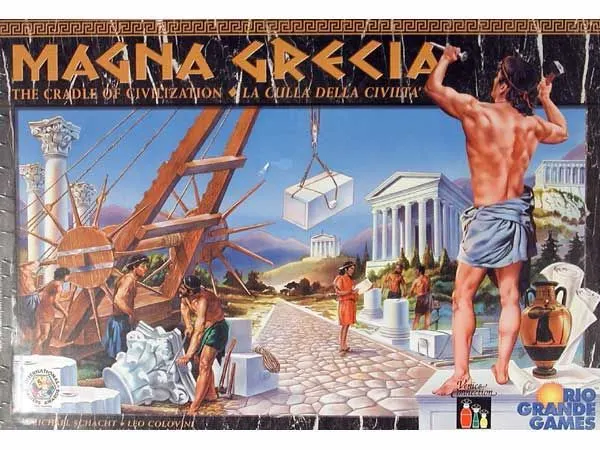
Magna Grecia es un juego de mesa publicado en 2003 para 2–4 jugadores, con partidas de 75 minutos y a partir de 12 años. Fue diseñado por Michael Schacht y Leo Colovini y sus mecánicas principales son Ownership, Tile Placement y Network and Route Building.


En inglés
From spielbox-online.de, translated via altavista babel fish (with a lot of manual tweaks): Magna Grecia (The cradle of the civilization) is the main attraction of the year with Clementoni. The game is a joint work of Leo Colovini and Michael Schacht. The southern region of Italy was called Magna Grecia and was settled 2,500 years ago by Greek merchants and adventurers. Before the arrival of the Greeks, the country was inhabited by only a few small tribes. Fruitful soil, navigable rivers, large forests, and bronze and silver mines offered enormous development possibilities. Larger cities developed, such as Tarantum, Syracuse, Katane, Locri, and Naxos. In addition, there were numerous villages of which no trace remains. A local road system promoted trade, and rich markets developed in the cities. More and more rivalries between the cities arose, particularly over control of the Oracle, which represented an important source for fame and wealth. Sufficient material for an evening of play. Each player must successfully settle and develop Magna Grecia. At favorable points, markets are built, villages are developed into cities and interconnected by a road system. Only thus may the interior be opened and the Oracle controlled. Constructing your own large city is often very expensive, and it is sometimes worthwhile to build instead in the neutral villages or opponents' cities. The board is covered with a hexagon grid on which pieces of road, towns, or markets are placed. A game is 12 rounds long. Each round is determined by an action map, which is set up at the beginning of play according to a certain pattern. The map specifies the player sequence and indicates to which extent the three basic actions (road construction, city building, and supply) may be used. There are also, of course, certain building rules to be considered. Additionally, markets can be established, the value of which depends on the number of connected locations. The Oracle is shown on the board. In order to control the Oracle, a player must connect one of his own cities to it by road. But if several cities are connected to an Oracle, the most important city takes precedence, determined by the number of locations connected to the city (not including Oracles). Markets and the Oracle determine when the game ends.
Según el catálogo, Magna Grecia admite de 2 a 4 jugadores. Este intervalo corresponde al número de jugadores indicado por la editorial, así que el juego puede prepararse para cualquier grupo dentro de ese margen. La preparación, algunas reglas y la puntuación pueden variar según el número de jugadores; consulta la configuración exacta en el reglamento de tu edición.
La duración indicada para Magna Grecia es de 75 minutos, la estimación de la editorial para una partida completa. El tiempo real depende del grupo, del número de jugadores y del conocimiento de las reglas: las primeras partidas suelen alargarse y los grupos con experiencia terminan antes. La preparación y la explicación de las reglas no están incluidas.
El catálogo indica Magna Grecia a partir de 12 años. Es la recomendación de la editorial y refleja la lectura necesaria, la complejidad de las reglas y las piezas pequeñas, no solo el tema. Los más pequeños a menudo pueden jugar con ayuda de un adulto: comprueba la edad recomendada en tu edición y la experiencia de tu grupo.
Magna Grecia tiene una puntuación de complejidad de 3,0 sobre 5 según los jugadores de BoardGameGeek, lo que lo convierte en un juego algo ligero. La puntuación refleja cuánto conocimiento de reglas, planificación y toma de decisiones exige una partida típica. Los juegos exigentes requieren una explicación inicial más larga, así que conviene usar una guía de preparación.
Magna Grecia pertenece a estas categorías: Territory Building y Ancient. Sus mecánicas principales son Ownership, Tile Placement y Network and Route Building. Las categorías describen el tema y la ambientación de un juego, mientras que las mecánicas describen lo que los jugadores hacen realmente en su turno. Cada mecánica lleva a una página del catálogo con juegos similares.
Los autores acreditados de Magna Grecia son: Michael Schacht y Leo Colovini. Estos créditos proceden de los datos publicados del juego y nombran a las personas responsables de su diseño, no a ilustradores ni editoriales. Las páginas de autor de MeepleRules reúnen otros títulos de los mismos autores, algo útil cuando un juego te gusta y buscas otros parecidos.
El catálogo clasifica Magna Grecia como juego base. Se juega por sí solo con los componentes de la caja y no requiere ningún otro título. Las expansiones, si existen, añaden contenido o reglas nuevas y aparecen por separado en el catálogo con un enlace a este juego base.