

- Puesto en BGG
- BGG #3399
- Puntuación BGG
- 6,8
Tao Long: The Way of the Dragon
- 2 jugadores
- 10–30 min
- Complejidad 2,7/5
- 2017
Ayuda con las reglas de Mangala
Explicaciones claras de turnos, efectos de cartas y situaciones dudosas, con referencias a fuentes oficiales e historial de preguntas guardado.
Para 2 jugadores
¿Qué quieres saber?
Las respuestas salen del reglamento oficial, con la página para comprobarlo.
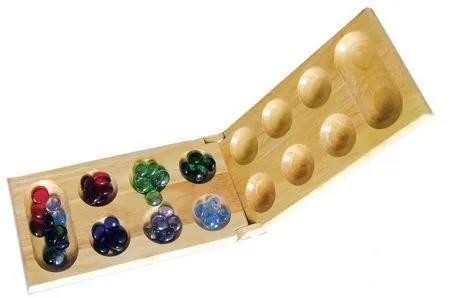
Mangala es un juego de mesa para 2 jugadores. Sus mecánicas principales son Mancala.







En inglés
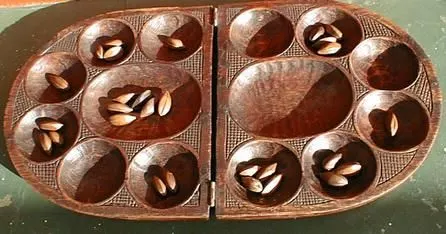
A mancala game. From Mancala World: http://mancala.wikia.com/wiki/Mangala_II "Mangala is a Turkish mancala game which was very popular in the 17th and 18th century. According to Metin And, a Turkish ethnologue, the game could be related to the "mancala" of The Arabian Nights (fifteenth night), one of the first literary accounts of mancala games. The game was depicted in Turkish paintings as early as in the 16th century. In Europe, it was first mentioned in 1694 by the English traveller Thomas Hyde. Mangala was also found by Edward Daniel Clarke in Balaklava, Crimea (now a suburb of Sevastopol) in 1801 and by Peter Emund Laurent on Chios Island (now Greece) in 1818. It might have influenced Mandoli (Hydra Island, Greece) and Ban-Ban (Bosnia). Mangala has almost the same rules as the Baltic German Bohnenspiel, which originated in Persia where it was known as Manqala or Manqalat. Two Ottoman Women playing Mangala (18th century) The classic Mangala is still known in Turkey. However, the Mangala played in Gaziantep in Southeast Anatolia is not related to it at all, but is a close variant of La'b madjnuni ("The Crazy Game"), which was played in Damascus (Syria) in the late 19th century. More games called "Mangala" (again with quite different rules) are popular among the Bedouins in Egypt. Mangala might be the first commercialized mancala game in a western country. A game called "mangola" (a common synonym for the Turkish Mangala at this time) was published by Jaques in England in 1863, after Walter Whitmore Jones claimed to have invented it. Jaques pattern book covering shows a thick wood board with two rows of six cells in which something like white beans are placed. The records of copyrights kept by the Stationers company, the Public Records Office at Kew, includes a volume covering 1862-64, which has an entry showing that the rules of Mangola were protected by copyright at that time. Richard Ballam, a board games collector, found an advertisement in the Illustrated London News (December 23, 1865) saying: "Mangola, a new game. By the author of Squails, Frogs & Toads etc. Wholesale Jaques & Son". Claiming foreign or nearly forgotten boardgames as own designs happens frequently in the game industry. (...) Rules Mangala is played on a board, which consists of 12 holes dug into the earth. Initially there are six glass beads ("boncuğu") or cowrie shells in each hole. On his turn a player distributes the contents of a hole, one by one, in a counter-clockwise direction into the succeeding holes. If the last bead falls in a hole on either side of the board, making a total of two, four or six beads including the last bead, its contents are captured. If this hole is preceded by other holes which contain two, four or six beads, their contents are also taken. A player must move if he can, but passes when his holes are empty. The game is finished when all holes are empty. The player who captured more beads wins the game."
Según el catálogo, Mangala admite 2 jugadores. Es el número de jugadores indicado por la editorial, así que el juego está diseñado exactamente para esa cantidad de participantes. Las variantes para otros tamaños de grupo, si existen, se describen en el reglamento de tu edición; consúltalo antes de preparar otra configuración.
Mangala tiene una puntuación de complejidad de 1,0 sobre 5 según los jugadores de BoardGameGeek, lo que lo convierte en un juego ligero. La puntuación refleja cuánto conocimiento de reglas, planificación y toma de decisiones exige una partida típica. Los juegos exigentes requieren una explicación inicial más larga, así que conviene usar una guía de preparación.
Mangala pertenece a estas categorías: Abstract Strategy. Sus mecánicas principales son Mancala. Las categorías describen el tema y la ambientación de un juego, mientras que las mecánicas describen lo que los jugadores hacen realmente en su turno. Cada mecánica lleva a una página del catálogo con juegos similares.
El catálogo clasifica Mangala como juego base. Se juega por sí solo con los componentes de la caja y no requiere ningún otro título. Las expansiones, si existen, añaden contenido o reglas nuevas y aparecen por separado en el catálogo con un enlace a este juego base.