

- Puesto en BGG
- BGG #13.103
- Puntuación BGG
- 7,2
NATO, Nukes & Nazis
- 2 jugadores
- 180 min
- Complejidad 3,8/5
- 1990
2012
Ayuda con las reglas de Operation Anaconda: Battle in Afghanistan, March 2002
Explicaciones claras de turnos, efectos de cartas y situaciones dudosas, con referencias a fuentes oficiales e historial de preguntas guardado.
¿Qué quieres saber?
Las respuestas salen del reglamento oficial, con la página para comprobarlo.
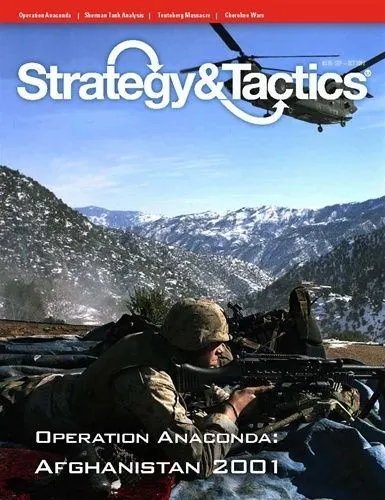
Operation Anaconda: Battle in Afghanistan, March 2002 es un juego de mesa publicado en 2012 para 1–2 jugadores y con partidas de 120 minutos. Fue diseñado por Joseph Miranda y sus mecánicas principales son Hexagon Grid.





En inglés
From the publisher' website: Operation Anaconda, the battle fought between Coalition forces and Al Qaeda in eastern Afghanistan in March of 2002. This battle was a combined US-Afghan-Coalition force attempt to surround and destroy Al Qaeda forces, but the operation fell apart owing to poor command control. While technically a Coalition victory, the battle demonstrated the strengths and weaknesses of both sides. The game system is based on the "Boots" system, which makes command-control the central feature of the design. Each player commands a combat force composed of one or more sub-commands. These sub-commands are maneuvered via picking Command Chits at random; When a Command Chit is picked, that sub-command is then activated. Since players do not know the order in which those Command Chits are picked, battles become chaotic fights as players strive to create and exploit opportunities. This is a two-player game, with one player commanding Coalition forces, and the other Al Qaeda. Combat in the game is quasi-tactical. Units fire at enemy targets at range. Additionally, the Coalition player has access to various types of fire support, such as airstrikes. However, owing to the chaotic nature of the battle, fire support as well as various reinforcements appear at random. The Al Qaeda player has the advantage of his units being deployed face down so that the Coalition player must use ISR (Intelligence-Surveillance-Reconnaissance) to reveal them. Game play becomes a tense contest between asymmetrical forces in the mountains of Afghanistan.
Según el catálogo, Operation Anaconda: Battle in Afghanistan, March 2002 admite de 1 a 2 jugadores. Este intervalo corresponde al número de jugadores indicado por la editorial, así que el juego puede prepararse para cualquier grupo dentro de ese margen. La preparación, algunas reglas y la puntuación pueden variar según el número de jugadores; consulta la configuración exacta en el reglamento de tu edición.
La duración indicada para Operation Anaconda: Battle in Afghanistan, March 2002 es de 120 minutos, la estimación de la editorial para una partida completa. El tiempo real depende del grupo, del número de jugadores y del conocimiento de las reglas: las primeras partidas suelen alargarse y los grupos con experiencia terminan antes. La preparación y la explicación de las reglas no están incluidas.
Operation Anaconda: Battle in Afghanistan, March 2002 tiene una puntuación de complejidad de 1,8 sobre 5 según los jugadores de BoardGameGeek, lo que lo convierte en un juego ligero. La puntuación refleja cuánto conocimiento de reglas, planificación y toma de decisiones exige una partida típica. Los juegos exigentes requieren una explicación inicial más larga, así que conviene usar una guía de preparación.
Operation Anaconda: Battle in Afghanistan, March 2002 pertenece a estas categorías: Wargame y Modern Warfare. Sus mecánicas principales son Hexagon Grid. Las categorías describen el tema y la ambientación de un juego, mientras que las mecánicas describen lo que los jugadores hacen realmente en su turno. Cada mecánica lleva a una página del catálogo con juegos similares.
Los autores acreditados de Operation Anaconda: Battle in Afghanistan, March 2002 son: Joseph Miranda. Estos créditos proceden de los datos publicados del juego y nombran a las personas responsables de su diseño, no a ilustradores ni editoriales. Las páginas de autor de MeepleRules reúnen otros títulos de los mismos autores, algo útil cuando un juego te gusta y buscas otros parecidos.
El catálogo clasifica Operation Anaconda: Battle in Afghanistan, March 2002 como juego base. Se juega por sí solo con los componentes de la caja y no requiere ningún otro título. Las expansiones, si existen, añaden contenido o reglas nuevas y aparecen por separado en el catálogo con un enlace a este juego base.