
- Puesto en BGG
- BGG #6376
- Puntuación BGG
- 8,1
Halo: Flashpoint
- 2 jugadores
- 30–90 min
- Complejidad 2,9/5
- 2024
2017
Ayuda con las reglas de Paco Ŝako
Explicaciones claras de turnos, efectos de cartas y situaciones dudosas, con referencias a fuentes oficiales e historial de preguntas guardado.
Para 2 jugadores
¿Qué quieres saber?
Las respuestas salen del reglamento oficial, con la página para comprobarlo.
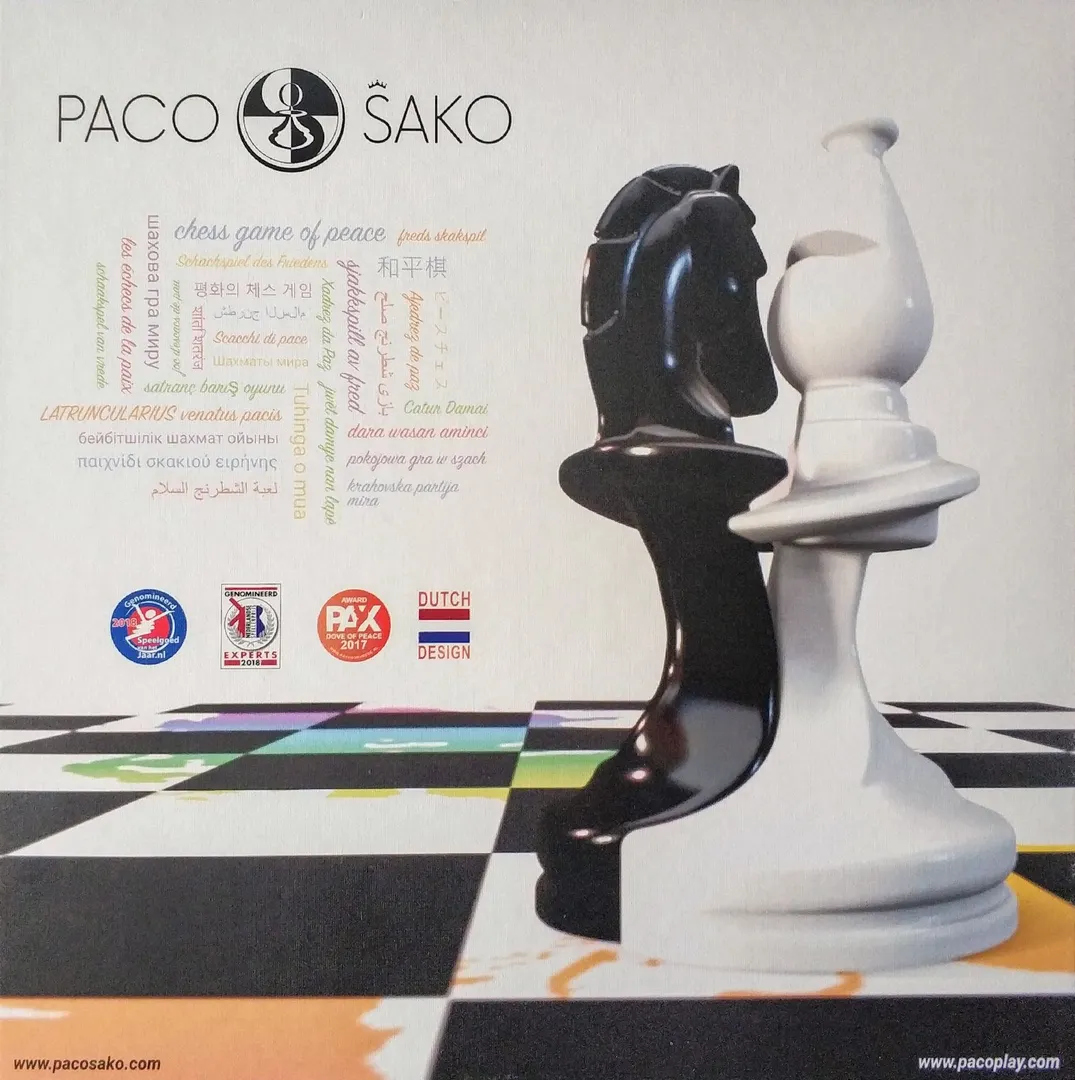
Paco Ŝako es un juego de mesa publicado en 2017 para 2 jugadores, con partidas de 15 a 60 minutos y a partir de 4 años. Fue diseñado por Felix Albers y sus mecánicas principales son Area Majority / Influence, Square Grid y Moving Multiple Units.



En inglés
Paco Ŝako (Esperanto words for "peace chess": pronounce "PAH-tso SHAH-ko" = /'pat͡so 'ʃako/ IPA) is a form of chess created to be an expression of peace, friendship and collaboration. The aim is to find, through strategic gameplay, a way to "embrace" the other player's king. The game represents a constructive conversation or development in which the two sides merge their knowledge, ideas, and strength. During the game, both players try to bring forward good or ever better ideas than the other player by moving their chess pieces around. For both players, the aim is to stand strong for your knowledge, ideas and strength, but you will be open to receive input from the other player when it is their turn. Making the last move and bringing one of your pieces into a union with the other player's King will make you win the game. Paco Ŝako is played on the same board and with the same chess pieces as traditional/classic chess, though the Paco Ŝako chess pieces have a different functionality. Black and white pieces can be merged into a union and can stay together on one square. Because there are no pieces taken, all pieces stay on the board during the game. Once unions are created, both players can still move them; you can take over a union and release your piece out of a union by replacing it with another piece and eventually there is the chain reaction, which really brings out the Paco Ŝako gameplay. Taking over unions and releasing pieces mean you may move several pieces in one turn. The game is very much focused on patterns and creativity, not on piece advantage. The nice thing about this is that both players stay in the game until the last move is made. There can be created an advantage in position and games can be fast because of the dynamics and physical patterns in which several pieces can be moved in one go. When the game develops into an endgame with a lot of unions, there will be a high energy on the board with lots of possibilities, chains and creative options, and often both players will get closer to making the final move. Sometimes it is about having momentum and holding it.
Según el catálogo, Paco Ŝako admite 2 jugadores. Es el número de jugadores indicado por la editorial, así que el juego está diseñado exactamente para esa cantidad de participantes. Las variantes para otros tamaños de grupo, si existen, se describen en el reglamento de tu edición; consúltalo antes de preparar otra configuración.
La duración indicada para Paco Ŝako es de 15 a 60 minutos, la estimación de la editorial para una partida completa. El tiempo real depende del grupo, del número de jugadores y del conocimiento de las reglas: las primeras partidas suelen alargarse y los grupos con experiencia terminan antes. La preparación y la explicación de las reglas no están incluidas.
El catálogo indica Paco Ŝako a partir de 4 años. Es la recomendación de la editorial y refleja la lectura necesaria, la complejidad de las reglas y las piezas pequeñas, no solo el tema. Los más pequeños a menudo pueden jugar con ayuda de un adulto: comprueba la edad recomendada en tu edición y la experiencia de tu grupo.
Paco Ŝako tiene una puntuación de complejidad de 2,9 sobre 5 según los jugadores de BoardGameGeek, lo que lo convierte en un juego algo ligero. La puntuación refleja cuánto conocimiento de reglas, planificación y toma de decisiones exige una partida típica. Los juegos exigentes requieren una explicación inicial más larga, así que conviene usar una guía de preparación.
Paco Ŝako pertenece a estas categorías: Abstract Strategy. Sus mecánicas principales son Area Majority / Influence, Square Grid y Moving Multiple Units. Las categorías describen el tema y la ambientación de un juego, mientras que las mecánicas describen lo que los jugadores hacen realmente en su turno. Cada mecánica lleva a una página del catálogo con juegos similares.
Los autores acreditados de Paco Ŝako son: Felix Albers. Estos créditos proceden de los datos publicados del juego y nombran a las personas responsables de su diseño, no a ilustradores ni editoriales. Las páginas de autor de MeepleRules reúnen otros títulos de los mismos autores, algo útil cuando un juego te gusta y buscas otros parecidos.
El catálogo clasifica Paco Ŝako como juego base. Se juega por sí solo con los componentes de la caja y no requiere ningún otro título. Las expansiones, si existen, añaden contenido o reglas nuevas y aparecen por separado en el catálogo con un enlace a este juego base.