
- Puesto en BGG
- BGG #6107
- Puntuación BGG
- 8,4
Arracourt
- 2 jugadores
- 120 min
- Complejidad 3,9/5
- 2022
2021
Ayuda con las reglas de Panzers Last Stand: Battles for Budapest, 1945
Explicaciones claras de turnos, efectos de cartas y situaciones dudosas, con referencias a fuentes oficiales e historial de preguntas guardado.
Para 2 jugadores
¿Qué quieres saber?
Las respuestas salen del reglamento oficial, con la página para comprobarlo.
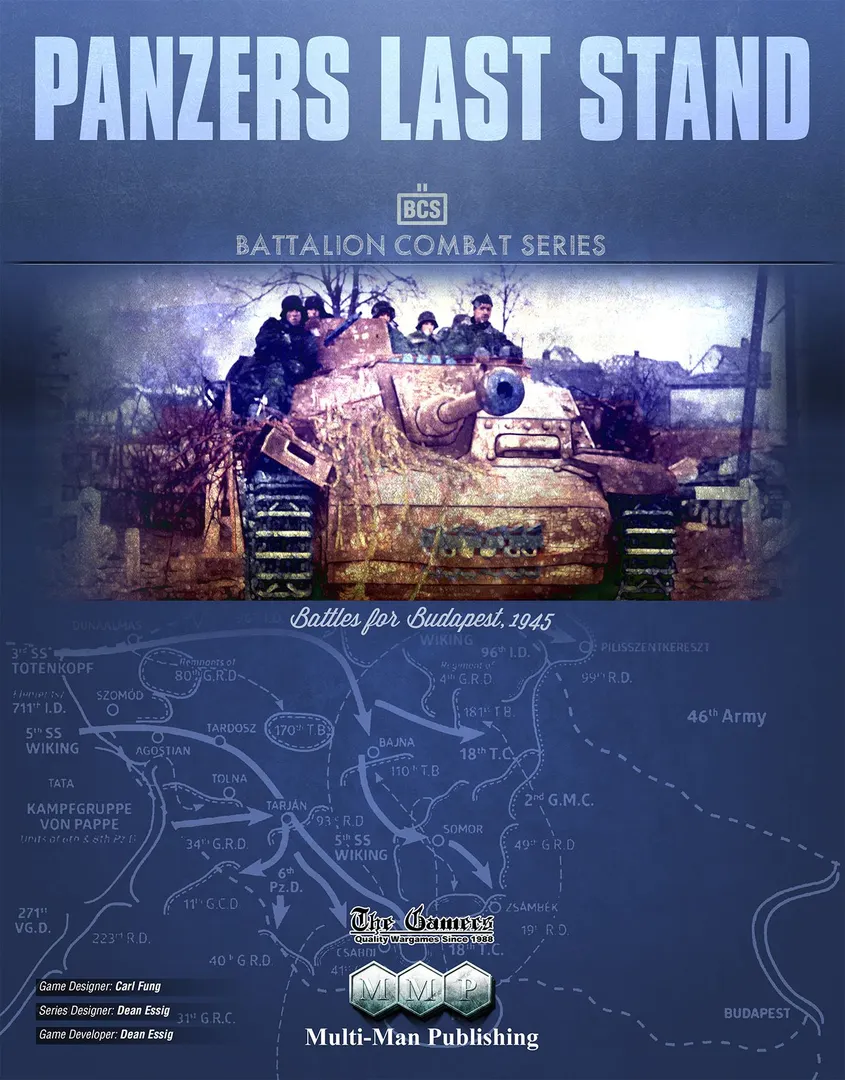
Panzers Last Stand: Battles for Budapest, 1945 es un juego de mesa publicado en 2021 para 2 jugadores y con partidas de 120 a 1560 minutos. Fue diseñado por Dean Essig y Carl Fung y sus mecánicas principales son Dice Rolling, Hexagon Grid y Simulation.





En inglés
Panzers Last Stand is a Battalion Combat Series game depicting the Axis relief operations of Budapest from January to March 1945 in what became Germany's last major offensives in the war. The campaign game covers the Konrad Operations (I, II, and III) in January 1945. There are scenarios for each of the Konrad Operations as well as Operation Southwind in February and Operation Spring Awakening in March 1945. In the final months of the war, Germany was still full of fight and believed Budapest to be the key to turning the tide. With Budapest fully surrounded by Soviet and former-Axis Romanian forces, the situation in the city was desperate. The Germans devised a plan to relieve Budapest by bringing in the SS-Totenkopf and SS-Wiking Panzer Divisions from Poland to launch a surprise attack before the Soviets closed the ring on the trapped forces in the city. Launched in the wee hours on New Year's Day, 1945, the fate of the Axis hung in the balance. The Soviets, having campaigned continuously from the summer of 1944, fought back viciously and showed their mettle against the elite SS Panzer Divisions. A great proportion of the armored forces for both sides funneled into the Budapest area. All but one of the seven SS Panzer Divisions and half of the Heer Panzer Divisions on the Eastern Front (a full third of all Panzer Divisions total) ultimately fought here. The Soviets committed three Tank, five Mechanized, and one Cavalry Corps to blunt the Axis drive. The battlefield became a graveyard of tanks. The game showcases late-war equipment like the Tiger II, Brummbär, IS-2, and ISU-152 while also including unique units like Cavalry, Assault Pioneers, Soviet Naval Infantry, Hungarian SS, and ad hoc forces mobilized to defend Budapest. Rules covering Danube River crossing, Urban combat, redeployment deception (Maskirovka), and Festung rules highlight this unique and often misunderstood campaign. Scenarios: The Taking of Budapest 123: Full Campaign (4 maps, 26 turns) Operation Konrad I & II (2 maps without Budapest, 10 turns) Operation Konrad I (2 maps without Budapest, 5 turns) Operation Konrad II (1 map without Budapest, 5 turns) Battle for Zamoly (Part of 1 map, 5 turns) Operation Konrad III (2 maps, 10 turns) Battle for Komárom (Part of 2 maps, 17 turns) Days of Battle: Opening Blows to Komárom (Part of 2 maps, 4 turns) Operation Southwind (Part of 2 maps, 8 turns) Operation Spring Awakening (2 maps, 10 turns) Components: BCS rulebook (v2.0, in full color) Two BCS Charts and Tables (v2.0, in full color) BCS Support rulebook (v2.0, in full color) PLS Game Specific rulebook Axis Player Booklet Soviet Player Booklet Turn Record Track Card Axis Player Display Card Soviet Player Display Card Last Blitzkrieg Addenda sheet Four 22” x 34” Full Color Game Maps 1,680 Counters (four sheets of units and two BCS marker sheets) 10 scenarios total, 2 one-map scenarios, 4 are 5 turns or less Box and Dice —description from the publisher
Según el catálogo, Panzers Last Stand: Battles for Budapest, 1945 admite 2 jugadores. Es el número de jugadores indicado por la editorial, así que el juego está diseñado exactamente para esa cantidad de participantes. Las variantes para otros tamaños de grupo, si existen, se describen en el reglamento de tu edición; consúltalo antes de preparar otra configuración.
La duración indicada para Panzers Last Stand: Battles for Budapest, 1945 es de 120 a 1560 minutos, la estimación de la editorial para una partida completa. El tiempo real depende del grupo, del número de jugadores y del conocimiento de las reglas: las primeras partidas suelen alargarse y los grupos con experiencia terminan antes. La preparación y la explicación de las reglas no están incluidas.
Panzers Last Stand: Battles for Budapest, 1945 tiene una puntuación de complejidad de 3,9 sobre 5 según los jugadores de BoardGameGeek, lo que lo convierte en un juego exigente. La puntuación refleja cuánto conocimiento de reglas, planificación y toma de decisiones exige una partida típica. Los juegos exigentes requieren una explicación inicial más larga, así que conviene usar una guía de preparación.
Panzers Last Stand: Battles for Budapest, 1945 pertenece a estas categorías: Wargame y World War II. Sus mecánicas principales son Dice Rolling, Hexagon Grid y Simulation. Las categorías describen el tema y la ambientación de un juego, mientras que las mecánicas describen lo que los jugadores hacen realmente en su turno. Cada mecánica lleva a una página del catálogo con juegos similares.
Los autores acreditados de Panzers Last Stand: Battles for Budapest, 1945 son: Dean Essig y Carl Fung. Estos créditos proceden de los datos publicados del juego y nombran a las personas responsables de su diseño, no a ilustradores ni editoriales. Las páginas de autor de MeepleRules reúnen otros títulos de los mismos autores, algo útil cuando un juego te gusta y buscas otros parecidos.
El catálogo clasifica Panzers Last Stand: Battles for Budapest, 1945 como juego base. Se juega por sí solo con los componentes de la caja y no requiere ningún otro título. Las expansiones, si existen, añaden contenido o reglas nuevas y aparecen por separado en el catálogo con un enlace a este juego base.