
- Puesto en BGG
- BGG #7414
- Puntuación BGG
- 8,2
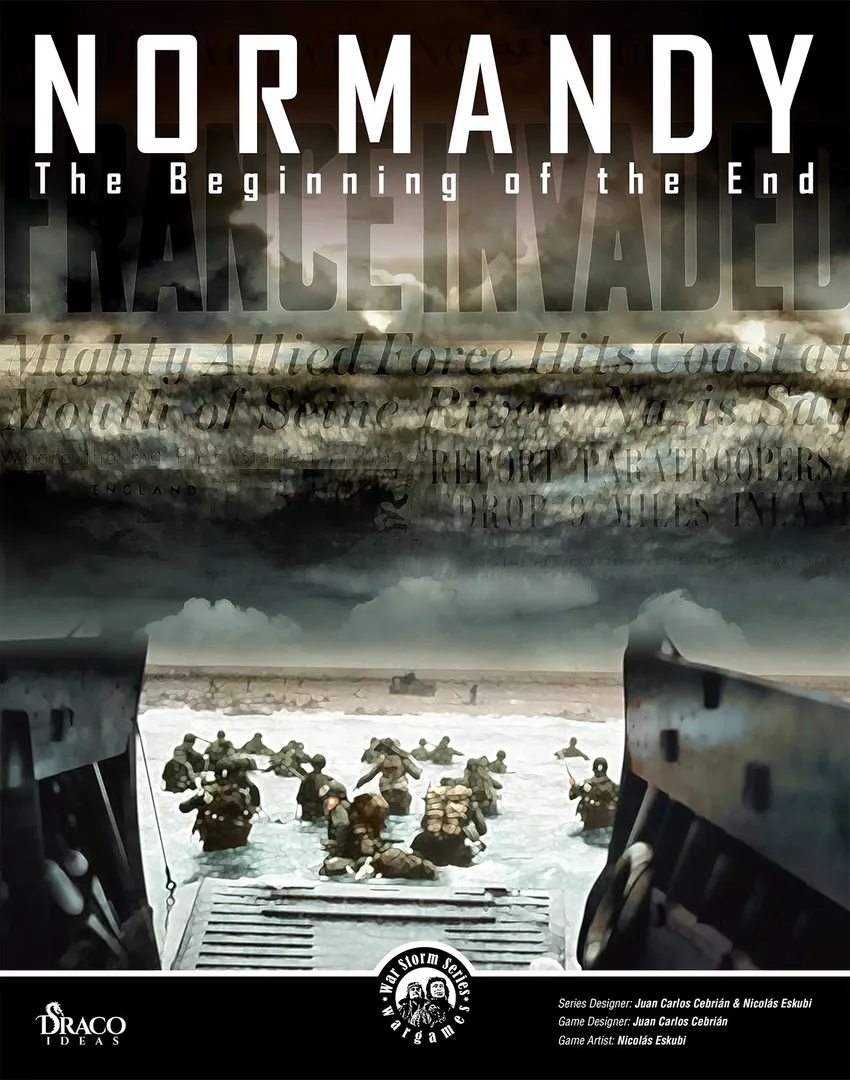
Normandy: The Beginning of the End
- 2 jugadores
- 60–120 min
- Complejidad 3,9/5
- 2018
2016
Ayuda con las reglas de Paths to Hell: Operation Barbarossa, June – December 1941
Explicaciones claras de turnos, efectos de cartas y situaciones dudosas, con referencias a fuentes oficiales e historial de preguntas guardado.
Para 1 jugador
¿Qué quieres saber?
Las respuestas salen del reglamento oficial, con la página para comprobarlo.
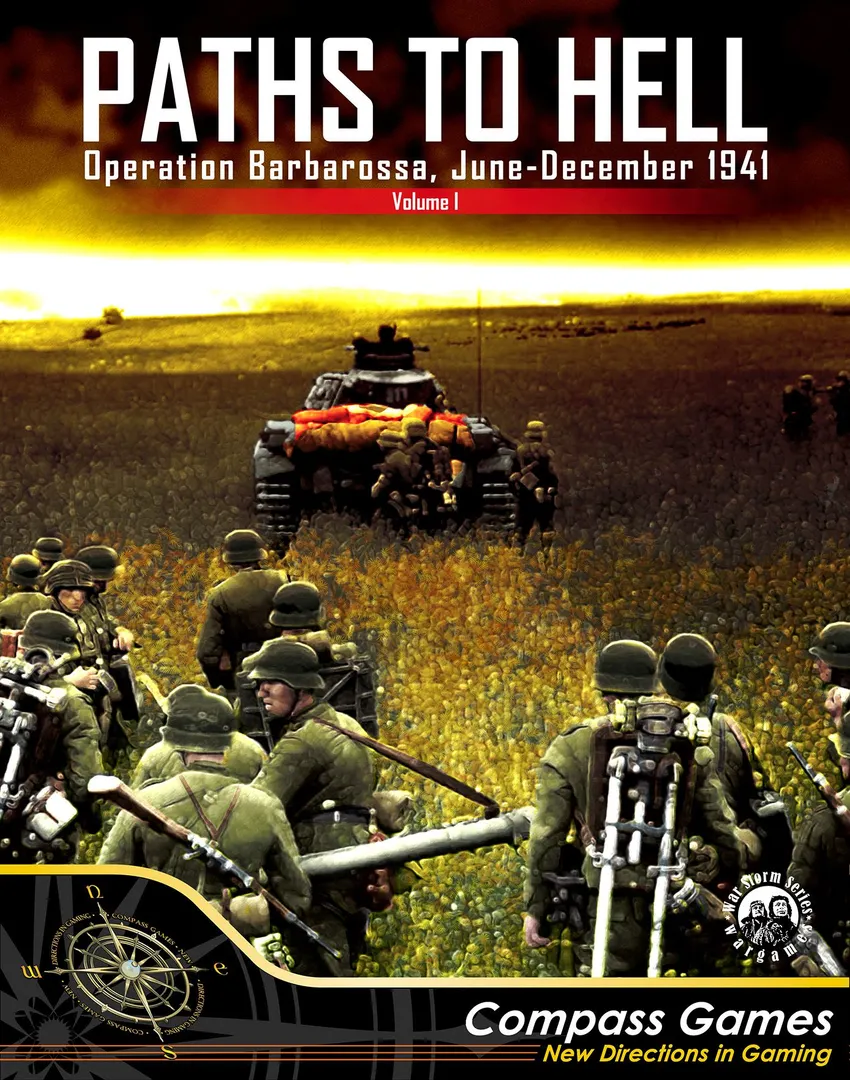
Paths to Hell: Operation Barbarossa, June – December 1941 es un juego de mesa publicado en 2016 para 1–2 jugadores. Fue diseñado por Juan Carlos Cebrián y Nicolás Eskubi y sus mecánicas principales son Dice Rolling, Hexagon Grid y Simulation.



En inglés
Paths to Hell (PTH) (Volume III) is a stand-alone game in the War Storms series (WSS). Recreates the events of those days and allows the players to reproduce the most famous battles of the Blitzkrieg on the East Front at a tactical level. Players take command of either the Allied or Axis forces (or can play solitaire) in the tactical battles of each scenario. PTH while utilizing "La Bataille de France, 1940" base rules, incorporates new and adapted rules and additions for this new front. The WSS promises many hours of fierce fighting between the infantry, tanks, artillery and aircraft belonging to the armies enveloped in this conflict. Just a few of the additions include: Human wave attacks Battalion officers Communist Commissars Recon rules Flamethrower tanks Motorcycle recon Waffen SS Rumnanian Gully Rail Roads One 8'5 x 11" chart with many overlays PTH has a moderate complexity with good solitaire suitability. The system emphasizes the role of officers. Officers can activate units, coordinate with other officers and their units, call for artillery support, air support, smoke screens, influence moral checks, coordinate assaults, and much more. Rules for special actions. Based on the principle of simultaneous execution, or simply "WE GO", a hybrid system of turns and "real time". The players must activate unit leaders to perform many actions (fire, assault, move, coordinate, etc). A turn ends when both players have completed all their activations. The scale is platoon level with units representing groups of between 30 and 40 soldiers, weapons units represents groups of 3-4 weapons and their accompanying crews (20-25 soldiers), and the AFVs/Transports representing groups of 3 to 5 vehicles and their corresponding crews. Scenarios are divided into turns representing about 12-15 minutes of action. Turns are divided into the following phases: Command Phase, Initiative Phase, Activation Phase and Marker Removal Phase The game uses isomorphic mapboards, each of which can align to any edge of equal length on any other mapboard. This allows for an almost unlimited number of combinations to create any terrain situation, including player designed scenarios. Each map hex represents a distance of approximately 150 to 200 metres. Components 4 Isomorphic Maps 8 Overlays 5 sheets of Counters (3 of 5/8” and 2 of 3/4”) 1 Standard Rulebook 1 Exclusive Rulebook 7 Scenario Cards featuring 13 scenarios 3 Charts and Table Cards 2 Battalion Charts Cards 2 six-side dice
Según el catálogo, Paths to Hell: Operation Barbarossa, June – December 1941 admite de 1 a 2 jugadores. Este intervalo corresponde al número de jugadores indicado por la editorial, así que el juego puede prepararse para cualquier grupo dentro de ese margen. La preparación, algunas reglas y la puntuación pueden variar según el número de jugadores; consulta la configuración exacta en el reglamento de tu edición.
Paths to Hell: Operation Barbarossa, June – December 1941 tiene una puntuación de complejidad de 3,4 sobre 5 según los jugadores de BoardGameGeek, lo que lo convierte en un juego de complejidad media. La puntuación refleja cuánto conocimiento de reglas, planificación y toma de decisiones exige una partida típica. Los juegos exigentes requieren una explicación inicial más larga, así que conviene usar una guía de preparación.
Paths to Hell: Operation Barbarossa, June – December 1941 pertenece a estas categorías: Wargame y World War II. Sus mecánicas principales son Dice Rolling, Hexagon Grid y Simulation. Las categorías describen el tema y la ambientación de un juego, mientras que las mecánicas describen lo que los jugadores hacen realmente en su turno. Cada mecánica lleva a una página del catálogo con juegos similares.
Los autores acreditados de Paths to Hell: Operation Barbarossa, June – December 1941 son: Juan Carlos Cebrián y Nicolás Eskubi. Estos créditos proceden de los datos publicados del juego y nombran a las personas responsables de su diseño, no a ilustradores ni editoriales. Las páginas de autor de MeepleRules reúnen otros títulos de los mismos autores, algo útil cuando un juego te gusta y buscas otros parecidos.
El catálogo clasifica Paths to Hell: Operation Barbarossa, June – December 1941 como juego base. Se juega por sí solo con los componentes de la caja y no requiere ningún otro título. Las expansiones, si existen, añaden contenido o reglas nuevas y aparecen por separado en el catálogo con un enlace a este juego base.