
- Puntuación BGG
- 6,1
Pick-a-Polar Bear: Pig and Dog Expansion
- 1–5 jugadores
- 15 min
- 2013
2013
Ayuda con las reglas de Pick-a-Polar Bear
Explicaciones claras de turnos, efectos de cartas y situaciones dudosas, con referencias a fuentes oficiales e historial de preguntas guardado.
Para 1 jugador
¿Qué quieres saber?
Las respuestas salen del reglamento oficial, con la página para comprobarlo.
Pick-a-Polar Bear es un juego de mesa publicado en 2013 para 1–5 jugadores, con partidas de 10 a 15 minutos y a partir de 8 años. Fue diseñado por Torsten Landsvogt y sus mecánicas principales son Pattern Recognition.









En inglés
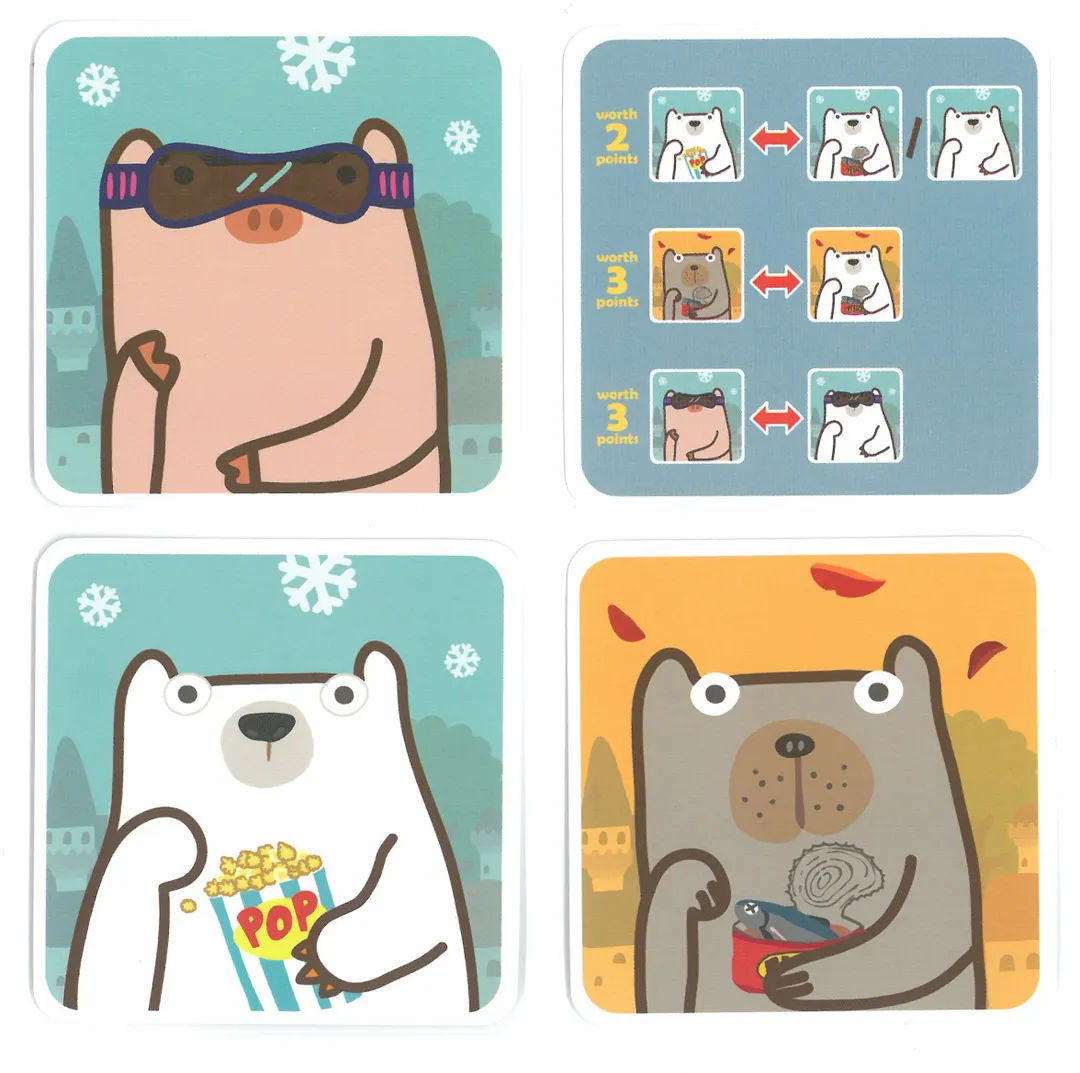
"Pick-a-Seal!" may combine with "Pick-a-Polar Bear!" for up to 8 players. Pick-a-Seal will be launched in Essen 2014. The nanuks are determined not to be sitting "bears" due to global warming. Sourcing a supply of canned fish may be a way to survive the diminishing sea ice — and if nothing else, it gives them a good reason to travel all the way from the North Pole to Germany to party down with their doggie friends there! Pick-a-Polar Bear, first published as Formissimo, features the same gameplay as Pick-a-Dog but with two new variants! To set up the basic game, lay out 30 cards in a grid and give one card face down to each player. Each card has five attributes, with each attribute having two states: large/small, with/without a raised arm, orange autumn/blue winter background, with/without goggles, and with/without canned fish. Someone shouts "Go!", then everyone looks at their card in hand. Players then start grabbing cards from the grid and stacking them in hand. The card grabbed must be identical to the top card in hand or differ from that top card in only one way. Thus, as you grab cards, the attributes of that top card will keep changing, forcing you to look for matches in new ways. Once a player thinks he can't grab any more cards, he yells "Stop!" The round ends, and all players check their card stacks. If someone made a mistake when grabbing cards, that player keeps none of the cards gathered that round. If the player who stopped the round made no mistakes, he earns an extra card. If, however, he stopped the round when he could have collected more cards, then he loses all the cards he's collected during this round. To set up for the next round, give each player a new face-down card and fill in the holes in the grid. When the deck runs out, complete that round, after which the game ends. Whoever has collected the most cards wins! Pick-a-Polar Bear includes two game variants. In the first, the player who has obtained the most cards in the preceding round cannot grab a card that's identical to his top card in the current round. For the second variant, shuffle eight "bonus round" cards into the deck. If when laying out the cards in the grid, the dealer reveals the back of a bonus round card when at least ten cards are on the table, everyone prepares for the bonus round. The dealer reveals this card, which shows two card elements such as upraised arm and goggles, and everyone races to yell out how many cards in the grid feature these two elements. Whoever yells out the correct answer first receives the bonus round card, which is worth 2 points; whoever yells out the wrong answer takes a -2 point penalty card. The dealer then continues filling the grid. (If the grid contains fewer than ten cards when a bonus round card comes up in the deck, discard this card and continue to fill the grid.)
Según el catálogo, Pick-a-Polar Bear admite de 1 a 5 jugadores. Este intervalo corresponde al número de jugadores indicado por la editorial, así que el juego puede prepararse para cualquier grupo dentro de ese margen. La preparación, algunas reglas y la puntuación pueden variar según el número de jugadores; consulta la configuración exacta en el reglamento de tu edición.
La duración indicada para Pick-a-Polar Bear es de 10 a 15 minutos, la estimación de la editorial para una partida completa. El tiempo real depende del grupo, del número de jugadores y del conocimiento de las reglas: las primeras partidas suelen alargarse y los grupos con experiencia terminan antes. La preparación y la explicación de las reglas no están incluidas.
El catálogo indica Pick-a-Polar Bear a partir de 8 años. Es la recomendación de la editorial y refleja la lectura necesaria, la complejidad de las reglas y las piezas pequeñas, no solo el tema. Los más pequeños a menudo pueden jugar con ayuda de un adulto: comprueba la edad recomendada en tu edición y la experiencia de tu grupo.
Pick-a-Polar Bear tiene una puntuación de complejidad de 1,0 sobre 5 según los jugadores de BoardGameGeek, lo que lo convierte en un juego ligero. La puntuación refleja cuánto conocimiento de reglas, planificación y toma de decisiones exige una partida típica. Los juegos exigentes requieren una explicación inicial más larga, así que conviene usar una guía de preparación.
Pick-a-Polar Bear pertenece a estas categorías: Card Game, Animals y Party Game. Sus mecánicas principales son Pattern Recognition. Las categorías describen el tema y la ambientación de un juego, mientras que las mecánicas describen lo que los jugadores hacen realmente en su turno. Cada mecánica lleva a una página del catálogo con juegos similares.
Los autores acreditados de Pick-a-Polar Bear son: Torsten Landsvogt. Estos créditos proceden de los datos publicados del juego y nombran a las personas responsables de su diseño, no a ilustradores ni editoriales. Las páginas de autor de MeepleRules reúnen otros títulos de los mismos autores, algo útil cuando un juego te gusta y buscas otros parecidos.
El catálogo clasifica Pick-a-Polar Bear como juego base. Se juega por sí solo con los componentes de la caja y no requiere ningún otro título. Las expansiones, si existen, añaden contenido o reglas nuevas y aparecen por separado en el catálogo con un enlace a este juego base.