
- Puesto en BGG
- BGG #6221
- Puntuación BGG
- 7,8
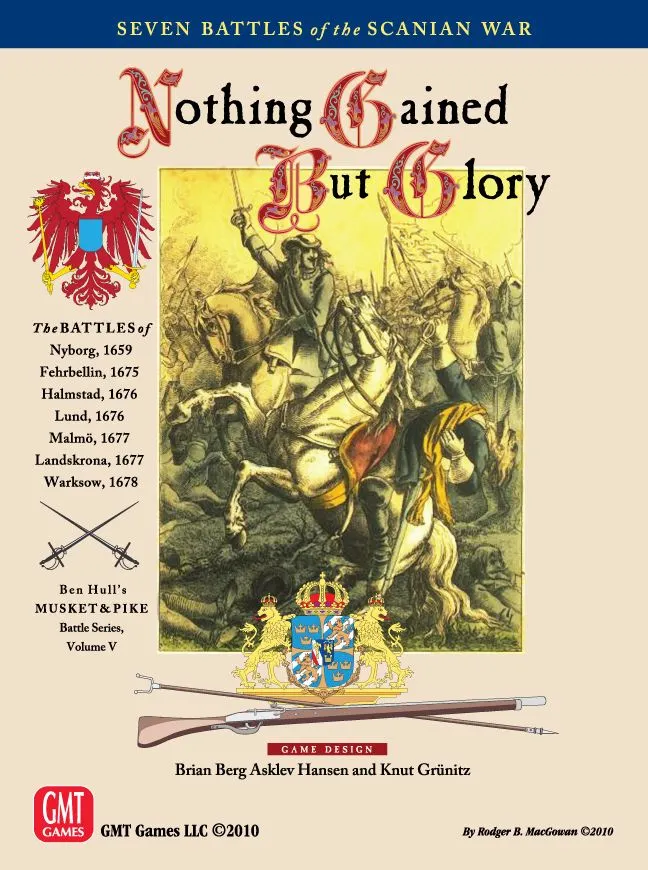
Nothing Gained But Glory
- 2 jugadores
- 300 min
- Complejidad 3,7/5
- 2010
2012
Ayuda con las reglas de Saints in Armor
Explicaciones claras de turnos, efectos de cartas y situaciones dudosas, con referencias a fuentes oficiales e historial de preguntas guardado.
Para 2 jugadores
¿Qué quieres saber?
Las respuestas salen del reglamento oficial, con la página para comprobarlo.
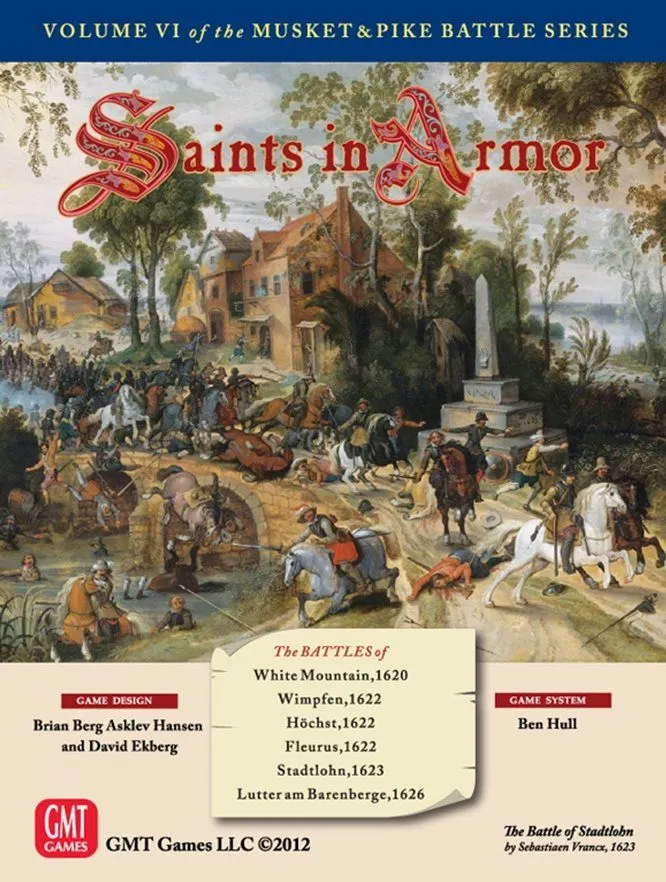
Saints in Armor es un juego de mesa publicado en 2012 para 2 jugadores, con partidas de 300 minutos y a partir de 14 años. Fue diseñado por Brian Asklev y David Ekberg y sus mecánicas principales son Hexagon Grid y Simulation.




En inglés
The Bohemian Revolt of 1618 triggered the Thirty Years War and in the early period of the war the Catholic/Imperial cause enjoyed an almost unbroken string of victories. This game, part of the Musket and Pike Battle Series, simulates six battles of the early Thirty Years War. In the period covered, the armies deployed in more compact formations so each battle fits on half of a standard map. The battles covered in this game are: White Mountain November, 1620 The combined army of the Holy Roman Empire and the Catholic League under Johann Tserclaes, the Count of Tilly, strike a blow directly at the Bohemian capital of Prague. The Bohemians make a stand on the slopes of White Mountain outside the town. Their Transylvanian allies desert them at the most critical point of the battle, causing the total collapse of the Bohemian army and its cause. This is a short scenario where the qualitatively superior Catholic forces must crush the strongly positioned Bohemians who are bolstered by a large Transylvanian contingent of questionable reliability. Wimpfen May, 1622 Tilly joins forces with the Spanish under Cordoba. Together they pursue the smaller army of the Markgraf of Baden-Durlach. They catch his army near the town of Wimpfen, where it is drawn up in a defensive position in a river bend. The Badian camp is fortified in a special traditional way with Spießwagen ("pikewagons"), mobile barricades equipped with sharp poles and small mortars. Only when a powder wagon detonates in the midst of the Protestant position, scattering the defenders, the Catholics are able to storm the wagonburg and heavy fighting breaks out. A balanced pitched battle. A larger Catholic army tries to defeat a Protestant army that is not only protected by a wagonburg but also possesses a strong cavalry force for counterattacks. Höchst June, 1622 The Bavarians under Tilly catch the forces of the zealous Protestant Duke Christian as they try to cross the river Main. To protect the crossing, Christian makes a stand at a stream. At first Tilly hesitates, but eventually the Bavarians attack and the Protestant army dissolves in a chaotic retreat. A rearguard situation, where the Protestants must delay the Catholics while simultaneously trying to retreat the majority of their army to safety. Fleurus August, 1622 Defeated and demoralized, the combined forces of the condottiere Mansfeld and Duke Christian try to escape the German theater and enter the service of the United Provinces instead. Cordoba's Spanish army blocks them at Fleurus in what is today Belgium. The unpaid and mutinous Protestants attack at dawn in an attempt to break through. In a vicious five-hour fight, the Spanish hold, but enough Protestants break through to force the Spanish to lift an important siege in the Netherlands. This is a smaller pitched battle where a large but very unreliable Protestant army attempts to overwhelm the smaller but more experienced Spanish army. This battle is suitable as an introduction to the game system. Stadtlohn August, 1623 Following the battle of Fleurus, Duke Christian again rebuilds an army with raw recruits to join with Mansfeld in the Netherlands and renew the fight for the Protestant cause. However, he soon finds himself outlawed by the Imperor, unsupported and forced to retreat when Tilly's veteran army bears down on him. The Protestan army, slowed by a massive baggage train attempts a last stand and finds itself caught by Tilly's vanguard when within sight of the Dutch border. True to form, Christian decides to risk his army to save his baggage train, but ends up losing both. A race-against-the-clock rearguard situation where the focus is on the fate of the Protestant baggage train that is slowly moving towards the map edge. Lutter am Barenberge August, 1626 The Danish King Christian IV intervenes in the Thirty Years War and pushes Tilly back during the early summer. However, he finds himself outnumbered and on the defensive when Tilly is reinforced by Imperial troops. Christian decides to turn on his pursuers and gives battle in a strong defensive position at Lutter am Barenberge. The initial Catholic attacks are repulsed, but the subsequent uncontrolled Danish counterattack results in the eventual collapse of the Danish army. This is also a rearguard battle, but with more evenly matched armies, though the Danes are severely hampered by an unusual command situation. In addition to scenario specific special rules that highlight the unique events of each battle, the battles in the game all share a simple set of special rules. These rules show the peculiarities of the early years of the Thirty Years War, such as Croat/Transylvanian style light cavalry. Even though not all of the battles included were equal contests in military terms, the player victory conditions are balanced. Along with the special rules, that means the battles are interesting for both sides.
Según el catálogo, Saints in Armor admite 2 jugadores. Es el número de jugadores indicado por la editorial, así que el juego está diseñado exactamente para esa cantidad de participantes. Las variantes para otros tamaños de grupo, si existen, se describen en el reglamento de tu edición; consúltalo antes de preparar otra configuración.
La duración indicada para Saints in Armor es de 300 minutos, la estimación de la editorial para una partida completa. El tiempo real depende del grupo, del número de jugadores y del conocimiento de las reglas: las primeras partidas suelen alargarse y los grupos con experiencia terminan antes. La preparación y la explicación de las reglas no están incluidas.
El catálogo indica Saints in Armor a partir de 14 años. Es la recomendación de la editorial y refleja la lectura necesaria, la complejidad de las reglas y las piezas pequeñas, no solo el tema. Los más pequeños a menudo pueden jugar con ayuda de un adulto: comprueba la edad recomendada en tu edición y la experiencia de tu grupo.
Saints in Armor tiene una puntuación de complejidad de 3,6 sobre 5 según los jugadores de BoardGameGeek, lo que lo convierte en un juego de complejidad media. La puntuación refleja cuánto conocimiento de reglas, planificación y toma de decisiones exige una partida típica. Los juegos exigentes requieren una explicación inicial más larga, así que conviene usar una guía de preparación.
Saints in Armor pertenece a estas categorías: Wargame y Pike and Shot. Sus mecánicas principales son Hexagon Grid y Simulation. Las categorías describen el tema y la ambientación de un juego, mientras que las mecánicas describen lo que los jugadores hacen realmente en su turno. Cada mecánica lleva a una página del catálogo con juegos similares.
Los autores acreditados de Saints in Armor son: Brian Asklev y David Ekberg. Estos créditos proceden de los datos publicados del juego y nombran a las personas responsables de su diseño, no a ilustradores ni editoriales. Las páginas de autor de MeepleRules reúnen otros títulos de los mismos autores, algo útil cuando un juego te gusta y buscas otros parecidos.
El catálogo clasifica Saints in Armor como juego base. Se juega por sí solo con los componentes de la caja y no requiere ningún otro título. Las expansiones, si existen, añaden contenido o reglas nuevas y aparecen por separado en el catálogo con un enlace a este juego base.