

- Puesto en BGG
- BGG #24.446
- Puntuación BGG
- 6,1
Cloak & Dagger
- 2–4 jugadores
- 30–60 min
- Complejidad 1,6/5
- 1984
2019
Ayuda con las reglas de Secret Night at Davis Manor
Explicaciones claras de turnos, efectos de cartas y situaciones dudosas, con referencias a fuentes oficiales e historial de preguntas guardado.
¿Qué quieres saber?
Las respuestas salen del reglamento oficial, con la página para comprobarlo.
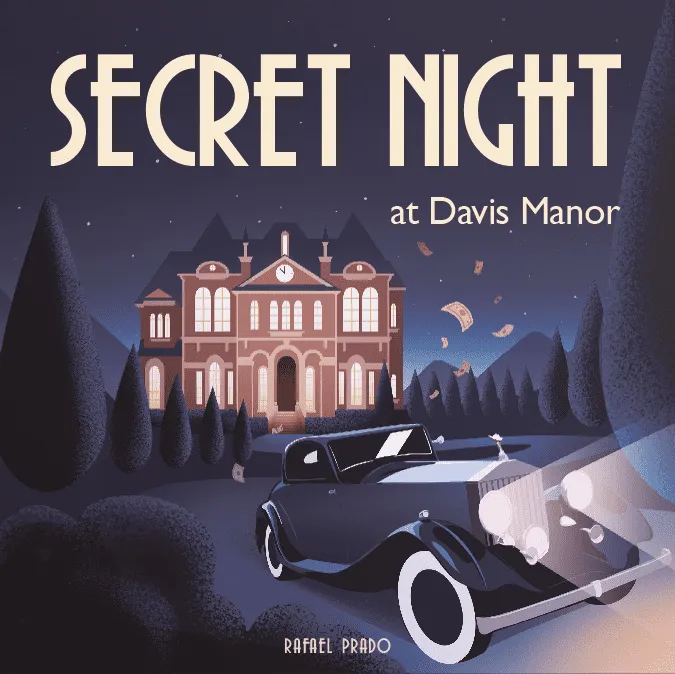
Secret Night at Davis Manor es un juego de mesa publicado en 2019 para 4–8 jugadores, con partidas de 60 a 120 minutos y a partir de 12 años. Fue diseñado por Rafael Prado y sus mecánicas principales son Variable Player Powers, Roll / Spin and Move y Team-Based Game.






En inglés
Secret Night at Davis Manor is a team-based board game set in 1928 York, England. It takes place in Davis Manor. Players secretly take on the role of police and thieves, and they must co-operate to achieve their objectives: The thieves have to take the money and escape with it in a vehicle, while the police have to arrest the thieves. Script: England, 1928, following a period of scarcity in the wake of the first world war, Europe is experiencing a period of artistic and economic splendor. In celebration of this new era of prosperity a grand dinner has been organised at the Davis Manor. The greatest Luminaries and elites of the time are set to attend, however all is not what it seems! The police have received warning that a master thief is planning to attend the event and steal the Davis Manor fortune. This thief is rumoured to never act alone, pulling off heists using hidden accomplices. Instead of cancelling the event a daring plan has been hatched! The chief inspector himself will attend the party, along with hidden detective agents. Using their skills, cunning and powers of deduction they will attempt to catch a thief! But be careful.. Not everyone is as they seem in Davis Manor and a lot can happen in the Secret Night. How to play resume: Roles: The Master Thief and the Chief Inspector reveal their roles and keep them shown.The rest of the players will keep their roles hidden. Characters: Each character has a special skill. The mansion: There are 16 rooms in the mansion.They are represented by their names on the perimeter of the Main Board. At the beginning of the game the object cards are shuffled (green circle at the back) and 16 of them are randomly placed face up in each room held by the Main Board. The rest of the object cards are stacked face down as a draw deck. Mechanics: Draw one card, spin the roulette to move the pawn around the board by the number rolled, and perform actions with object cards and/or the Action Square. During their movement, the player can do as many actions as they wants/are able to. The most common action is to perform a search. Being on a green search hex gives you the opportunity to take the card stored in the associated room slot on the edge of the Main Board. Once checked, you should keep one of the cards in your hand (at your choice) in the slot of the room hidden face down. Inventory: The maximum number of cards at the end of your turn is 3, and 1 must always be shown face up next to the player board (even if you only have 1 card in total). Action square: Once per turn, when you are next to another pawn, you may use the Action Square to perform an action: -To Trade cards with another player, either, 1 for 1 , 2 for 2 or 3 for 3. -To Steal a card: The target victim shuffles all his cards (shown and hidden) before he is robbed. The player performing the action then chooses 1 card blindly. -Push: Move a player up to 2 squares. If he encounters an obstacle: (wall, other player) stops. -Whisper a secret: Use it to have a private conversation (whispering to the ear) with another player. This can be useful for plotting strategies or bluffing. In addition to these actions, players may use the object cards. End of the game: The game ends at dawn (9 turns - 6:00 am) or when a team's score counter reaches 10 points. If the game ends in a tie and the Deceiver (the role for games with odd players) is not in play, the first team to score wins.
Según el catálogo, Secret Night at Davis Manor admite de 4 a 8 jugadores. Este intervalo corresponde al número de jugadores indicado por la editorial, así que el juego puede prepararse para cualquier grupo dentro de ese margen. La preparación, algunas reglas y la puntuación pueden variar según el número de jugadores; consulta la configuración exacta en el reglamento de tu edición.
La duración indicada para Secret Night at Davis Manor es de 60 a 120 minutos, la estimación de la editorial para una partida completa. El tiempo real depende del grupo, del número de jugadores y del conocimiento de las reglas: las primeras partidas suelen alargarse y los grupos con experiencia terminan antes. La preparación y la explicación de las reglas no están incluidas.
El catálogo indica Secret Night at Davis Manor a partir de 12 años. Es la recomendación de la editorial y refleja la lectura necesaria, la complejidad de las reglas y las piezas pequeñas, no solo el tema. Los más pequeños a menudo pueden jugar con ayuda de un adulto: comprueba la edad recomendada en tu edición y la experiencia de tu grupo.
Secret Night at Davis Manor tiene una puntuación de complejidad de 2,7 sobre 5 según los jugadores de BoardGameGeek, lo que lo convierte en un juego algo ligero. La puntuación refleja cuánto conocimiento de reglas, planificación y toma de decisiones exige una partida típica. Los juegos exigentes requieren una explicación inicial más larga, así que conviene usar una guía de preparación.
Secret Night at Davis Manor pertenece a estas categorías: Murder / Mystery y Spies / Secret Agents. Sus mecánicas principales son Variable Player Powers, Roll / Spin and Move y Team-Based Game. Las categorías describen el tema y la ambientación de un juego, mientras que las mecánicas describen lo que los jugadores hacen realmente en su turno. Cada mecánica lleva a una página del catálogo con juegos similares.
Los autores acreditados de Secret Night at Davis Manor son: Rafael Prado. Estos créditos proceden de los datos publicados del juego y nombran a las personas responsables de su diseño, no a ilustradores ni editoriales. Las páginas de autor de MeepleRules reúnen otros títulos de los mismos autores, algo útil cuando un juego te gusta y buscas otros parecidos.
El catálogo clasifica Secret Night at Davis Manor como juego base. Se juega por sí solo con los componentes de la caja y no requiere ningún otro título. Las expansiones, si existen, añaden contenido o reglas nuevas y aparecen por separado en el catálogo con un enlace a este juego base.