
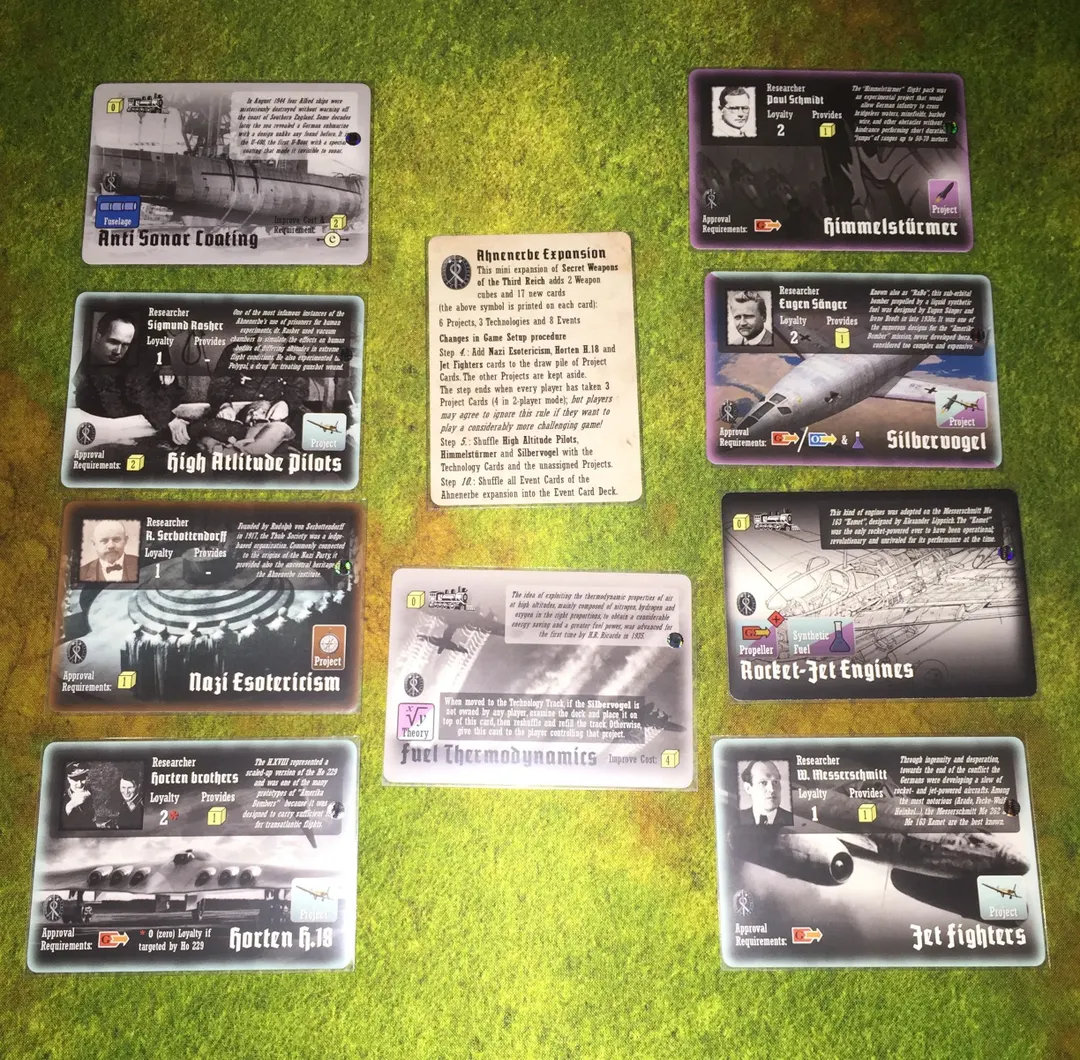
- Puntuación BGG
- 7,4
Secret Weapons of the Third Reich: Ahnenerbe Expansion
- 1–4 jugadores
- 120–180 min
- Complejidad 3,0/5
- 2015
2015
Ayuda con las reglas de Secret Weapons of the Third Reich
Explicaciones claras de turnos, efectos de cartas y situaciones dudosas, con referencias a fuentes oficiales e historial de preguntas guardado.
Para 1 jugador
¿Qué quieres saber?
Las respuestas salen del reglamento oficial, con la página para comprobarlo.
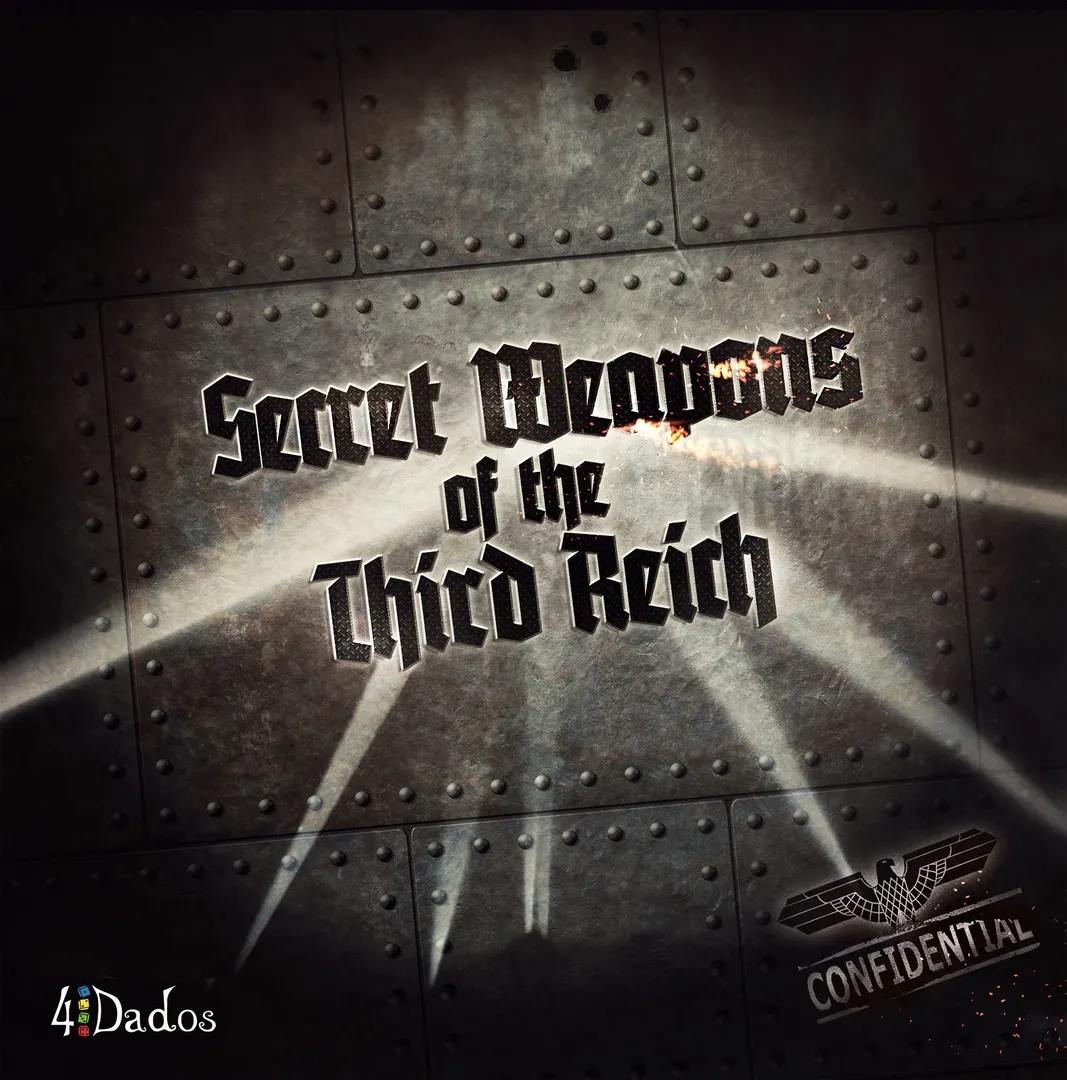
Secret Weapons of the Third Reich es un juego de mesa publicado en 2015 para 1–4 jugadores, con partidas de 120 a 180 minutos y a partir de 12 años. Fue diseñado por Luca Cammisa y sus mecánicas principales son Cooperative Game, Open Drafting y Worker Placement.



En inglés
The date: March 1938. The vast majority of Austrians cheer the Anschluss of their country by the German Reich. Central Europe is falling into Nazi hands and all the best European scientists will soon compete under the aegis of Heinrich Himmler, for whom no scheme is too wild or too improbable — but which team has the imagination, the courage, and the drive to most successfully accomplish their goals? Secret Weapons of the Third Reich is a game for one to four players simulating the arms race of World War II from the German perspective. From secret submarine bases in Greenland to the mysterious Base 211 in Neuschwabenland, Antarctica, this game recreates the incredible tales of Nazi technology, from the famous V-1 buzz bombs and V-2 rockets to the unlikely flying saucers derived from the work of Nikola Tesla. Will players be able to deliver the Haunebu project to completion? Will Hans Kammler escape with his last battalion of flying saucers to the dark side of the moon? Will the secret submarine fleet sail to Antarctica to pursue the war after the war? Or could German scientists produce an atomic bomb to be dropped on New York by an electro-gravitational flying saucer or within the warhead of a futuristic intercontinental V-3? Would it even be possible to build a huge solar satellite gun to strike America? In the game, each player controls one or more research groups, each working on a secret weapon project. Each research group has a leading researcher, who provides an initial bonus (expressed in resource cubes or scientist cylinders) when the project is assigned. The researcher has a regime loyalty value that measures both the ability to make requisition attempts and the ability to resist opposing attempts. A player tries to get their projects approved, then completed. Certain requirements (resource cubes and/or scientist cylinders and technologies attached to projects) must be met and costs paid in order to reach the stage of development of a project. Each turn, approved projects generate specific amounts of resource cubes as funding. Completed projects award victory points (VP) and allow, in most cases, weapon production. Produced weapons award VP to the owning player in addition to helping to achieve a cooperative goal for all players. In fact, if together the players fail to reach a certain number of weapons produced by the end of the game, they all lose. The weapon production goal varies depending on the number of players. Play begins in 1938, one year before the outbreak of world war. At the start, players can only place research groups for their approved projects (project plants) in the portion of the map representing Germany and Austria. In 1939 and later, the conquests of Nazi Germany allow players to deploy their project plants in occupied European territories — but players will have to pay attention to the various locations because some areas allow only research and development, others only weapon production, and still others only research and development for U-Boat projects. Also, players must operate in a "state of warfare". This means that as time goes on they are more and more subject to enemy bombardments that can cause a great loss of resources and technologies. In addition, as starting in 1943 Allied and Soviet advances on Berlin make the map progressively smaller, players must face logistical issues never encountered during the early years of the war. Should a completed project or produced weapon fall into Allied hands, players not only lose VP, but the weapons production goal recedes as well! Thus a certain amount of player cooperation is a must. Each player must balance his personal interests with the common need to share technologies and resources in order to fulfill the common goal. Last, but not least, via events one player may secretly become the turncoat, working in the shadows to help the enemy, and winning the game if all players would otherwise lose.
Según el catálogo, Secret Weapons of the Third Reich admite de 1 a 4 jugadores. Este intervalo corresponde al número de jugadores indicado por la editorial, así que el juego puede prepararse para cualquier grupo dentro de ese margen. La preparación, algunas reglas y la puntuación pueden variar según el número de jugadores; consulta la configuración exacta en el reglamento de tu edición.
La duración indicada para Secret Weapons of the Third Reich es de 120 a 180 minutos, la estimación de la editorial para una partida completa. El tiempo real depende del grupo, del número de jugadores y del conocimiento de las reglas: las primeras partidas suelen alargarse y los grupos con experiencia terminan antes. La preparación y la explicación de las reglas no están incluidas.
El catálogo indica Secret Weapons of the Third Reich a partir de 12 años. Es la recomendación de la editorial y refleja la lectura necesaria, la complejidad de las reglas y las piezas pequeñas, no solo el tema. Los más pequeños a menudo pueden jugar con ayuda de un adulto: comprueba la edad recomendada en tu edición y la experiencia de tu grupo.
Secret Weapons of the Third Reich tiene una puntuación de complejidad de 3,9 sobre 5 según los jugadores de BoardGameGeek, lo que lo convierte en un juego exigente. La puntuación refleja cuánto conocimiento de reglas, planificación y toma de decisiones exige una partida típica. Los juegos exigentes requieren una explicación inicial más larga, así que conviene usar una guía de preparación.
Secret Weapons of the Third Reich pertenece a estas categorías: Science Fiction y World War II. Sus mecánicas principales son Cooperative Game, Open Drafting y Worker Placement. Las categorías describen el tema y la ambientación de un juego, mientras que las mecánicas describen lo que los jugadores hacen realmente en su turno. Cada mecánica lleva a una página del catálogo con juegos similares.
Los autores acreditados de Secret Weapons of the Third Reich son: Luca Cammisa. Estos créditos proceden de los datos publicados del juego y nombran a las personas responsables de su diseño, no a ilustradores ni editoriales. Las páginas de autor de MeepleRules reúnen otros títulos de los mismos autores, algo útil cuando un juego te gusta y buscas otros parecidos.
El catálogo clasifica Secret Weapons of the Third Reich como juego base. Se juega por sí solo con los componentes de la caja y no requiere ningún otro título. Las expansiones, si existen, añaden contenido o reglas nuevas y aparecen por separado en el catálogo con un enlace a este juego base.