
- Puesto en BGG
- BGG #18.173
- Puntuación BGG
- 7,3
Quagmire
- 2–4 jugadores
- 20–45 min
- Complejidad 2,0/5
- 2026
2014
Ayuda con las reglas de Sixteen
Explicaciones claras de turnos, efectos de cartas y situaciones dudosas, con referencias a fuentes oficiales e historial de preguntas guardado.
¿Qué quieres saber?
Las respuestas salen del reglamento oficial, con la página para comprobarlo.
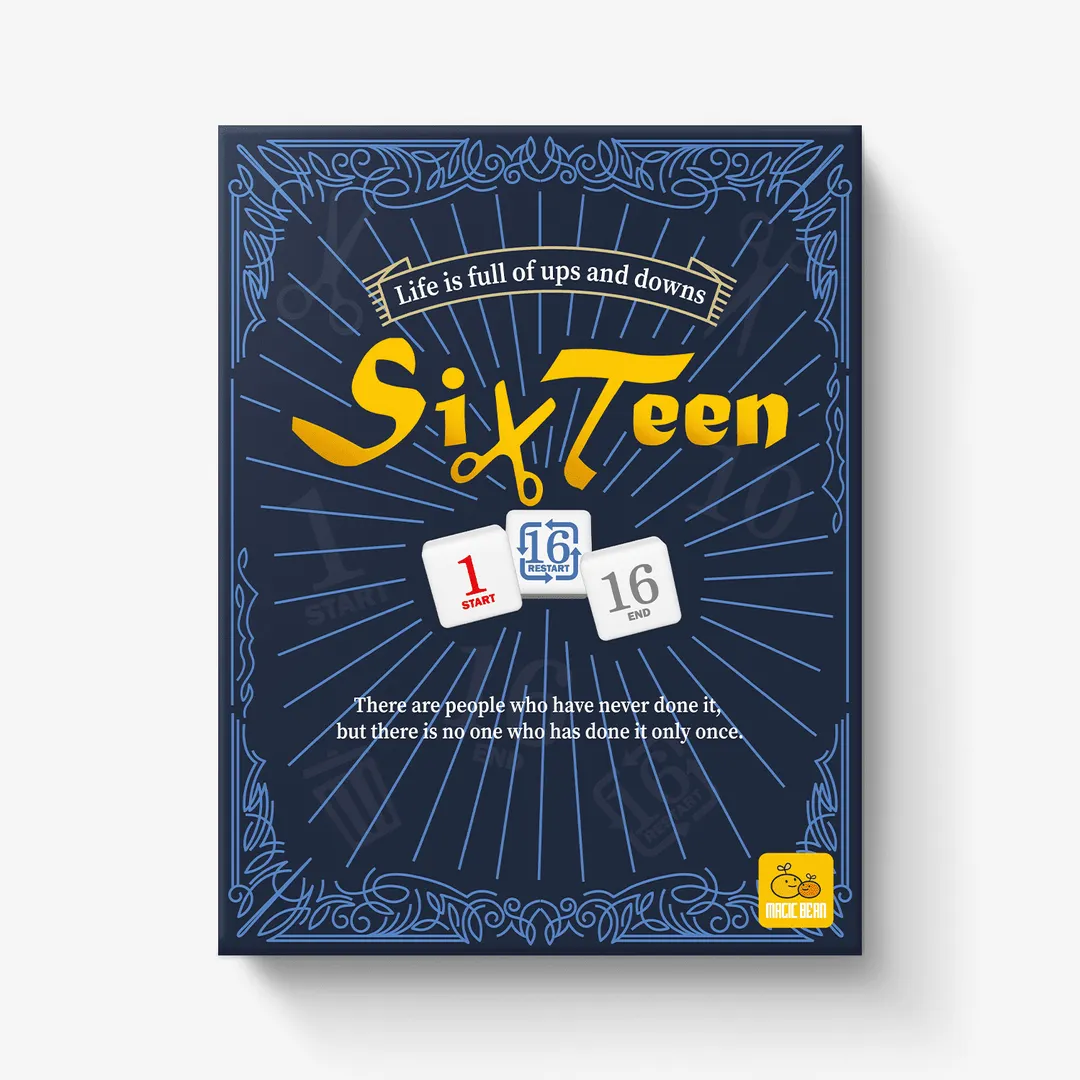
Sixteen es un juego de mesa publicado en 2014 para 2–4 jugadores, con partidas de 15 a 30 minutos y a partir de 6 años. Fue diseñado por Magicbean Games y sus mecánicas principales son Hand Management, Tile Placement y Pattern Movement.




En inglés
SET UP Each player takes one shield. Fold the wings of the shield and stand it in front of you. After putting all the tiles in the pocket, mix them well and split them equally among the players.(22 pieces each for 4 people) When playing with 3 players, each player takes 29 tiles and leave the remaining 1 tile in the pocket. The tiles taken from the pocket are taken inside the shield. Cover the tiles well and turn them all over so other players can't see them. If the game is played by 2 players, place all 5 colored “1” tiles in the center of the table and put all remaining tiles in the pocket and mix well. Each person takes 30 tiles from the pocket. Leave the remaining tiles in the pocket and do not use them. Then, hide all the tiles in the shield so that other players can’t see them and turn them all over. If you put the tiles of the same color together, it will be helpful for you to play the game. STARTING SETTING - 4 Players : 22 Tiles - 3 Players : 29 Tiles - 4 Players : 30 Tiles GOAL OF THE GAME Every tile you own is your negative score. The goal of Sixteen is to put down all the tiles you own first, or leave the fewest number of tiles. Tiles can be placed one color per turn, and must be placed in a higher number (in ascending order) than the number of tiles placed at the very end. You can also create an opportunity to remove remaining tiles by using 16END and 16RESTART tiles and special tiles such as scissors and trash cans. Make strategies by predicting other player’s remaining tiles. SPECIAL TILES - 16 RESTART(5 : 1 per color) : You can restart the row by resetting the row of that color to the number '1'. Place a tile and pass the turn to the next player. - 16 END(5 : 1 per color) : You can finish the row of that color. 16END tiles can be removed with scissors or trash bin tiles, but you cannot place 16RESTART tiles. - Scissor tile(2) : You can remove one of the last tiles in a row. After removing it, you can place the tile one more time. You can only place the tile on the row that you used scissor tiles, or you can use scissor tiles only. Place the removed tiles and used scissor tiles separately next to the table. - Trash Bin Tiles(1) : You can discard as many tiles as you like, except for tile '1' in a row. You can place the tile one more time after discarding it. You can only place the tile once more on the line where you used the trash can tile, or you can use the trash can tile only. Put the discarded tiles and the used trash can tiles separately next to the table. PLAYING THE GAME If there is a tile with the number '1', place it all in the center of the table. The game is played clockwise starting with the player with the red number '1' tile. In the case of 2 players, a random player will be selected to start the game. When it's your turn, you can place down a tile once. Only tiles of one color can be placed down at a time. Each color of tiles with a number greater than the number of tiles placed at the end (in ascending order) can be placed. You cannot place a tile with a number smaller than the number of tiles placed at the end. If the ascending order conditions are satisfied, tiles can be laid down in two ways. (Default) : Place a larger number of tiles than the one placed at the end (Group) : Lay down a group of consecutive tiles END OF THE GAME There are two ways to end a game. If either of them applies, the game ends immediately. First, if a player has laid down all of their tiles, the game ends immediately and that player wins. Second, if all players yell ‘PASS’ in one round, the game ends and the player with the lowest score wins. [How to calculate points] All the player remove theirs shield and add the number of tiles they have left. For any remaining 16 END and 16RESTART tiles, add 16 points. For scissors and trash bin tiles add 20 points each. Consecutive tiles must be in ascending order. If there is no break in the middle, the number of tiles can be placed down at once without a limit. 16END and 16RESTART can also be put down in groups. However, you can't lay down two 16 tiles at once. (Yes. You cannot put down 16END after 16RESTART in one turn) After putting down the 16END and 16RESTART tiles, hand over the turn to the next player. After using scissors and trash can tiles, you can place down tiles of the corresponding color one more time, and this action is optional and not required. Scissors and trash can must be used until the game ends. If you don't use them and keep them till the end of the game, you get -20 points. “Pass” if there are no tiles that can be put down in your turn. When your turn comes back, if there's a tile you can put down, put the tile down again and hand over the turn to the next player. The game continues until all players yell PASS or one player has put down all of the tiles they had. If the calculation is over, the player with the lowest score wins. If there is a tie, compare the number of tiles and the one with fewer tiles wins. Ex) When 2 people are tied for the 1st place (19 points), the number of their tiles is compared. The 1PLAYER has 3 tiles, and the 2PLAYER has 2 tiles. Therefore, the 2PLAYER who has 1 less tile wins. Contact Publisher MAGICBEANGAMES(Republic of Korea) e-mail : [email protected]
Según el catálogo, Sixteen admite de 2 a 4 jugadores. Este intervalo corresponde al número de jugadores indicado por la editorial, así que el juego puede prepararse para cualquier grupo dentro de ese margen. La preparación, algunas reglas y la puntuación pueden variar según el número de jugadores; consulta la configuración exacta en el reglamento de tu edición.
La duración indicada para Sixteen es de 15 a 30 minutos, la estimación de la editorial para una partida completa. El tiempo real depende del grupo, del número de jugadores y del conocimiento de las reglas: las primeras partidas suelen alargarse y los grupos con experiencia terminan antes. La preparación y la explicación de las reglas no están incluidas.
El catálogo indica Sixteen a partir de 6 años. Es la recomendación de la editorial y refleja la lectura necesaria, la complejidad de las reglas y las piezas pequeñas, no solo el tema. Los más pequeños a menudo pueden jugar con ayuda de un adulto: comprueba la edad recomendada en tu edición y la experiencia de tu grupo.
Sixteen tiene una puntuación de complejidad de 1,0 sobre 5 según los jugadores de BoardGameGeek, lo que lo convierte en un juego ligero. La puntuación refleja cuánto conocimiento de reglas, planificación y toma de decisiones exige una partida típica. Los juegos exigentes requieren una explicación inicial más larga, así que conviene usar una guía de preparación.
Sixteen pertenece a estas categorías: Party Game y Math. Sus mecánicas principales son Hand Management, Tile Placement y Pattern Movement. Las categorías describen el tema y la ambientación de un juego, mientras que las mecánicas describen lo que los jugadores hacen realmente en su turno. Cada mecánica lleva a una página del catálogo con juegos similares.
Los autores acreditados de Sixteen son: Magicbean Games. Estos créditos proceden de los datos publicados del juego y nombran a las personas responsables de su diseño, no a ilustradores ni editoriales. Las páginas de autor de MeepleRules reúnen otros títulos de los mismos autores, algo útil cuando un juego te gusta y buscas otros parecidos.
El catálogo clasifica Sixteen como juego base. Se juega por sí solo con los componentes de la caja y no requiere ningún otro título. Las expansiones, si existen, añaden contenido o reglas nuevas y aparecen por separado en el catálogo con un enlace a este juego base.