- Puntuación BGG
- 8,1
Enlightened Warlords: A Player's Guide to Soldier Kings
- 2–8 jugadores
- 240 min
- Complejidad 2,0/5
- 2011
2002
Ayuda con las reglas de Soldier Kings: The Seven Years War Worldwide
Explicaciones claras de turnos, efectos de cartas y situaciones dudosas, con referencias a fuentes oficiales e historial de preguntas guardado.
Para 2 jugadores
¿Qué quieres saber?
Las respuestas salen del reglamento oficial, con la página para comprobarlo.
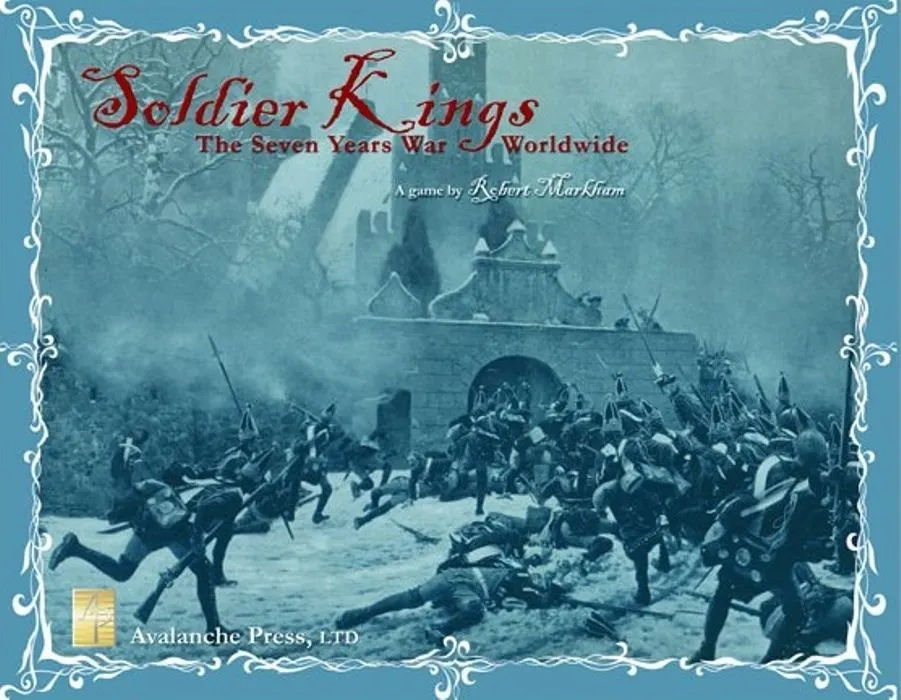
Soldier Kings: The Seven Years War Worldwide es un juego de mesa publicado en 2002 para 2–8 jugadores, con partidas de 180 a 480 minutos y a partir de 14 años. Fue diseñado por Robert G. Markham y sus mecánicas principales son Variable Player Powers, Dice Rolling y Point to Point Movement.
En inglés
From the Avalanche Press website: The Seven Years' War Worldwide Between 1756 and 1763, Europe erupted into what became the first true world-wide conflict, known as the Seven Years’ War. On the one hand, Britain and France vied for supremacy in world-wide trade, becoming deadly enemies in the process. On the other, Austria and Prussia struggled for dominance in Germany. On the fringes, Russia began to feel her growing power, while Spain, the Netherlands and Turkey all knew their time was almost up. Soldier Kings re-creates the free-for-all that was the Seven Years’ War. Two to eight players take the roles of the nations listed above, trying to capture or hold onto the rich lands of Europe, India, South-East Asia and America. The world is changing; the power that grabs the most now will dominate the modern age that is just dawning. If you’re the Soldier King, that power will be you. In Soldier Kings, each player has armies and fleets. There are also a handful of generals and admirals to assist these in battle and in movement. The best is Frederick of Prussia, called “The Great” for a reason. The worst is the hapless Prince of Orange, with whom the Dutch player is saddled. Players have allies; some are set at the beginning of the game, others alliances are forged during the course of play. Everyone else is an enemy. No one is “neutral”; those are just enemies you haven’t attacked yet. The map is divided into land areas and sea zones. Armies move on land, fleets at sea. Each land area is rated for the amount of money and manpower it generates each turn. Manpower represents not just fresh recruits for your forces, but also the things made with human labor: food, uniforms, weapons and so on. Money is, well, money. You expend manpower to rebuild your forces, and money to finance their actions. Thus you need to hang on to areas that generate these resources for you, and take them from the other guy. You do that by defeating enemy armies, and besieging enemy areas. Combat is conducted by rolling dice, one for each attack factor. These hits must be sustained by enemy armies by reducing them in strength, or eliminating them. A good general lets you roll more dice. Each area is rated for its garrison strength; to capture it, you have to defeat the garrison troops through siege (in addition to driving off any enemy armies there). The procedure here is very similar. Throwing a twist into all of this is card play. The universe is loaded with random elements; life does not unfold as an orderly series of “phases.” After a short countdown to start the game, players can play cards at any time, in any order. The cards are the centerpiece of the game, giving it its free-wheeling nature. Generals can vacillate. Mercenaries can be hired. Local militia can appear to help. Soldiers might run off to loot. Bridges get burned, snow falls early, the harvests are bad, the harvests are good. Royal marriages, minor country alliances, the rise of new leaders — all sorts of events take place during card play. The game contains seven scenarios: a campaign game covering the entire war, and then six shorter ones, one for each year of the war. Play ends on a pre-determined turn or when a player has achieved his or her conditions for automatic victory, whichever comes first.
Según el catálogo, Soldier Kings: The Seven Years War Worldwide admite de 2 a 8 jugadores. Este intervalo corresponde al número de jugadores indicado por la editorial, así que el juego puede prepararse para cualquier grupo dentro de ese margen. La preparación, algunas reglas y la puntuación pueden variar según el número de jugadores; consulta la configuración exacta en el reglamento de tu edición.
La duración indicada para Soldier Kings: The Seven Years War Worldwide es de 180 a 480 minutos, la estimación de la editorial para una partida completa. El tiempo real depende del grupo, del número de jugadores y del conocimiento de las reglas: las primeras partidas suelen alargarse y los grupos con experiencia terminan antes. La preparación y la explicación de las reglas no están incluidas.
El catálogo indica Soldier Kings: The Seven Years War Worldwide a partir de 14 años. Es la recomendación de la editorial y refleja la lectura necesaria, la complejidad de las reglas y las piezas pequeñas, no solo el tema. Los más pequeños a menudo pueden jugar con ayuda de un adulto: comprueba la edad recomendada en tu edición y la experiencia de tu grupo.
Soldier Kings: The Seven Years War Worldwide tiene una puntuación de complejidad de 2,5 sobre 5 según los jugadores de BoardGameGeek, lo que lo convierte en un juego algo ligero. La puntuación refleja cuánto conocimiento de reglas, planificación y toma de decisiones exige una partida típica. Los juegos exigentes requieren una explicación inicial más larga, así que conviene usar una guía de preparación.
Soldier Kings: The Seven Years War Worldwide pertenece a estas categorías: Wargame y Age of Reason. Sus mecánicas principales son Variable Player Powers, Dice Rolling y Point to Point Movement. Las categorías describen el tema y la ambientación de un juego, mientras que las mecánicas describen lo que los jugadores hacen realmente en su turno. Cada mecánica lleva a una página del catálogo con juegos similares.
Los autores acreditados de Soldier Kings: The Seven Years War Worldwide son: Robert G. Markham. Estos créditos proceden de los datos publicados del juego y nombran a las personas responsables de su diseño, no a ilustradores ni editoriales. Las páginas de autor de MeepleRules reúnen otros títulos de los mismos autores, algo útil cuando un juego te gusta y buscas otros parecidos.
El catálogo clasifica Soldier Kings: The Seven Years War Worldwide como juego base. Se juega por sí solo con los componentes de la caja y no requiere ningún otro título. Las expansiones, si existen, añaden contenido o reglas nuevas y aparecen por separado en el catálogo con un enlace a este juego base.