
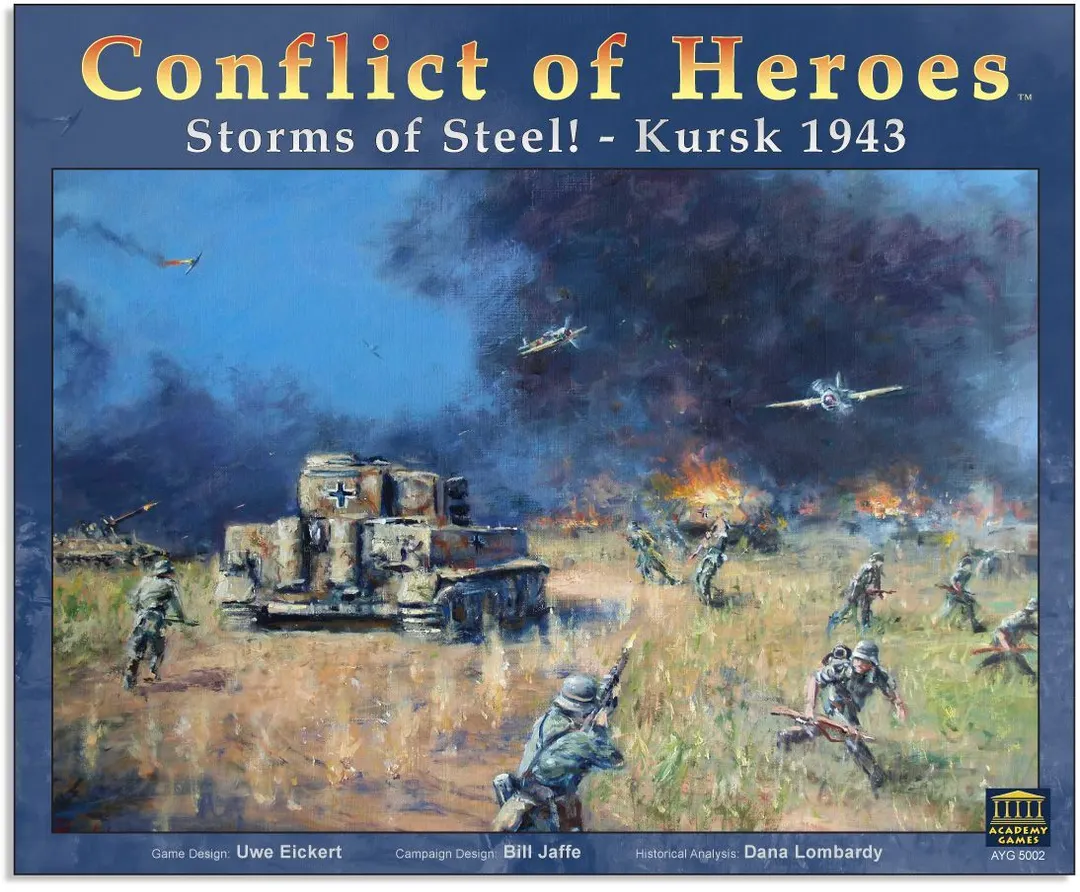
- Puesto en BGG
- BGG #1899
- Puntuación BGG
- 7,7
Conflict of Heroes: Storms of Steel! – Kursk 1943
- 1–4 jugadores
- 120 min
- Complejidad 3,1/5
- 2009

1979
Ayuda con las reglas de Streets of Stalingrad
Explicaciones claras de turnos, efectos de cartas y situaciones dudosas, con referencias a fuentes oficiales e historial de preguntas guardado.
Para 2 jugadores
¿Qué quieres saber?
Las respuestas salen del reglamento oficial, con la página para comprobarlo.
Streets of Stalingrad es un juego de mesa publicado en 1979 para 2 jugadores, con partidas de 180 minutos y a partir de 12 años. Fue diseñado por Dana Lombardy y David Parham y sus mecánicas principales son Dice Rolling y Hexagon Grid.
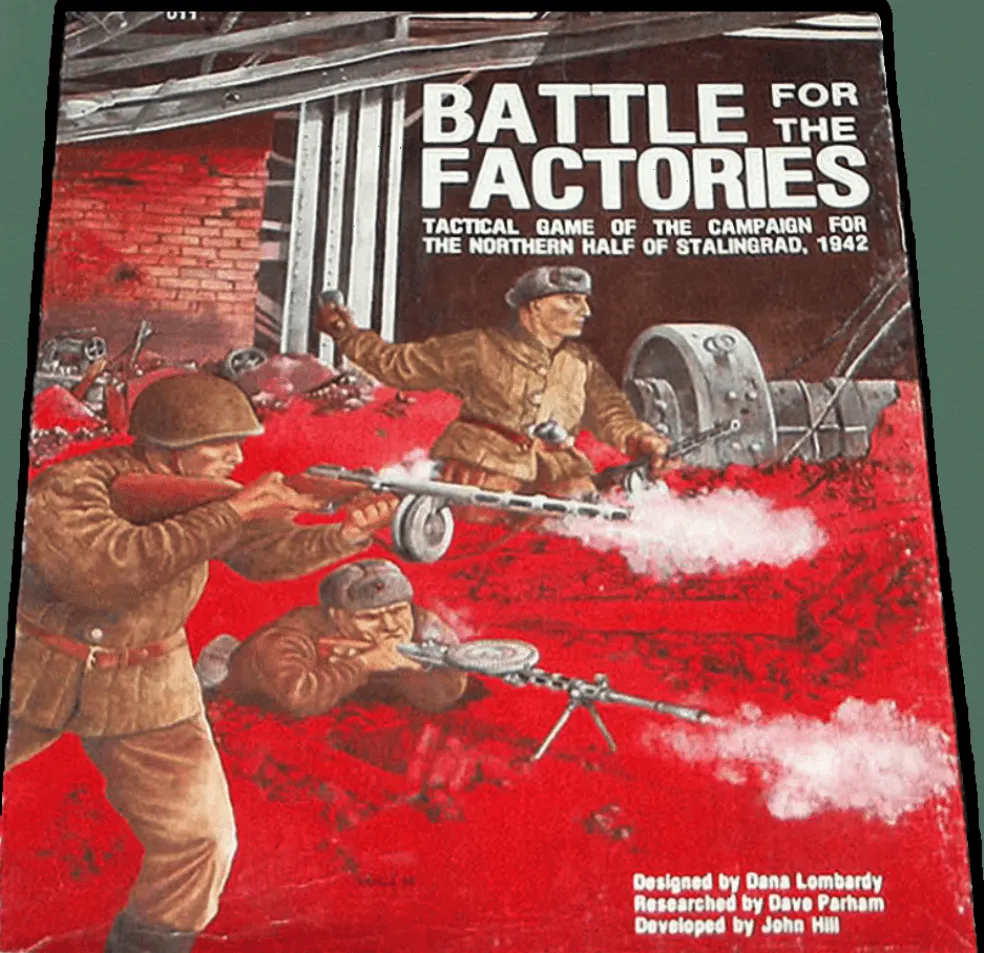
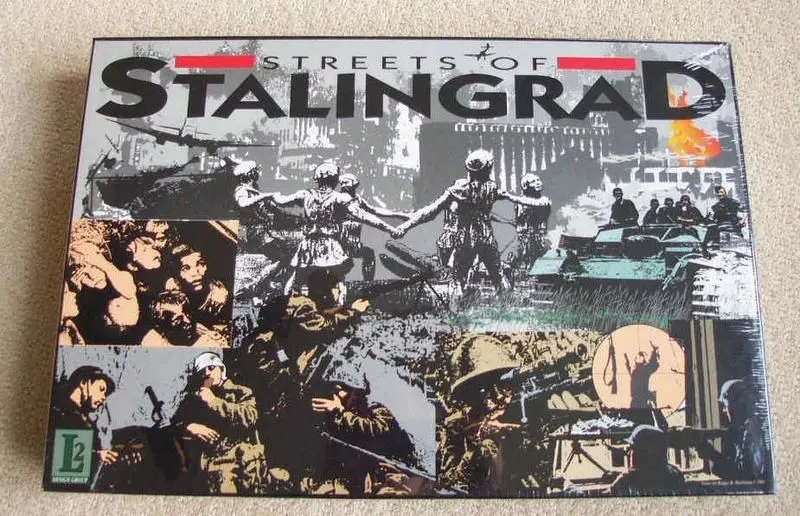





En inglés
"Streets of Stalingrad" is a World War 2 East Front wargame that models the fight for the city of Stalingrad, September-October, 1942, at the company level. It employs a scale of 300 meters per hex, with daily turns and 2160 counters. The two designers spent years researching the orders of battle and aerial maps to produce a game that is possibly the most researched and arguably the most accurate depiction of a battle, mechanics aside. The large, fairly thin but sturdy counters are the shades of the uniforms of the armies according to the designers. Instead of the usual American style designations on the counters to depict what type of unit it is, the designers used the actual designations used by the separate armies. This could be confusing except for the wonderful large player aids supplied with actual photos of the unit types. Labels and ziplock bag are even supplied for sorting purposes although sorting can be confusing. Moves mag put out an issue in the late '70's, early '80's with an article that fixed the problem. The 3 large maps are taken straight from aerial photos. You see the city block by block and outside the city individual buildings can even be seen. There is very little color on the maps but they are beautiful and very functional. The terrain effects chart once again has actual photos of the terrain so you can get an idea of exactly what the soldiers were facing. There are many scenarios available so you can tailor the game for time and room as some only use 1 map or a portion of a map. Each scenario has a separate set up sheet for both sides that are large enough to put all the counters on the sheets. Each scenario has a miniature version of the map to be used with set up information. For a monster game it is very easy to set up and get into a game. There are 3 rulebooks included, 2 basic game and 1 advanced game. When learning the game it is fantastic that they included a rulebook for each player. This is the kind of detail that is evident throughout the game. The rule books are detailed without being overbearing, as a lot of Avalon Hill's and SPI's were from the time period. They are chock full of examples to clear up ambiguities. The game is difficult because of the scale only. It is actually a fairly simple game, mechanics wise, and can be played by anyone with some wargame experience. This game shows that it has been designed to play, by wargamers, in every detail.
Según el catálogo, Streets of Stalingrad admite 2 jugadores. Es el número de jugadores indicado por la editorial, así que el juego está diseñado exactamente para esa cantidad de participantes. Las variantes para otros tamaños de grupo, si existen, se describen en el reglamento de tu edición; consúltalo antes de preparar otra configuración.
La duración indicada para Streets of Stalingrad es de 180 minutos, la estimación de la editorial para una partida completa. El tiempo real depende del grupo, del número de jugadores y del conocimiento de las reglas: las primeras partidas suelen alargarse y los grupos con experiencia terminan antes. La preparación y la explicación de las reglas no están incluidas.
El catálogo indica Streets of Stalingrad a partir de 12 años. Es la recomendación de la editorial y refleja la lectura necesaria, la complejidad de las reglas y las piezas pequeñas, no solo el tema. Los más pequeños a menudo pueden jugar con ayuda de un adulto: comprueba la edad recomendada en tu edición y la experiencia de tu grupo.
Streets of Stalingrad tiene una puntuación de complejidad de 4,3 sobre 5 según los jugadores de BoardGameGeek, lo que lo convierte en un juego exigente. La puntuación refleja cuánto conocimiento de reglas, planificación y toma de decisiones exige una partida típica. Los juegos exigentes requieren una explicación inicial más larga, así que conviene usar una guía de preparación.
Streets of Stalingrad pertenece a estas categorías: Wargame y World War II. Sus mecánicas principales son Dice Rolling y Hexagon Grid. Las categorías describen el tema y la ambientación de un juego, mientras que las mecánicas describen lo que los jugadores hacen realmente en su turno. Cada mecánica lleva a una página del catálogo con juegos similares.
Los autores acreditados de Streets of Stalingrad son: Dana Lombardy y David Parham. Estos créditos proceden de los datos publicados del juego y nombran a las personas responsables de su diseño, no a ilustradores ni editoriales. Las páginas de autor de MeepleRules reúnen otros títulos de los mismos autores, algo útil cuando un juego te gusta y buscas otros parecidos.
El catálogo clasifica Streets of Stalingrad como juego base. Se juega por sí solo con los componentes de la caja y no requiere ningún otro título. Las expansiones, si existen, añaden contenido o reglas nuevas y aparecen por separado en el catálogo con un enlace a este juego base.