
- Puesto en BGG
- BGG #1180
- Puntuación BGG
- 7,5
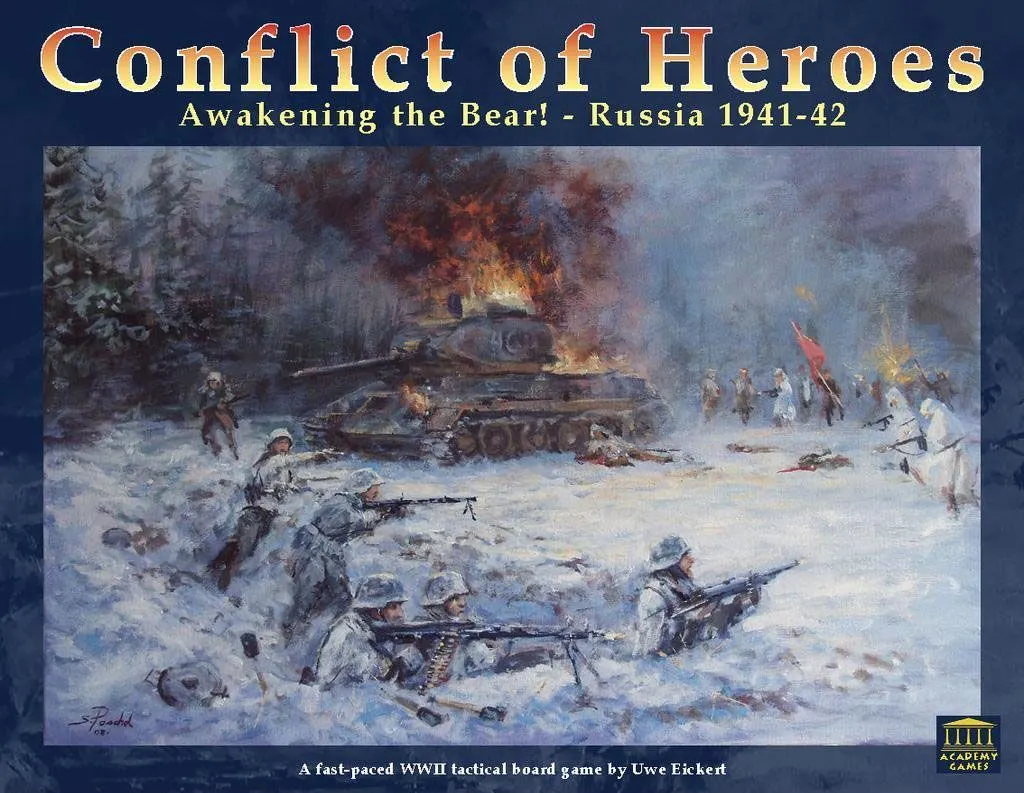
Conflict of Heroes: Awakening the Bear! – Russia 1941-42
- 1–4 jugadores
- 120 min
- Complejidad 3,0/5
- 2008
2011
Ayuda con las reglas de Strike of the Eagle
Explicaciones claras de turnos, efectos de cartas y situaciones dudosas, con referencias a fuentes oficiales e historial de preguntas guardado.
Para 2 jugadores
¿Qué quieres saber?
Las respuestas salen del reglamento oficial, con la página para comprobarlo.
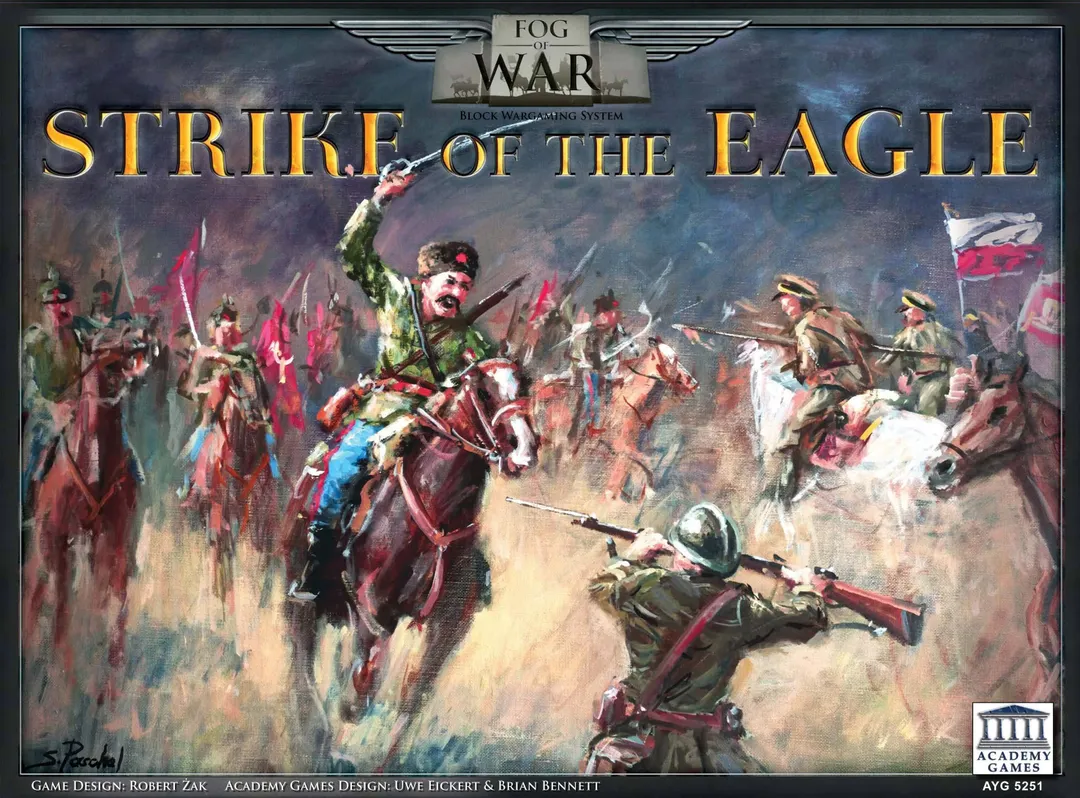
Strike of the Eagle es un juego de mesa publicado en 2011 para 2–4 jugadores, con partidas de 60 a 240 minutos y a partir de 13 años. Fue diseñado por Uwe Eickert, Robert Żak y Brian Bennett y sus mecánicas principales son Area Movement, Area Majority / Influence y Simulation.

En inglés
WWI has ended, but the battle for democracy has just begun. Communist movements have sprung up throughout Europe. Trotsky, Lenin and Stalin plan to blast through Poland in order to support the red revolutions in Germany, France and England. Only the armies of Poland stand in the way of the Bolshevik tide. Strike of the Eagle models the battles and historical events of the Polish-Soviet War of 1919-1920. To simulate the tension of the era from the fog of war, players alternate placing secret orders on their armies in order to bluff, mislead and misdirect their opponents. These concealed orders make it difficult to deduce an opponent's plans and are used to hide a player's true intentions and objectives. Players then reveal and resolve the issued orders. They can then disrupt their opponent's moves, cut off supply and much more. Once orders are resolved the next turn begins. Units are represented by wooden blocks. Battles are fought with no dice, but with a simple and quick combat system. Action cards are pivotal to the game in that they allow players to either modify how many orders they may issue, add army reinforcements or modify a battle's resolution.[...] Strike of the Eagle includes several scenarios for 2-4 players. Some are short games that can be played in an hour, up to the full campaign that can last several hours. The map portrays a portion of Eastern Europe in 1920. It is divided into areas that are named after local cities to simplify scenario setups. Along the outer edge of the map is a grid to help find areas during game setup. Each area name is followed by its grid location. The map is divided into two fronts; the northern and the southern. The front line is designated by a yellow line that runs from east to west. In 4 player scenarios, each allied player commands blocks on one front only. If a block of one player crosses the line between fronts, it moves to the control of his ally at the beginning of the next Operation Phase. The Fog of War series is a card driven game where Divisions and Brigades are represented as blocks. These blocks stand upright during the game to prevent opponents from knowing their strength or unit type and can only be revealed during combat or through Recon Area orders given during each Operation Phase. Strike of the Eagle is divided into a number of Rounds, each Round being subdivided into a number of identical phases. The Round Phase Track marks the game's progression. Each round is divided into the Replenish Cards Phase, five identical Operation Phases, and a Reinforcement Phase. Each side has a pool of order counters to draw from. These order counters represent the various types of orders each unit or group may be given. These orders, which range from Forced Marches to Reconnaissance actions, allow the player to strategically manouver his Divisions and Brigades. Orders are placed face down, leading to guesswork and strategic anticipation on the part of your opponent! The sequence of placing and executing orders is determined by the player(s) with the higher initiative. Each front has its own initiative track. Initiative is gained and lost as the game progresses. Whether to place first or second is an important strategic element of the game! Strike of the Eagle is a card driven game. Each card is broken up into a number of different parts and each card can be played for either its event as listed in the body of the card, to increase the number of orders available in a phase (uppermost left), for the combat value on the card (uppermost right), or for reinforcements (lowermost left). Supply is important in Stike of the Eagle. If units are out of supply they will fight less well, take much greater losses, and lose the advantage of any Garrison which might be located at their city. (from Academy Games website)
Según el catálogo, Strike of the Eagle admite de 2 a 4 jugadores. Este intervalo corresponde al número de jugadores indicado por la editorial, así que el juego puede prepararse para cualquier grupo dentro de ese margen. La preparación, algunas reglas y la puntuación pueden variar según el número de jugadores; consulta la configuración exacta en el reglamento de tu edición.
La duración indicada para Strike of the Eagle es de 60 a 240 minutos, la estimación de la editorial para una partida completa. El tiempo real depende del grupo, del número de jugadores y del conocimiento de las reglas: las primeras partidas suelen alargarse y los grupos con experiencia terminan antes. La preparación y la explicación de las reglas no están incluidas.
El catálogo indica Strike of the Eagle a partir de 13 años. Es la recomendación de la editorial y refleja la lectura necesaria, la complejidad de las reglas y las piezas pequeñas, no solo el tema. Los más pequeños a menudo pueden jugar con ayuda de un adulto: comprueba la edad recomendada en tu edición y la experiencia de tu grupo.
Strike of the Eagle tiene una puntuación de complejidad de 3,1 sobre 5 según los jugadores de BoardGameGeek, lo que lo convierte en un juego de complejidad media. La puntuación refleja cuánto conocimiento de reglas, planificación y toma de decisiones exige una partida típica. Los juegos exigentes requieren una explicación inicial más larga, así que conviene usar una guía de preparación.
Strike of the Eagle pertenece a estas categorías: Wargame, Bluffing y Civil War. Sus mecánicas principales son Area Movement, Area Majority / Influence y Simulation. Las categorías describen el tema y la ambientación de un juego, mientras que las mecánicas describen lo que los jugadores hacen realmente en su turno. Cada mecánica lleva a una página del catálogo con juegos similares.
Los autores acreditados de Strike of the Eagle son: Uwe Eickert, Robert Żak y Brian Bennett. Estos créditos proceden de los datos publicados del juego y nombran a las personas responsables de su diseño, no a ilustradores ni editoriales. Las páginas de autor de MeepleRules reúnen otros títulos de los mismos autores, algo útil cuando un juego te gusta y buscas otros parecidos.
El catálogo clasifica Strike of the Eagle como juego base. Se juega por sí solo con los componentes de la caja y no requiere ningún otro título. Las expansiones, si existen, añaden contenido o reglas nuevas y aparecen por separado en el catálogo con un enlace a este juego base.