
- Puesto en BGG
- BGG #14.743
- Puntuación BGG
- 8,1
Crimea: Conquest & Liberation
- 2–4 jugadores
- 120 min
- Complejidad 4,2/5
- 2023
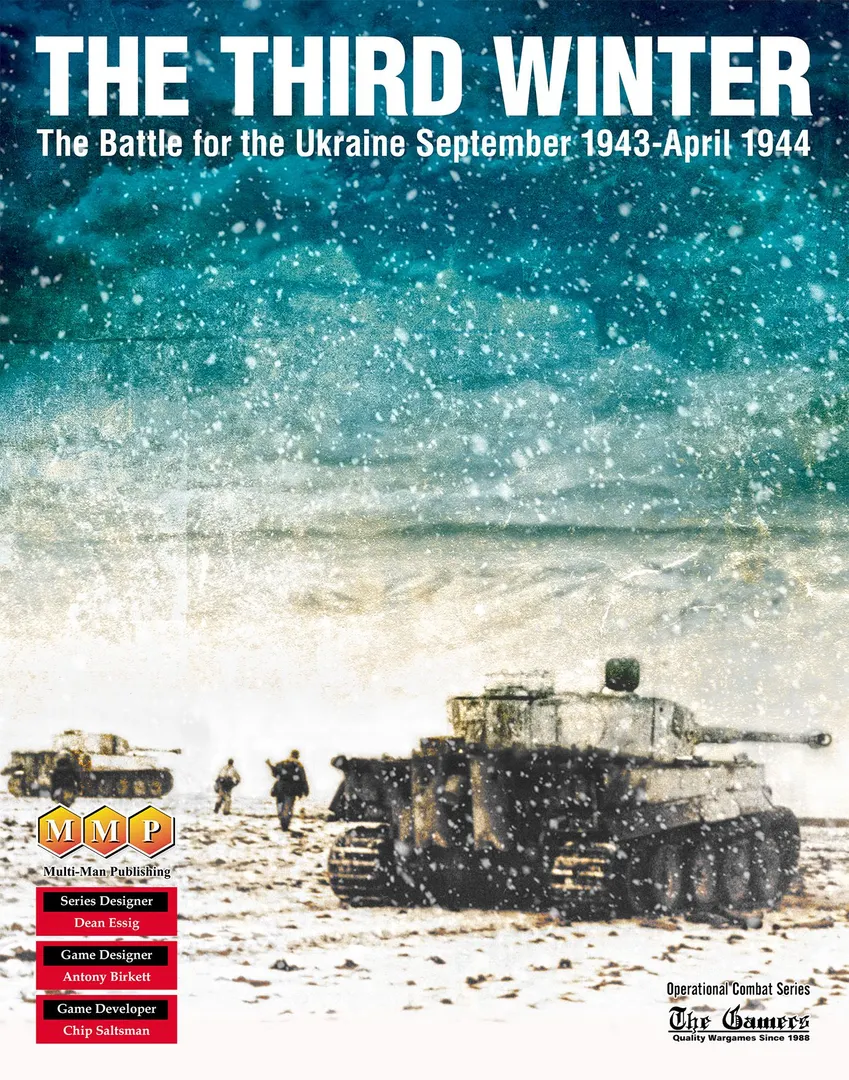
2021
Ayuda con las reglas de The Third Winter: The Battle for the Ukraine September 1943-April 1944
Explicaciones claras de turnos, efectos de cartas y situaciones dudosas, con referencias a fuentes oficiales e historial de preguntas guardado.
Para 2 jugadores
¿Qué quieres saber?
Las respuestas salen del reglamento oficial, con la página para comprobarlo.
The Third Winter: The Battle for the Ukraine September 1943-April 1944 es un juego de mesa publicado en 2021 para 2–6 jugadores, con partidas de 3000 a 10000 minutos y a partir de 16 años. Fue diseñado por Chip Saltsman y Antony Birkett y sus mecánicas principales son Dice Rolling, Grid Movement y Hexagon Grid.



En inglés
The Third Winter: The Campaign for the Ukraine, September 1943 - April 1944, begins with the “Race to the Dnepr,” as Army Group South rushed to a secure defensive position behind one of Europe’s largest rivers. Four powerful Soviet Fronts must be used in close cooperation to overcome the Axis forces, which include two Panzer Armies. The game contains 85% of the total Wehrmacht’s mechanized strength at this stage of the war and 75% of the Red Army’s. The Germans must hold the Dnepr barrier as long as possible, followed by a fighting retreat to the Carpathian Mountains to the west. The Soviets can crush the Axis invader with the advantage of their most reliable ally: General Winter. It is the Third Winter on the Russian Front. The Soviets have the initiative and a formidable force, but an equally challenging task. The Dnepr is a huge obstacle and the German panzer formations are wounded but dangerous. The German player has the challenge of active defense in the style of Army Group South Commander Erich von Manstein. Both sides are in for a challenging fight. The Third Winter is a big game, with 5-mile hexes, 3.5-day turns, and counters for units from battalions up to divisions. The battles from this campaign – the Race to the Dnepr, the Battle of Kiev, Korsun Pocket, the Kamenets-Podolsky pocket (“Hube’s Pocket”) and the splitting of Army Group South in two—merge into the dynamic of whole campaign. Special rules in this 19th game of the Operational Combat Series have been carefully designed to recreate this intense campaign. They include: • Soviet Front command structure is modeled by the four Fronts being either on Offensive or Paused posture. The Soviet player can switch one front “off” and another “on” to shift focus and force the Axis to deal with sudden threats in a different part of the map. When Soviet formations are burned out, they withdraw into the “RVGK” for rebuilding, and can reappear suddenly in a new area, enabling Maskirovka surprises. Each Front has a dedicated Air Army and Frontal Barrages to initiate offensives. The game shows the increasing strength and competency of the Red Army in both units and Action ratings. • German units in play include Kampfgruppe Divisions, German Remnants, German Army and Army Group HQs,Tiger Companies, Hartman and JG52 aces, Hans-Ulrich Rudel and his tank-busting aircraft, and the Romanian Home army • Random events similar to what are found in the award-winning Beyond the Rhine. These cover things like Soviet Patrol Boat Raids, Lend-Lease, Fuel Shortages, Heroes who affect combat, Arty Ammo Stockpiles, and Partisan Offensives. The 44 possible events add a lot of historical flavor but require very little rules overhead. • The importance and difficulty of the Dnepr crossings are distilled into rules allowing the bridges to be blown and repaired, and ferries to be emplaced, all leading to Soviet Bridgehead battles • Both sides were deploying more and more anti-aircraft assets, modeled with units that make air barrages more difficult. • Axis Fortress HQ units that enable cut-off units to continue to function and shows the decline of the Wehrmacht, from a mobile warfare army to a defensive army, with limited counterattack capability. KG HQs allow ad hoc mechanized formations to combine to simulate the desperate nature of the struggle. The Third Winter features two monster-sized campaigns that use a 44x66-inch map layout and over 1,500 combat units. Also included are several smaller scenarios, including four 1-map games. Scenario 1: The Dnepr Battles (Grand Campaign Game, 4 maps, 63 turns, 26 Sept 1943 to 26 April 1944) Scenario 2: Die Götterdämmerung (January Campaign Start, 4 maps, 27 turns, 26 Jan 44 to 26 April 44) Scenario 3: Red Thunder (April Campaign Start, 2 maps, 6 turns, 8 Apr 44 to 26 April 44) Scenario 4: Manstein’s Fire Brigades (Battle for Kiev, 1 map, 9 turns, 26 Dec 43 to 22 Jan 44) Scenario 5: II SS Pz Corps Strikes Back (Battle for Ternopol, 1 map, 6 turns, 8 Apr 44 to 26 April 44) Scenario 6: Rumanian Finish (Odessa and breaking into Rumania, 1 map, 6 turns, 8 Apr 44 to 26 April 44) Scenario 7: Hube’s Pocket (The “Moving Pocket” Battle, 1 map, 8 turns, 22 Mar 44 to 15 Apr 44) Game Scale: Turn: 1/2 Week (3 or 4 days) Hex: 5 miles / 8 km Units: Company to Corps Game Inventory: Four 22" X 34" mapsheets Eight countersheets (2,240 1/2" dual-side printed counters) One 48-page OCS rules booklet One Third Winter game rules booklet One Third Winter scenario booklet Two 4 page OCS Charts & Tables folders Three Player Aid Cards (1 sided) Two 6-sided dice (description from designer)
Según el catálogo, The Third Winter: The Battle for the Ukraine September 1943-April 1944 admite de 2 a 6 jugadores. Este intervalo corresponde al número de jugadores indicado por la editorial, así que el juego puede prepararse para cualquier grupo dentro de ese margen. La preparación, algunas reglas y la puntuación pueden variar según el número de jugadores; consulta la configuración exacta en el reglamento de tu edición.
La duración indicada para The Third Winter: The Battle for the Ukraine September 1943-April 1944 es de 3000 a 10000 minutos, la estimación de la editorial para una partida completa. El tiempo real depende del grupo, del número de jugadores y del conocimiento de las reglas: las primeras partidas suelen alargarse y los grupos con experiencia terminan antes. La preparación y la explicación de las reglas no están incluidas.
El catálogo indica The Third Winter: The Battle for the Ukraine September 1943-April 1944 a partir de 16 años. Es la recomendación de la editorial y refleja la lectura necesaria, la complejidad de las reglas y las piezas pequeñas, no solo el tema. Los más pequeños a menudo pueden jugar con ayuda de un adulto: comprueba la edad recomendada en tu edición y la experiencia de tu grupo.
The Third Winter: The Battle for the Ukraine September 1943-April 1944 tiene una puntuación de complejidad de 3,9 sobre 5 según los jugadores de BoardGameGeek, lo que lo convierte en un juego exigente. La puntuación refleja cuánto conocimiento de reglas, planificación y toma de decisiones exige una partida típica. Los juegos exigentes requieren una explicación inicial más larga, así que conviene usar una guía de preparación.
The Third Winter: The Battle for the Ukraine September 1943-April 1944 pertenece a estas categorías: Wargame y World War II. Sus mecánicas principales son Dice Rolling, Grid Movement y Hexagon Grid. Las categorías describen el tema y la ambientación de un juego, mientras que las mecánicas describen lo que los jugadores hacen realmente en su turno. Cada mecánica lleva a una página del catálogo con juegos similares.
Los autores acreditados de The Third Winter: The Battle for the Ukraine September 1943-April 1944 son: Chip Saltsman y Antony Birkett. Estos créditos proceden de los datos publicados del juego y nombran a las personas responsables de su diseño, no a ilustradores ni editoriales. Las páginas de autor de MeepleRules reúnen otros títulos de los mismos autores, algo útil cuando un juego te gusta y buscas otros parecidos.
El catálogo clasifica The Third Winter: The Battle for the Ukraine September 1943-April 1944 como juego base. Se juega por sí solo con los componentes de la caja y no requiere ningún otro título. Las expansiones, si existen, añaden contenido o reglas nuevas y aparecen por separado en el catálogo con un enlace a este juego base.