- Puntuación BGG
- 7,2
Three Sisters: Rock Garden Expansion
- 1–4 jugadores
- 30–60 min
- Complejidad 3,0/5
- 2022
2022
Ayuda con las reglas de Three Sisters
Explicaciones claras de turnos, efectos de cartas y situaciones dudosas, con referencias a fuentes oficiales e historial de preguntas guardado.
Para 1 jugador
¿Qué quieres saber?
Las respuestas salen del reglamento oficial, con la página para comprobarlo.
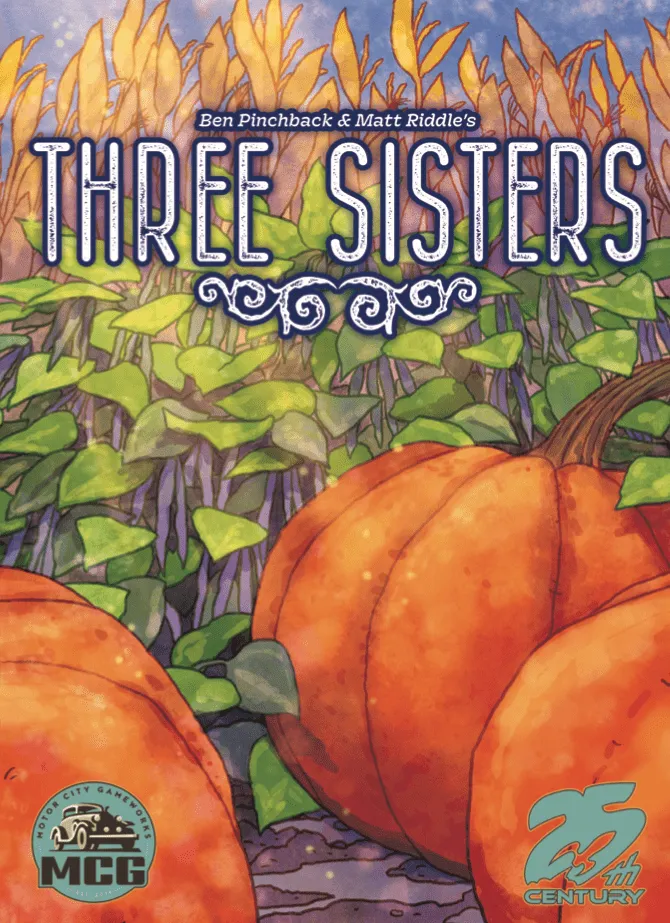
Three Sisters es un juego de mesa publicado en 2022 para 1–4 jugadores, con partidas de 30 a 60 minutos y a partir de 14 años. Fue diseñado por Ben Pinchback y Matt Riddle y sus mecánicas principales son Dice Rolling, Paper-and-Pencil y Solo / Solitaire Game.




En inglés
Three Sisters is a strategic roll-and-write game about backyard farming. Three Sisters is named after an indigenous agricultural technique still widely used today in which three different crops — pumpkins, corn, and beans — are planted close together. Corn provides a lattice for beans to climb, the beans bring nitrogen from the air into the soil, and the squash provides a natural mulch ground cover to reduce weeds and keep pests away. In the game, you have your own player sheet with multiple areas: the garden, which is divided into six numbered zones, each containing the three crop types; the apiary; compost; perennials; goods; fruit; and the shed, which is filled with tools that have special abilities. All the crops, fruits, flowers, and hives are represented by tracks that you will mark off as you acquire these items. Many of the tracks are interconnected with other elements in the game, giving you bonuses along the way. A common feature of these tracks are circles that represent a harvest, which generates goods; get enough goods, and you unlock bonus actions. Advancing on all of these tracks offers various amounts of points, advancements, and bonuses. The game lasts eight rounds. Each round, roll dice based on the number of players, group them by number, then place them on an action space of the circular action wheel, starting with the current position of the farmer; the farmer moves each round, which means that dice showing 1s, 2s, etc. will end up on different spaces each round. Once the dice have been placed, each player drafts one die and uses it as described below. Once everyone has drafted a die, all players get to use the lowest-valued die remaining on the action wheel. A die lets you do two things, which you can do in either order: Plant or water the numbered zone matching the value of the die. Take the action of the space from which you removed the die. To plant, you mark the bottom space of two empty crop tracks. (Note that you can't plant beans until the corn adjacent to the beans is tall enough to support them.) To water, you mark one space in all the crop tracks that already have at least one mark in them. As for the actions on the action wheel, you can: Plant or water again in the same numbered zone. Gain one compost (which lets you adjust die values) and four goods (which will get you bonuses at the farmer's market). Mark off the hive track, which can bring you points, goods, or bonus actions. Mark one of the four fruit tracks. Each fruit is worth different points and different amounts of goods and has different track lengths and circle positions. Visit the farmer's market, which gives you points and bonuses based on the number of goods you've collected. Mark one of the fifteen tool tracks in your shed. As soon as you complete a track, you gain that power or end-game scoring opportunity. Perennials don't have a direct action associated with them and are marked off only through actions in other areas, with the various perennials giving different bonuses as you mark them. At the end of the round, all players receive a bonus action, either rain that waters all numbered zones in your garden, a trip to the shed, or a visit to the farmer's market. After eight rounds, you score points for harvested crops, perennials, the apiary, fruit, and some shed items. Whoever has the most points wins. Three Sisters has a solo mode in which you try to top your own score against an "opponent" that drafts dice and blocks areas of your sheet.
Según el catálogo, Three Sisters admite de 1 a 4 jugadores. Este intervalo corresponde al número de jugadores indicado por la editorial, así que el juego puede prepararse para cualquier grupo dentro de ese margen. La preparación, algunas reglas y la puntuación pueden variar según el número de jugadores; consulta la configuración exacta en el reglamento de tu edición.
La duración indicada para Three Sisters es de 30 a 60 minutos, la estimación de la editorial para una partida completa. El tiempo real depende del grupo, del número de jugadores y del conocimiento de las reglas: las primeras partidas suelen alargarse y los grupos con experiencia terminan antes. La preparación y la explicación de las reglas no están incluidas.
El catálogo indica Three Sisters a partir de 14 años. Es la recomendación de la editorial y refleja la lectura necesaria, la complejidad de las reglas y las piezas pequeñas, no solo el tema. Los más pequeños a menudo pueden jugar con ayuda de un adulto: comprueba la edad recomendada en tu edición y la experiencia de tu grupo.
Three Sisters tiene una puntuación de complejidad de 2,6 sobre 5 según los jugadores de BoardGameGeek, lo que lo convierte en un juego algo ligero. La puntuación refleja cuánto conocimiento de reglas, planificación y toma de decisiones exige una partida típica. Los juegos exigentes requieren una explicación inicial más larga, así que conviene usar una guía de preparación.
Three Sisters pertenece a estas categorías: Dice y Farming. Sus mecánicas principales son Dice Rolling, Paper-and-Pencil y Solo / Solitaire Game. Las categorías describen el tema y la ambientación de un juego, mientras que las mecánicas describen lo que los jugadores hacen realmente en su turno. Cada mecánica lleva a una página del catálogo con juegos similares.
Los autores acreditados de Three Sisters son: Ben Pinchback y Matt Riddle. Estos créditos proceden de los datos publicados del juego y nombran a las personas responsables de su diseño, no a ilustradores ni editoriales. Las páginas de autor de MeepleRules reúnen otros títulos de los mismos autores, algo útil cuando un juego te gusta y buscas otros parecidos.
El catálogo clasifica Three Sisters como juego base. Se juega por sí solo con los componentes de la caja y no requiere ningún otro título. Las expansiones, si existen, añaden contenido o reglas nuevas y aparecen por separado en el catálogo con un enlace a este juego base.