
- Puesto en BGG
- BGG #17.784
- Puntuación BGG
- 7,3
Heptalion
- 2–4 jugadores
- 10 min
- Complejidad 1,3/5
- 2012
2015
Ayuda con las reglas de Vault
Explicaciones claras de turnos, efectos de cartas y situaciones dudosas, con referencias a fuentes oficiales e historial de preguntas guardado.
Para 2 jugadores
¿Qué quieres saber?
Las respuestas salen del reglamento oficial, con la página para comprobarlo.
Vault es un juego de mesa publicado en 2015 para 2 jugadores, con partidas de 15 a 30 minutos y a partir de 10 años. Fue diseñado por Néstor Romeral Andrés y sus mecánicas principales son Square Grid y Grid Movement.




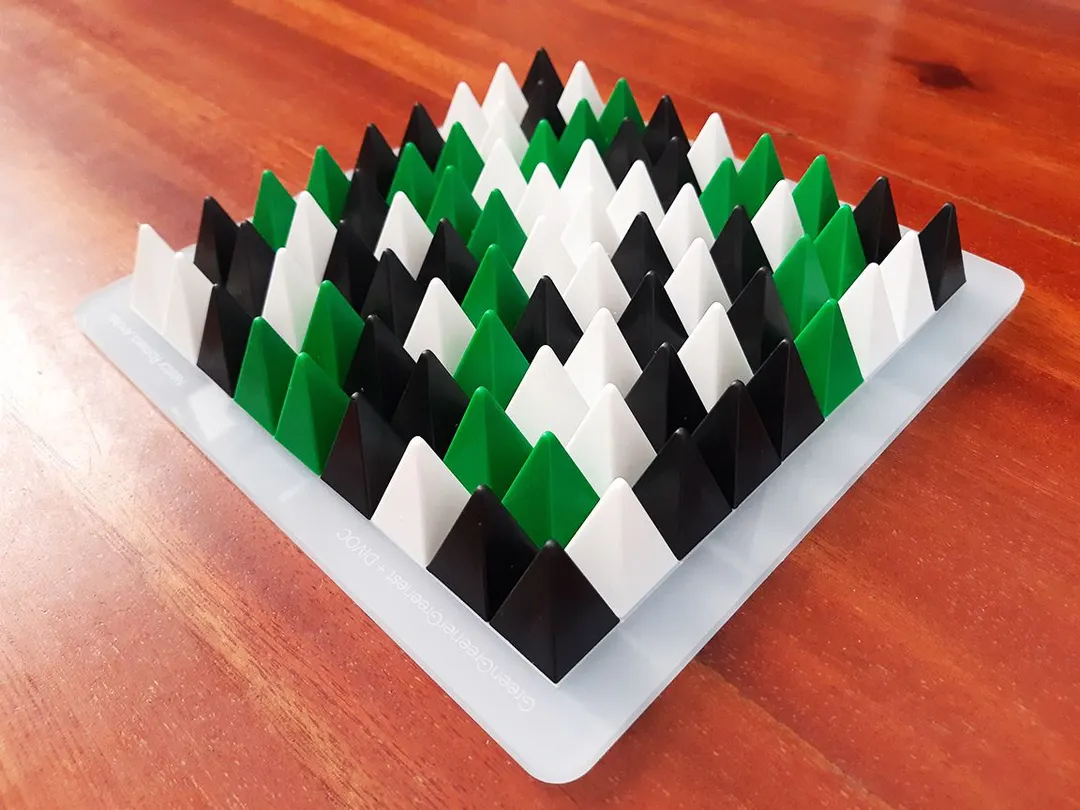
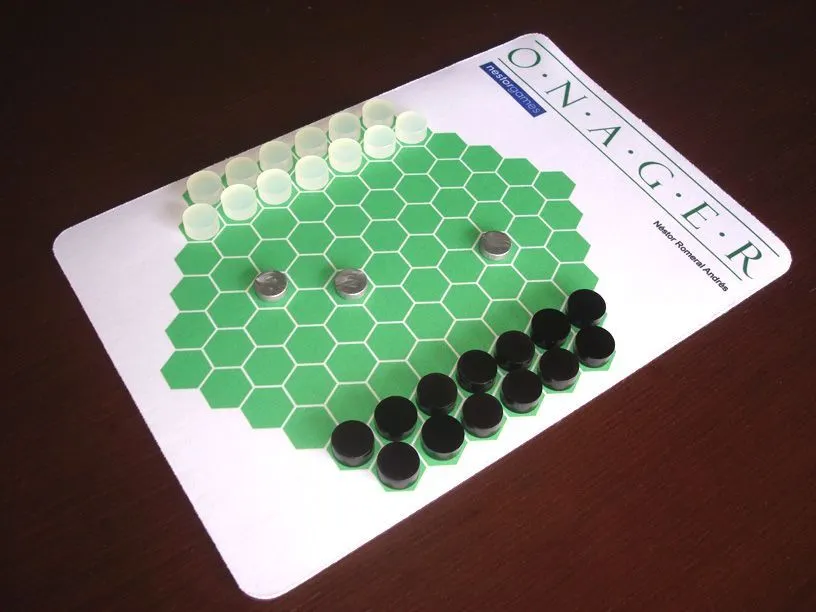

En inglés
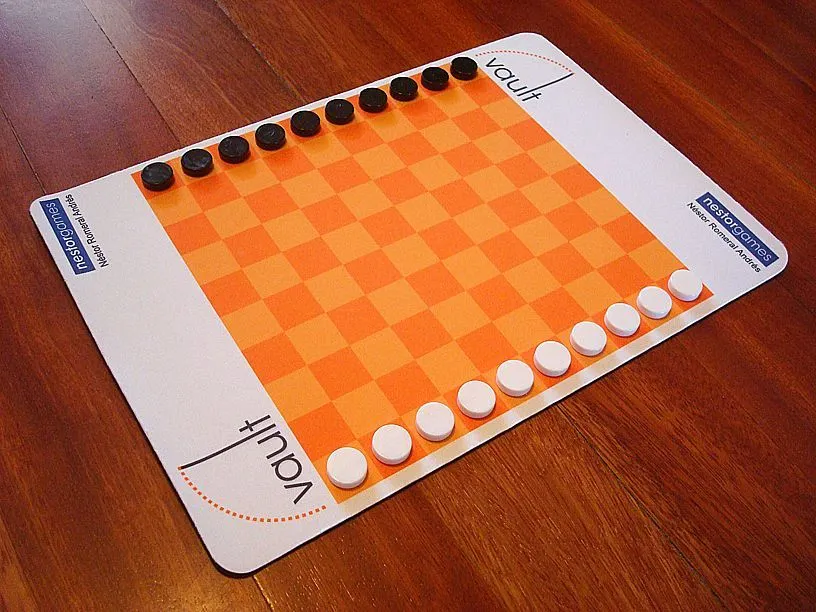
INTRODUCTION Vault is an abstract game in which each player tries to reach the opponent’s back rank. Vault is named after pole vaulting, which is a track and field event in which a person uses a long, flexible pole as an aid to jump over a bar. Vault is a derivative of Onager, by the same designer and uses a variation of its jumping mechanism (also present in Billabong, for example) that allows multiple directions to be used. It’s like vector movement but without acceleration. Unlike Onager, Vault only works well on a square grid, as jumping directions are difficult to visualize in a hexagonal grid. MATERIAL - A square grid with an even number of cells (recommended 10x10). Preferably checkered* for clarity, but this is not mandatory. - As many white and black pawns as the number of cells per side. SETUP Each player has an allocated colour (Black or White). Fill your nearest row with pawns of your colour (one per cell). HOW TO PLAY White starts. Players alternate turns during the game until the victory condition is reached. On your turn, either walk or jump with one of your pawns. Walk Move one of your pieces to an adjacent empty space as a King in Chess. Jump In order to jump, choose 2 friendly pieces. One of the pieces then jumps over the other piece in the direction defined by both pawns, landing on a space beyond that is at a distance equal to the distance between the two friendly pieces before the jump was made (like a mirror). Notice that jumping is not restricted to orthogonal or diagonal directions. The landing space must be either empty or occupied by an enemy piece, which is then captured and removed from the game. A piece cannot land on a friendly piece. Pieces cannot land outside the board. Notice that the spaces between the jumping pawn and the landing space don’t need to be empty. Also, captures can only be made by jumping. GAME END If at the start of your turn you have at least one piece on your opponent's back rank then you have won. If the above condition is not reached and you can’t make a legal movement at the start of your turn, you lose. This rarely happens. Players may agree on a draw at any moment during the game. NOTES FROM THE DESIGNER This is intended to be the simplest game that uses this jumping mechanism. I’ve decided not to use Onager’s stacking mechanism (in order to make is simpler for turn based online play and also playable with non-stacking pieces) or the multiple jump (as it would be almost impossible to think ahead). As a variant, you can use the stacking mechanism of Onager. (*) On a checkered board, the jumping piece always lands in a space of the same colour as the starting one.
Según el catálogo, Vault admite 2 jugadores. Es el número de jugadores indicado por la editorial, así que el juego está diseñado exactamente para esa cantidad de participantes. Las variantes para otros tamaños de grupo, si existen, se describen en el reglamento de tu edición; consúltalo antes de preparar otra configuración.
La duración indicada para Vault es de 15 a 30 minutos, la estimación de la editorial para una partida completa. El tiempo real depende del grupo, del número de jugadores y del conocimiento de las reglas: las primeras partidas suelen alargarse y los grupos con experiencia terminan antes. La preparación y la explicación de las reglas no están incluidas.
El catálogo indica Vault a partir de 10 años. Es la recomendación de la editorial y refleja la lectura necesaria, la complejidad de las reglas y las piezas pequeñas, no solo el tema. Los más pequeños a menudo pueden jugar con ayuda de un adulto: comprueba la edad recomendada en tu edición y la experiencia de tu grupo.
Vault tiene una puntuación de complejidad de 2,0 sobre 5 según los jugadores de BoardGameGeek, lo que lo convierte en un juego algo ligero. La puntuación refleja cuánto conocimiento de reglas, planificación y toma de decisiones exige una partida típica. Los juegos exigentes requieren una explicación inicial más larga, así que conviene usar una guía de preparación.
Vault pertenece a estas categorías: Print & Play y Abstract Strategy. Sus mecánicas principales son Square Grid y Grid Movement. Las categorías describen el tema y la ambientación de un juego, mientras que las mecánicas describen lo que los jugadores hacen realmente en su turno. Cada mecánica lleva a una página del catálogo con juegos similares.
Los autores acreditados de Vault son: Néstor Romeral Andrés. Estos créditos proceden de los datos publicados del juego y nombran a las personas responsables de su diseño, no a ilustradores ni editoriales. Las páginas de autor de MeepleRules reúnen otros títulos de los mismos autores, algo útil cuando un juego te gusta y buscas otros parecidos.
El catálogo clasifica Vault como juego base. Se juega por sí solo con los componentes de la caja y no requiere ningún otro título. Las expansiones, si existen, añaden contenido o reglas nuevas y aparecen por separado en el catálogo con un enlace a este juego base.