
- Puesto en BGG
- BGG #16.367
- Puntuación BGG
- 7,9
Ayu
- 2 jugadores
- 45 min
- Complejidad 2,5/5
- 2011
2013
Ayuda con las reglas de Veletas
Explicaciones claras de turnos, efectos de cartas y situaciones dudosas, con referencias a fuentes oficiales e historial de preguntas guardado.
Para 2 jugadores
¿Qué quieres saber?
Las respuestas salen del reglamento oficial, con la página para comprobarlo.
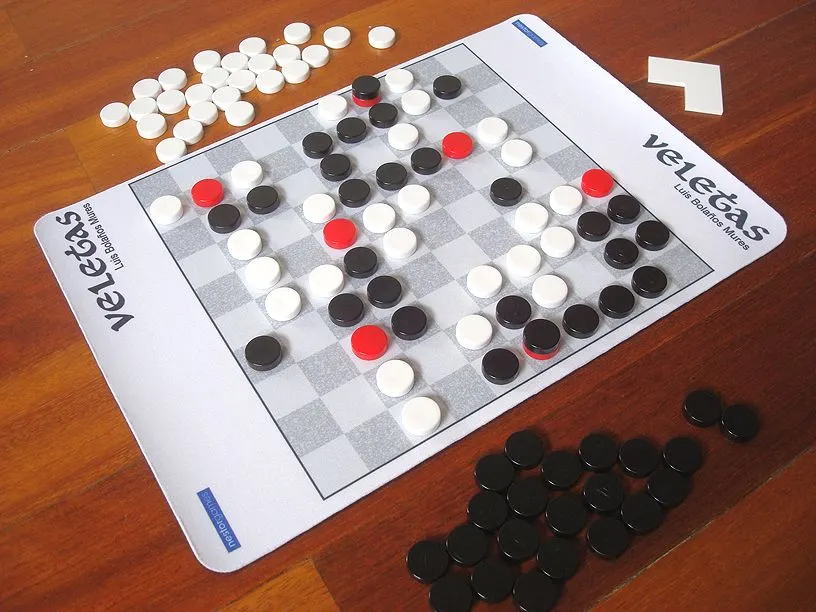
Veletas es un juego de mesa publicado en 2013 para 2 jugadores, con partidas de 45 minutos y a partir de 5 años. Fue diseñado por Luis Bolaños Mures y sus mecánicas principales son Square Grid, Grid Movement y Enclosure.
En inglés
Veletas is a drawless territory game for two players: Black and White. It is played on the spaces (squares) of a 10x10 checkered square board, which is initially empty. Apart from the board, the necessary material comprises seven shooters and a sufficient number of black and white stones. Both players control a number of neutral red pieces and shoot stones of their own colour from them. In order to win, a player must claim a majority of neutral pieces by having them surrounded by larger groups of their own pieces than their opponent's. This game won (along with Four) the BoardGameGeek Best Combinatorial 2-Player Game of 2013 Award. Definitions A group is a set of one or more like-colored, orthogonally adjacent stones. The size of a group is the number of stones in it. Stones on top of shooters are not part of any groups. A trapped shooter is a shooter that cannot make any legal move in the current position. Play The first player begins by placing three shooters and one black stone on empty squares of the board. The second player then chooses which player will be Black and which will be White. Next, White places the remaining four shooters and one white stone on empty squares of the board. In both cases, no shooters can be placed on the perimeter of the board. This restriction does not apply to the rest of the game. From then on, the players take turns, starting with Black. On your turn, you may (but are not obliged to) move a shooter to an empty square in a straight orthogonal or diagonal line, without jumping over any stones. Then, you must place a stone of your color on an empty square that is a straight orthogonal or diagonal line away from the square onto which the shooter was moved (or from any shooter, if none was moved), with no stones in between along that line. This is called shooting. Claimed shooters (see below) cannot move or shoot. Note shooters can move and shoot over claimed or unclaimed shooters. After shooting, if there are any trapped shooters on the board that have not been claimed before, each one of them is claimed by the player who owns the biggest group orthogonally adjacent to it. If there is no such group or the biggest such groups of each color are the same size, the shooter is claimed by the opponent. Claiming a shooter is indicated by placing a stone of the corresponding color on top of it. Claimed shooters remain unchanged for the rest of the game. The game ends when a player has claimed the majority of shooters, i.e. at least four of them. That player wins. Draws are not possible. Smaller versions For shorter but still reasonable games, the following variants are suggested: 7x7 board with three shooters. The first player places one shooter, and White places the other two. Whoever claims two shooters wins. 9x9 board with five shooters. The first player places two shooters, and White places the other three. Whoever claims three shooters wins. Online Play Board Game Arena (real time, turn-based) Boardspace.net (real time, AI option) igGameCenter (real time) AbstractPlay (turn-based) Mobile Apps Boardspace.net local multiplayer or online, IOS Boardspace.net local multiplayer or online, Android
Según el catálogo, Veletas admite 2 jugadores. Es el número de jugadores indicado por la editorial, así que el juego está diseñado exactamente para esa cantidad de participantes. Las variantes para otros tamaños de grupo, si existen, se describen en el reglamento de tu edición; consúltalo antes de preparar otra configuración.
La duración indicada para Veletas es de 45 minutos, la estimación de la editorial para una partida completa. El tiempo real depende del grupo, del número de jugadores y del conocimiento de las reglas: las primeras partidas suelen alargarse y los grupos con experiencia terminan antes. La preparación y la explicación de las reglas no están incluidas.
El catálogo indica Veletas a partir de 5 años. Es la recomendación de la editorial y refleja la lectura necesaria, la complejidad de las reglas y las piezas pequeñas, no solo el tema. Los más pequeños a menudo pueden jugar con ayuda de un adulto: comprueba la edad recomendada en tu edición y la experiencia de tu grupo.
Veletas tiene una puntuación de complejidad de 2,0 sobre 5 según los jugadores de BoardGameGeek, lo que lo convierte en un juego algo ligero. La puntuación refleja cuánto conocimiento de reglas, planificación y toma de decisiones exige una partida típica. Los juegos exigentes requieren una explicación inicial más larga, así que conviene usar una guía de preparación.
Veletas pertenece a estas categorías: Territory Building, Print & Play y Abstract Strategy. Sus mecánicas principales son Square Grid, Grid Movement y Enclosure. Las categorías describen el tema y la ambientación de un juego, mientras que las mecánicas describen lo que los jugadores hacen realmente en su turno. Cada mecánica lleva a una página del catálogo con juegos similares.
Los autores acreditados de Veletas son: Luis Bolaños Mures. Estos créditos proceden de los datos publicados del juego y nombran a las personas responsables de su diseño, no a ilustradores ni editoriales. Las páginas de autor de MeepleRules reúnen otros títulos de los mismos autores, algo útil cuando un juego te gusta y buscas otros parecidos.
El catálogo clasifica Veletas como juego base. Se juega por sí solo con los componentes de la caja y no requiere ningún otro título. Las expansiones, si existen, añaden contenido o reglas nuevas y aparecen por separado en el catálogo con un enlace a este juego base.