- Puntuación BGG
- 8,3
Expansión de Victory at Sea: Battle for the Pacific
Victory at Sea: Kriegsmarine U-Boats & MTB sections
2020
Ayuda con las reglas de Victory at Sea: Kriegsmarine U-Boats & MTB sections
Explicaciones claras de turnos, efectos de cartas y situaciones dudosas, con referencias a fuentes oficiales e historial de preguntas guardado.
- 2 jugadores
- 10+

Asistente de reglas de Victory at Sea: Kriegsmarine U-Boats & MTB sections
¿Qué quieres saber?
Las respuestas salen del reglamento oficial, con la página para comprobarlo.
Victory at Sea: Kriegsmarine U-Boats & MTB sections es una expansión de Victory at Sea: Battle for the Pacific publicada en 2020 para 2 jugadores y a partir de 10 años. Sus mecánicas principales son Simulation.
Sobre el juego
En inglés
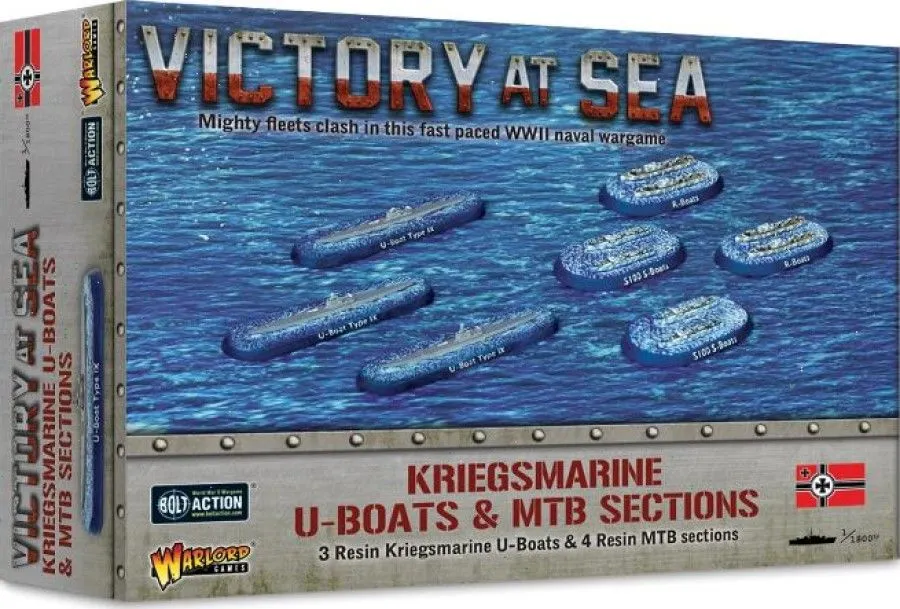
Submarines: A long-ranged submersible, the Type IX was the most successful U-boat of the war, with each vessel averaging over 100,000 tons of shipping sunk. One Type IX, U-107, made the most successful convoy mission of the war, with nearly 100,000 tons of shipping sunk out of Freetown in Africa. The latest variants of this design were capable of ranges of more than 23,000 miles, allowing them to rove far in search of convoys, while their heavy load of torpedoes allowed them to keep pace with a convoy, attacking night after night. MTBs: The R1-class of R-Boat (from the German Räumboot, meaning minesweeper) was intended to be used as a shallow water minesweeper but, as the war went on, it became a multi-role craft. Its duties expanded to include patrol, antisubmarine, convoy escort, minelaying, and rescue operations. Some classes of R-Boat, such as the R310, were fitted with torpedo tubes, though performance was very modest compared to craft specifically designed for the role. The ultimate S-Boat to be operational in significant numbers was the S-100-class, which was produced from 1943 and was said to be the best fast patrol boat of its time. The S-100-class was nicknamed the Calotte, as it featured a rounded armoured bridge. It was powered by three Daimler-Benz engines giving it an overall capacity of around 7,500 hp and developing an outstanding top speed of 48 knots. Contents: 3 Type IX U-Boats 2 S-100 S-Boat Sections 2 R-Boat Sections Ship Cards —description from the publisher
Mecánicas
Editoriales
- Warlord Games
Preguntas y respuestas
Según el catálogo, Victory at Sea: Kriegsmarine U-Boats & MTB sections admite 2 jugadores. Es el número de jugadores indicado por la editorial, así que el juego está diseñado exactamente para esa cantidad de participantes. Las variantes para otros tamaños de grupo, si existen, se describen en el reglamento de tu edición; consúltalo antes de preparar otra configuración.
El catálogo indica Victory at Sea: Kriegsmarine U-Boats & MTB sections a partir de 10 años. Es la recomendación de la editorial y refleja la lectura necesaria, la complejidad de las reglas y las piezas pequeñas, no solo el tema. Los más pequeños a menudo pueden jugar con ayuda de un adulto: comprueba la edad recomendada en tu edición y la experiencia de tu grupo.
Victory at Sea: Kriegsmarine U-Boats & MTB sections pertenece a estas categorías: Wargame, Miniatures y Nautical. Sus mecánicas principales son Simulation. Las categorías describen el tema y la ambientación de un juego, mientras que las mecánicas describen lo que los jugadores hacen realmente en su turno. Cada mecánica lleva a una página del catálogo con juegos similares.
El catálogo clasifica Victory at Sea: Kriegsmarine U-Boats & MTB sections como expansión de Victory at Sea: Battle for the Pacific. Las expansiones añaden contenido, reglas o escenarios al juego base y normalmente no se pueden jugar solas, así que necesitas Victory at Sea: Battle for the Pacific para usarla. Comprueba que tu edición de Victory at Sea: Battle for the Pacific sea compatible, porque algunas expansiones se revisaron entre ediciones.