
- Puntuación BGG
- 8,3
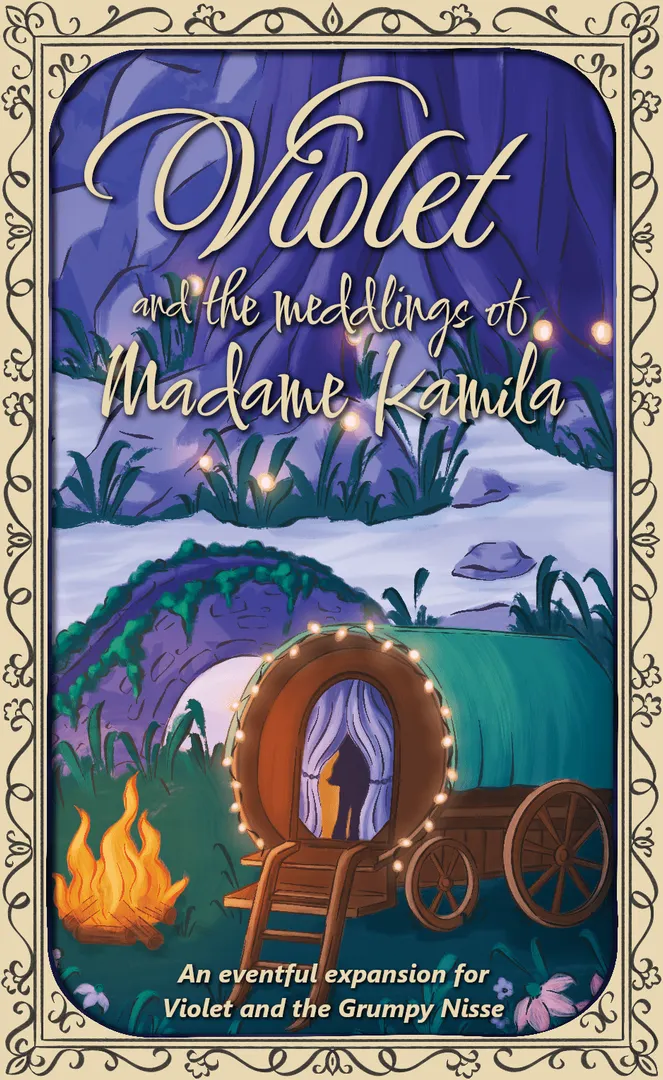
Violet and the meddlings of Madame Kamila
- 2 jugadores
- 20–30 min
- Complejidad 2,0/5
- 2025

2022
Ayuda con las reglas de Violet and the Grumpy Nisse
Explicaciones claras de turnos, efectos de cartas y situaciones dudosas, con referencias a fuentes oficiales e historial de preguntas guardado.
Para 2 jugadores
¿Qué quieres saber?
Las respuestas salen del reglamento oficial, con la página para comprobarlo.
Violet and the Grumpy Nisse es un juego de mesa publicado en 2022 para 2 jugadores, con partidas de 20 a 30 minutos y a partir de 12 años. Fue diseñado por Pedro Pereira y sus mecánicas principales son Variable Player Powers, Open Drafting y Trick-taking.






En inglés
In Violet and the Grumpy Nisse, one player is Violet and the other is Torech, the very grumpy nisse (a creature from Nordic folklore similar to a gnome) who has been kicked out of every single household in the village and taken shelter in the woods, which he claimed as his own domain. Now, Violet is setting out to meet with her friend Ordep, the friendly troll, a journey that takes her right through the woods that Torech has claimed for himself. After being kicked out of the village, Torech cannot stand the idea of a human invading his home, let alone a human who is friends with a troll! So he is out to make Violet's journey as unpleasant as he possibly can, playing all sorts of tricks on her. Violet and the Grumpy Nisse is a two-player trick-taking game. Players take different approaches on how to play this game depending on who they are playing as: Violet has control over the pacing of the game, but is also more vulnerable to losing tricks as she has to manage her lantern, making sure it's always fueled so that she doesn't get lost in the darkness of the woods at night. She also wasn't expecting a nisse to cross her path; this can be scary, and she has to manage her fear so not to be overwhelmed by her own paranoia. Torech has very little control over the pacing of the game, but he does has a few tricks up his sleeve. As Violet's fear of him increases, he becomes bolder and sets out more and more traps that make it harder for Violet to reach her friend. Also, unlike Violet, losing a trick is not nearly as bad for Torech as it is for Violet. He, after all, is the master of tricks! The game ends with a win for Violet if she reaches the end of her journey. Torech wins if Violet's lantern runs out of fuel, or if her fear sneaks up on her before she gets to Ordep. What's unique about this trick taking game: It's highly thematic and instead of keeping track of scores on a pad, you will have Violet's pawn advancing on a map, that displays her progress and how close/far she is from winning the game. Torech has two tracks on the board he will be focusing on and that display how close/far he is from winning the game: Violet's fear, which he threatens with each trick he successfully plays on her (wins), and Violet's Light track, which he wants to run out as quickly as possible so that she gets lost. Trump will change over the course of a game as Violet journeys through the different parts of the landscape. Because Violet controls the pacing, she will be able to speed through them, or stay for a little longer to take advantage of a certain suit. Most cards have a special ability, however, a card's ability is triggered only if it isn't used as a trump (trump is determined by Violet's location on the map). Thanks to the many different traps Torech can use, each game will have different events play out at different timings, depending on how early Violet becomes a victim of her own fears.
Según el catálogo, Violet and the Grumpy Nisse admite 2 jugadores. Es el número de jugadores indicado por la editorial, así que el juego está diseñado exactamente para esa cantidad de participantes. Las variantes para otros tamaños de grupo, si existen, se describen en el reglamento de tu edición; consúltalo antes de preparar otra configuración.
La duración indicada para Violet and the Grumpy Nisse es de 20 a 30 minutos, la estimación de la editorial para una partida completa. El tiempo real depende del grupo, del número de jugadores y del conocimiento de las reglas: las primeras partidas suelen alargarse y los grupos con experiencia terminan antes. La preparación y la explicación de las reglas no están incluidas.
El catálogo indica Violet and the Grumpy Nisse a partir de 12 años. Es la recomendación de la editorial y refleja la lectura necesaria, la complejidad de las reglas y las piezas pequeñas, no solo el tema. Los más pequeños a menudo pueden jugar con ayuda de un adulto: comprueba la edad recomendada en tu edición y la experiencia de tu grupo.
Violet and the Grumpy Nisse tiene una puntuación de complejidad de 2,0 sobre 5 según los jugadores de BoardGameGeek, lo que lo convierte en un juego algo ligero. La puntuación refleja cuánto conocimiento de reglas, planificación y toma de decisiones exige una partida típica. Los juegos exigentes requieren una explicación inicial más larga, así que conviene usar una guía de preparación.
Violet and the Grumpy Nisse pertenece a estas categorías: Card Game y Fantasy. Sus mecánicas principales son Variable Player Powers, Open Drafting y Trick-taking. Las categorías describen el tema y la ambientación de un juego, mientras que las mecánicas describen lo que los jugadores hacen realmente en su turno. Cada mecánica lleva a una página del catálogo con juegos similares.
Los autores acreditados de Violet and the Grumpy Nisse son: Pedro Pereira. Estos créditos proceden de los datos publicados del juego y nombran a las personas responsables de su diseño, no a ilustradores ni editoriales. Las páginas de autor de MeepleRules reúnen otros títulos de los mismos autores, algo útil cuando un juego te gusta y buscas otros parecidos.
El catálogo clasifica Violet and the Grumpy Nisse como juego base. Se juega por sí solo con los componentes de la caja y no requiere ningún otro título. Las expansiones, si existen, añaden contenido o reglas nuevas y aparecen por separado en el catálogo con un enlace a este juego base.