
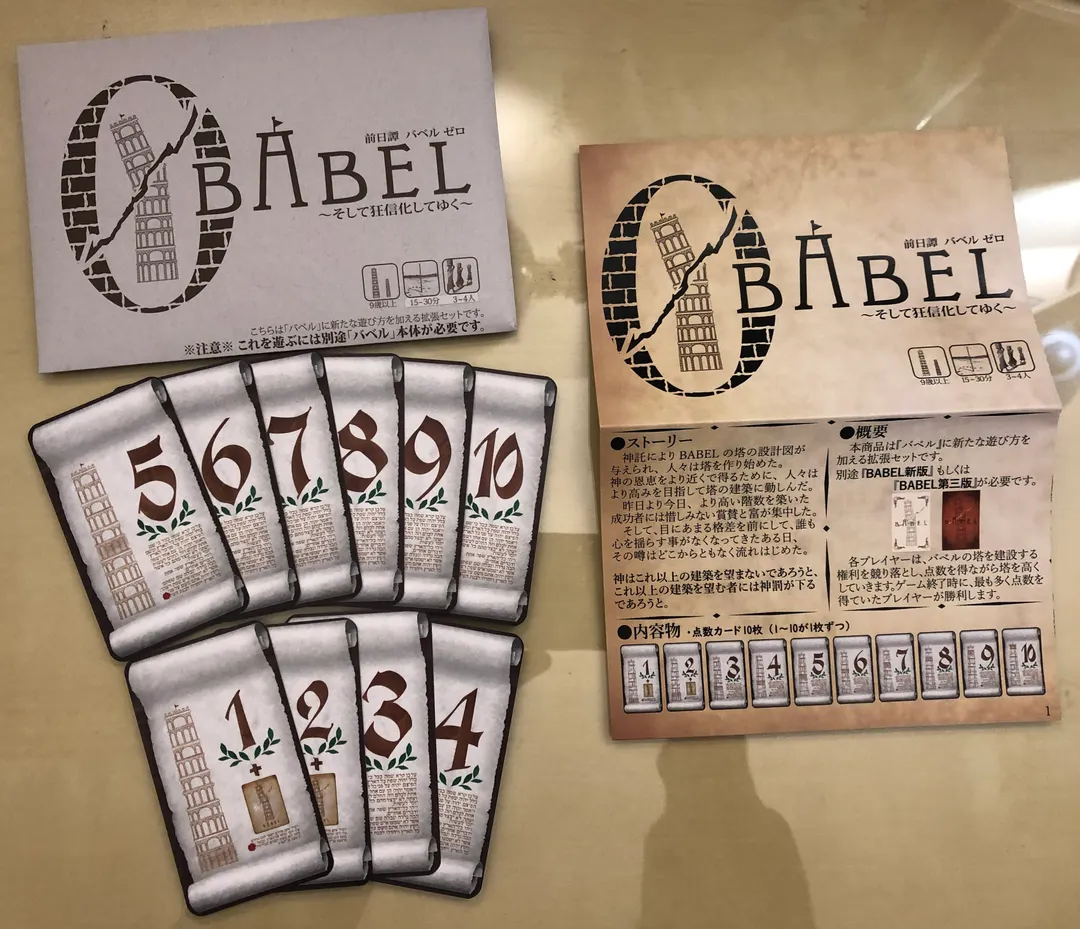
BABEL: 0
- 3–4 joueurs
- 15–30 min
- 2021
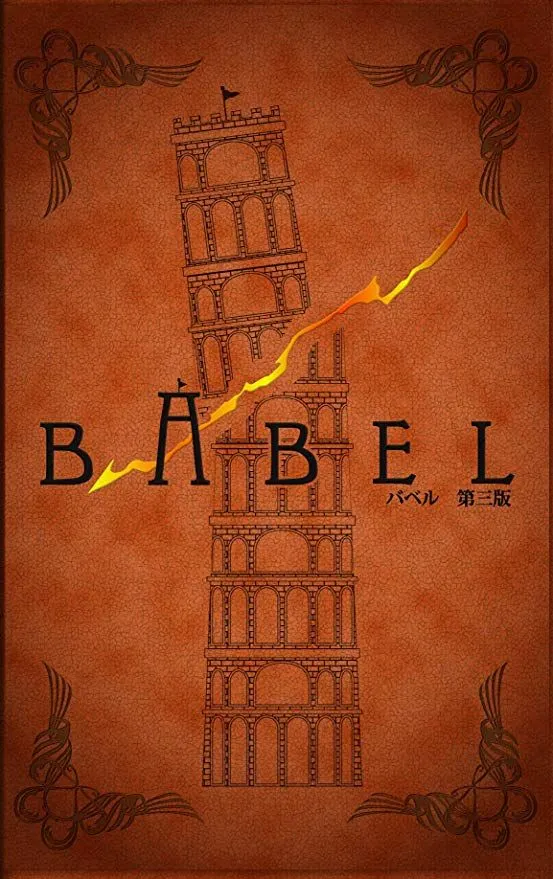
2016
Aide aux règles de BABEL
Des explications claires des tours, effets de cartes et situations litigieuses, avec des références aux sources officielles et un historique des questions sauvegardé.
Pour 1 joueur
Que voulez-vous savoir ?
Les réponses viennent du livret officiel, avec la page à vérifier.
BABEL est un jeu de société sorti en 2016 pour 1 à 5 joueurs, avec des parties de 15 à 30 minutes et à partir de 10 ans. Il a été conçu par Masakazu Takizawa (たきざわ まさかず) et ses principales mécaniques sont Hand Management et Cooperative Game.







En anglais
BABEL is a balancing game in which players make a tower of paper by building walls of different heights. This game has three modes of play: hidden identity mode (saboteurs may exist), limited communication co-operative mode (players use strange languages - frog, robot, dog, cat, no words), and random co-operative mode (players may not choose walls). In hidden identity mode, players are secretly assigned a role: Builder or Saboteur (Fanatic is the 2nd Edition). A Builder's goal is to build an eight-tier tower, and a Saboteur's goal is to make one of the builders collapse the tower. The 2nd edition, published in 2017, kept the gameplay the same, but made significant changes to the components of the 1st edition (2016). The original edition had the player's Height cards also acting as the actual floors of the tower. The Height card had a sort of Pac-man shape. By combining two pieces, you made the hexagonal floor you would build. The player building the level was meant to arrange the floor parts to match the wall parts. That is, if the heights combined are a 3 and a 5, the 3-wall goes over the 3-floor, and the 5-wall goes over the 5-floor. The 2017 edition did away with this physical mechanism; instead, players had normal playing cards numbered 1 to 5, and wholly separate floor tiles to actually build with. This edition also introduced a new card 'Break Down The Wall', which means that only one wall piece is used in the level being built. Also, in the new edition, the tower starts with a floor, and on your turn you place two walls and then the floor. The new edition also has a sturdier box and is slightly larger. Gameplay Each player has three cards in their hand. In your turn, you place a floor card, which is numbered 1-5, face-up, and other players place a floor card face-down, saying a hint (saboteurs might be misleading you). Then you choose and reveal one of these face-down cards (the unused go unseen to a discard pile), take a floor tile (in the 2016 edition - combine the chosen card with yours to make a hexagonal floor), and take two walls that correspond to the floor numbers. You must place the floor and the walls on top of tower without making it collapse. Height of walls gradually vary over floor numbers, so you should pick the same number if you want to build an upright tower. If you are a saboteur, it's up to you whether you secretly or explicitly betray the builders. You may try to mislead builders to take unbalanced walls, or boldly build up a skewed tower in your turn. But beware. Your side loses the game if you make the tower collapse yourself. You may also reveal your identity during your turn, in which case builders need to complete one more floor to win the game. In the co-operative mode, players may loosely discuss which card ought to be selected (you cannot say obvious info, such as 'my card is a 3!'). But discussions are done in foreign languages - dog, cat, frog, robot, and no words. You are dealt a card and can only use your given language to communicate. The game can be played as a solitaire but only in random mode. You randomly take two floor cards and use the corresponding walls to build one tier. Repeat the process until you build 12-tier tower without it falling. There is an instructional manga by 七色洋品店 (Nanairo Youhinten) in the first edition. The second edition has a manga by Ayame Gonta (あやめ ゴン太). These are online on the Game Market webpage for the game (see links below). Publisher's summary BABEL is a dexterity game where you build a tower using walls of unoriented heights. You may play the game in 3 variations: Hidden identity mode - the traitor secretly tries to collapse the tower Co-op mode - as postfin of the myth, build with limited communications Solitaire mode - build the tower as high as you can with random draw of walls Difference between the first edition and the 2017 new version: The following improvements were made from the version sold at TGM2016. 1: Introduced the "Height Card". No need to combine the floor cards anymore. 2: Introduced the "Break down the wall" card. When played, the active player must build the tower with only 1 wall card this turn. 3: Construction order for each turn altered, from floor=>wall to wall=>floor. 4: More sturdier box. BABELは不ぞろいのカードを積み上げて、塔を完成させるバランスゲームです。 裏切り者が暗躍する正体隠匿モード、神話の後日談が楽しめる完全協力モード、ランダムにカードを積む神の戯れモード1パッケージで3つのモードが楽しめます。 初版と2017年新版との違い: 2016年にゲームイベント『ゲームマーケット』にて頒布した初版から、下記の点が改良されています。 1.高さ番号カードが導入され、半分ずつの床を組み合わせる必要がなくなりました。 2.壁柱1枚で支えなければならない〈破壊カード〉が追加されました。 3.手番での建設行程が、床→壁から壁→床に変わりました。 4.箱が頑丈になりました。 BABELは不揃いの高さの壁カードを積み上げ塔を完成させるバランスゲームです。裏切り者が暗躍する正体隠匿モード、神話の後日談を楽しむ母語が使えなくなる完全協力モード、ランダムに壁カードを積む髪の戯れモード、1パッケージで3つのモードが楽しめます。 ●正体隠匿モード● 人数+1枚の人格カードを配り、建設者(建てたい人)狂信者(壊したい人)を決定します。床カード5種を各3枚配り、手番プレイヤーはその中から1枚を表にして出します。他のプレイヤーは一言そえて裏向きにカードを出します。手番プレイヤーはその中から1枚選び床カードを組み合わせ1枚にし、対応する、高さの違う壁カード(5種類あります)をそれぞれの床の上にのせます。8段積めたら建設者の勝ち、塔を崩したらその陣営の負けになります。また、狂信者は自分の手番に正体を明かすことで、完成段数を1段上げることができます。
Selon le catalogue, BABEL se joue de 1 à 5 personnes. Cette fourchette correspond au nombre de joueurs indiqué par l’éditeur : le jeu s’installe donc pour toute taille de groupe dans cette limite. La mise en place, certaines règles et le décompte peuvent varier selon l’effectif ; vérifiez la configuration exacte dans la règle de votre édition.
La durée indiquée pour BABEL est de 15 à 30 minutes, selon l’estimation de l’éditeur pour une partie complète. La durée réelle dépend du groupe, de l’effectif et de la connaissance des règles : les premières parties sont plus longues, les groupes expérimentés terminent plus vite. Mise en place et explication des règles ne sont pas comprises.
Le catalogue indique BABEL à partir de 10 ans. C’est la recommandation de l’éditeur ; elle tient compte de la lecture nécessaire, de la complexité des règles et des petits composants, pas seulement du thème. Les plus jeunes peuvent souvent participer avec l’aide d’un adulte : vérifiez l’âge indiqué sur votre édition et tenez compte de l’expérience de votre groupe.
BABEL appartient à ces catégories : Card Game, Party Game et Bluffing. Ses principales mécaniques sont Hand Management et Cooperative Game. Les catégories décrivent le thème et l’univers d’un jeu, tandis que les mécaniques décrivent ce que les joueurs font réellement pendant leur tour. Chaque mécanique mène à une page du catalogue avec des jeux similaires.
Les auteurs crédités pour BABEL sont : Masakazu Takizawa (たきざわ まさかず). Ces crédits proviennent des données publiées du jeu et désignent les personnes responsables de sa conception, et non les illustrateurs ou les éditeurs. Les pages d’auteurs sur MeepleRules regroupent les autres titres des mêmes auteurs, ce qui est utile lorsqu’un jeu vous plaît et que vous en cherchez de similaires.
Le catalogue présente BABEL comme un jeu de base. Il se joue seul avec le matériel contenu dans la boîte et ne nécessite aucun autre titre. Les extensions, s’il en existe, y ajoutent du contenu ou des règles et sont répertoriées séparément dans le catalogue, avec un lien vers ce jeu de base.