

- Rang BGG
- BGG #2 362
- Note BGG
- 8,0
SPQR (Deluxe Edition)
- 1–4 joueurs
- 240 min
- Complexité 3,9/5
- 2008
2008
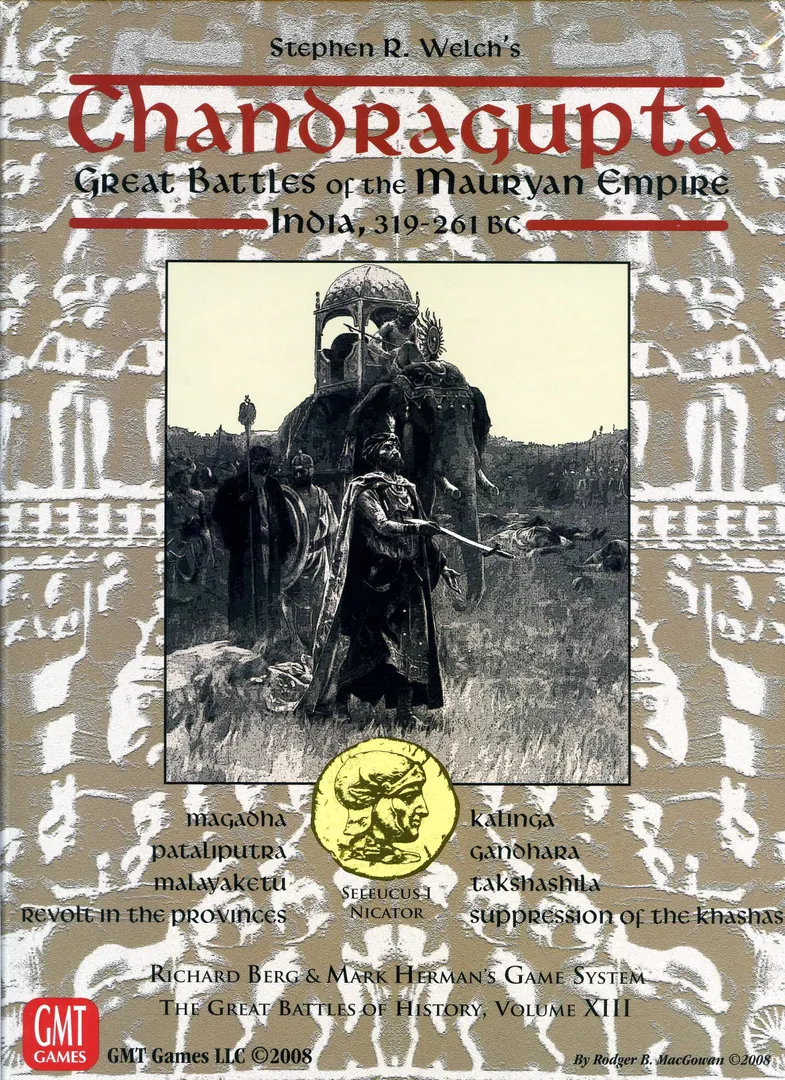
Aide aux règles de Chandragupta: Great Battles of the Mauryan Empire – India, 319-261 BC
Des explications claires des tours, effets de cartes et situations litigieuses, avec des références aux sources officielles et un historique des questions sauvegardé.
Pour 2 joueurs
Que voulez-vous savoir ?
Les réponses viennent du livret officiel, avec la page à vérifier.
Chandragupta: Great Battles of the Mauryan Empire – India, 319-261 BC est un jeu de société sorti en 2008 pour 2 joueurs, avec des parties de 240 minutes et à partir de 12 ans. Il a été conçu par Richard H. Berg, Mark Herman, Alan J. Ray et Stephen R. Welch et ses principales mécaniques sont Dice Rolling et Hexagon Grid.










En anglais
Chandragupta brings the art of war in ancient India to GMT’s “Great Battles of History” Series. Beginning with Chandragupta Maurya’s victories over the Nanda clan, the game follows the brief but rapid rise of the Mauryan dynasty, from Chandragupta’s expulsion of Seleucus from the Indus river valley to the conquest of the last independent kingdom on the subcontinent, Kalinga, by his grandson Ashoka. The Mauryan empire became the largest and most powerful in India’s history – a distinction that would remain unchallenged until the arrival of the Mughals some 1,700 years later. Chandragupta simulates the traditional “four-fold” division of the Indian military system, with the elephant corps reigning supreme, and the hordes of light infantry regarded as little more than fodder for chariots’ wheels and trampling pachyderms. Chariots still play a prominent role on the Indian battlefield of the era, but the cavalry, with its versatility and endurance, is a potent competitor. In Chandragupta, victory goes to the commander who can master the unique aspects of the differing Indian military “classes” – the professional, lifelong soldiers called Maulas, the mercenary levies, unpredictable tribal allies, and the militias of the powerful trade guilds. While Maulas and mercenaries are commanded under a single hierarchical command structure, the tribals and the trade guilds are led by independent chiefs. Units include cataphracted elephants, “heavy” four- (and sometimes eight-!) wheeled chariots, and even an “elCH” unit – yes, elephant-pulled chariots. Rules include Combined Chariot/Infantry and Elephant/Infantry lines, Dharmayudda or “just” warfare, Guild enmity, and Tribal loyalty. EL units can even breach camp walls and pull down city gates (if they don’t rampage first). Fans of GBoH will appreciate the exciting variety in Chandragupta’s scenarios, from huge set-piece battles on flat plains, to tribal suppressions, a night assault on a military camp, and street fighting in the city of Takshashila. Chandragupta is the 13th volume in the series. Battles: Pataliputra (319 BC) – Chandragupta’s mentor, the Brahmin Chanakya, brashly challenges the Nanda dynasty with a cadre of mercenaries. Maghada (317 BC) – Chandragupta again confronts the Nandas, who are this time led by the formidable general Bhadrasala. Mayalaketu (317 BC) – Chanakya attacks the turncoat general Mayalaketu and his rebel army in camp. Takshashila (316 BC) – the Thracian general Eudamus, allied to Indian king Ambhi, defends the city of Takshashila against Chandragupta’s assault. Gandhara (304 BC) – former officer of Alexander the Great, now “Master of Babylonia,” Seleucus I Nicator crosses the Indus river to invade Gandhara, and is confronted by the Mauryan army at the river’s banks. Revolt in the Provinces (275 BC) – Chandragupta’s grandson, Ashoka, brings a relief force to lift a rebel siege of Takshashila and rescue the aging Chanakya who is holed up in the city’s palace. Khashas (274 BC) – Chandragupta’s son, Bhindusara, puts down a confederation of the independent Khasha kings with an attack on their mountain strongholds. Kalinga (261 BC) – the most famous battle of the Mauryan era, Ashoka’s army attacks the kingdom of Kalinga in a huge – and bloody -- set-piece battle.
Selon le catalogue, Chandragupta: Great Battles of the Mauryan Empire – India, 319-261 BC se joue à 2 personnes. C’est le nombre de joueurs indiqué par l’éditeur : le jeu est donc conçu pour exactement ce nombre de participants. Les variantes pour d’autres tailles de groupe, s’il en existe, sont décrites dans la règle de votre édition ; consultez-la avant d’installer une autre configuration.
La durée indiquée pour Chandragupta: Great Battles of the Mauryan Empire – India, 319-261 BC est de 240 minutes, selon l’estimation de l’éditeur pour une partie complète. La durée réelle dépend du groupe, de l’effectif et de la connaissance des règles : les premières parties sont plus longues, les groupes expérimentés terminent plus vite. Mise en place et explication des règles ne sont pas comprises.
Le catalogue indique Chandragupta: Great Battles of the Mauryan Empire – India, 319-261 BC à partir de 12 ans. C’est la recommandation de l’éditeur ; elle tient compte de la lecture nécessaire, de la complexité des règles et des petits composants, pas seulement du thème. Les plus jeunes peuvent souvent participer avec l’aide d’un adulte : vérifiez l’âge indiqué sur votre édition et tenez compte de l’expérience de votre groupe.
Chandragupta: Great Battles of the Mauryan Empire – India, 319-261 BC obtient une note de complexité de 3,8 sur 5 auprès des joueurs de BoardGameGeek, ce qui en fait un jeu exigeant. Cette note reflète la quantité de règles, de planification et de décisions qu’exige une partie typique. Prévoyez une explication plus longue pour les jeux exigeants et utilisez un guide de préparation avant la soirée.
Chandragupta: Great Battles of the Mauryan Empire – India, 319-261 BC appartient à ces catégories : Wargame et Ancient. Ses principales mécaniques sont Dice Rolling et Hexagon Grid. Les catégories décrivent le thème et l’univers d’un jeu, tandis que les mécaniques décrivent ce que les joueurs font réellement pendant leur tour. Chaque mécanique mène à une page du catalogue avec des jeux similaires.
Les auteurs crédités pour Chandragupta: Great Battles of the Mauryan Empire – India, 319-261 BC sont : Richard H. Berg, Mark Herman, Alan J. Ray et Stephen R. Welch. Ces crédits proviennent des données publiées du jeu et désignent les personnes responsables de sa conception, et non les illustrateurs ou les éditeurs. Les pages d’auteurs sur MeepleRules regroupent les autres titres des mêmes auteurs, ce qui est utile lorsqu’un jeu vous plaît et que vous en cherchez de similaires.
Le catalogue présente Chandragupta: Great Battles of the Mauryan Empire – India, 319-261 BC comme un jeu de base. Il se joue seul avec le matériel contenu dans la boîte et ne nécessite aucun autre titre. Les extensions, s’il en existe, y ajoutent du contenu ou des règles et sont répertoriées séparément dans le catalogue, avec un lien vers ce jeu de base.