

- Rang BGG
- BGG #572
- Note BGG
- 8,1
Fire in the Lake
- 1–4 joueurs
- 180 min
- Complexité 4,2/5
- 2014
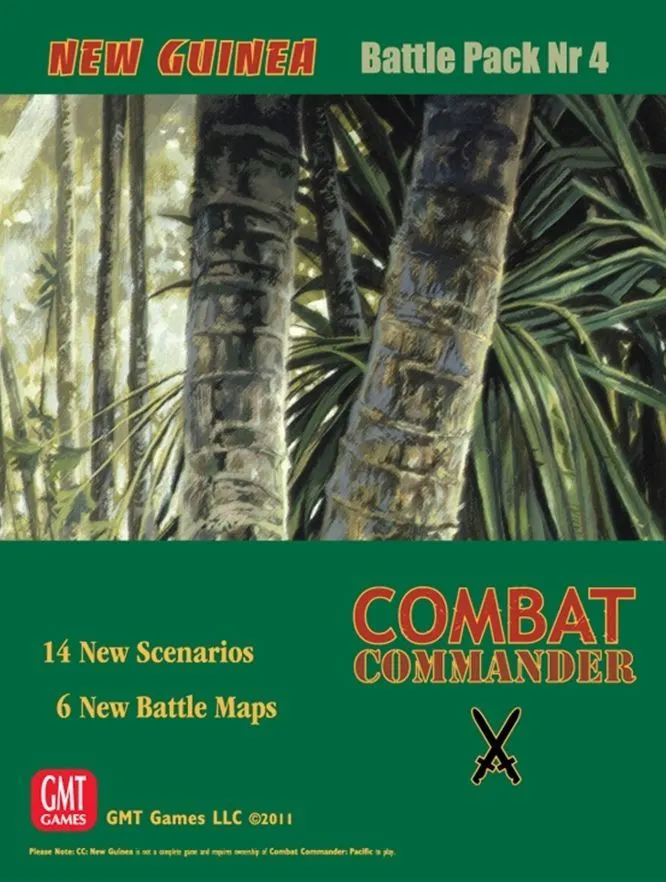
Aide aux règles de Combat Commander: Battle Pack #4 – New Guinea
Des explications claires des tours, effets de cartes et situations litigieuses, avec des références aux sources officielles et un historique des questions sauvegardé.
Que voulez-vous savoir ?
Les réponses viennent du livret officiel, avec la page à vérifier.
Combat Commander: Battle Pack #4 – New Guinea est une extension de Combat Commander: Pacific sortie en 2011 pour 2 joueurs, avec des parties de 180 minutes et à partir de 12 ans. Il a été conçu par Mark Herman, John Foley, Bryan Collars, Volko Ruhnke, John H. Butterfield, Kai Jensen et Andy Maly et ses principales mécaniques sont Variable Player Powers, Hexagon Grid et Simulation.




En anglais
Combat Commander: Battle Pack #4 - New Guinea is the fourth themed collection of scenarios for use with the Combat Commander series of games. The theme of this fourth Battle Pack shifts to the actions in New Guinea from January 1942 through July 1944, following the major campaign phases with characteristic actions. CC -New Guinea features fourteen new scenarios printed on cardstock as well as six new maps. Rules relevant to the characteristic fighting in the coastal jungle versus the highlands are included as needed for each scenario, without the need of an additional rule booklet. A number of unusual, creative special scenario rules cover the unique situations represented, including Air Supply, Barge Landing, Canebreak and Coastal Jungle, Emplaced M3 Tanks, Joint Allied Operations including the Papuan Infantry Battalion, Patrol Dogs, Swamp Holes and Swamp Forest. The new maps depict specific locations in New Guinea: the beachhead at the base of Mt Vulcan across from Rabaul, the village of Oivi, a high-mountain ridge overlooking Eora Creek, a strongpoint on the Soputa-Sanananda Road, the edge of the airstrip at Wau, and one of the crossings of the Driniumor River near the Afua Trail. The scenarios included in CC–New Guinea are: * M1 – “Rabaul Rousers” set at the base of Mt Vulcan on Simpson Bay across from the town of Rabaul, with a Japanese barge landing against Australian defenses at night, 23 January 1942; * M2 – “The Gloomy Forest” set at the village of Oivi, with Australians and Papuans of Maroubra Force facing the rapidly moving Yokohama Advance Party, 26 July 1942; * M3 – “Rebuked at Rabi”, set at Milne Bay, with an SNLF attack against Australian units, 3 September 1942; * M4 – “Templeton’s Crossing” set at a heavily-contested crossing of Eora Creek high in the Stanleys, 17 October 1942; * M5 – “Blind Man’s Bluff” set along one of the high ridges above the treacherous Eora Creek, with intermingled combatants, 28 October 1942; * M6 – “Breakout” set at Gorari after the fall of Kokoda to the Australians, with a desperate banzai action, 11 November 1942; * M7 – “The Butcher’s Bill” set on the Soputa-Sanananda Road, with US forces entering the conflict in horrific swamp forest, 10 December 1942; * M8 – “Closing Outer Camp” set at Buna station, with Australian units using M3 tanks to eradicate the defenders, 18 December 1942; * M9 – “Wau Me Worry” set at the Wau air strip (with active landing operations during the action), with Australian defenders facing a desperate attack, 31 January 1943; * M10 – “Bulolo River Bridge” set outside the outpost at Wau, with patrols of both sides (including Japanese Patrol Dogs) attempting to use the same bridge at cross-purposes, 30 January 1943; * M11 – “Shattered Bobdubi” set during the advance upon Salamua, with Australian units driving upon a Japanese base camp set in the kunai-covered heights of the interior, 30 June 1943; * M12 – “Scarlet Beach” set at the mouth of the Song River near Finschhafen, with a Japanese barge landing at night against combined Australian and US defenders, 17 October 1943; * M13 – “Bad Dreams” set on the Driniumor River, featuring the heroic stand of an unknown US BAR operator facing a hastily prepared Japanese night charge, 10 July 1944; and * M14 – “Encirclement of Troop C” set on the Driniumor River, featuring a Troop of US Cavalry trying to stave off being surrounded by Japanese units that had surprised them by walking casually into their positions, 21 July 1944. NOTE: CC–New Guinea is not a complete game and requires ownership of Combat Commander: Pacific to play. Designed by John Foley Developed by Kai Jensen Additional scenario designs in this fourth Pack are courtesy of John Butterfield, Bryan Collars, Mark Herman, Andrew Maly and Volko Ruhnke.
Selon le catalogue, Combat Commander: Battle Pack #4 – New Guinea se joue à 2 personnes. C’est le nombre de joueurs indiqué par l’éditeur : le jeu est donc conçu pour exactement ce nombre de participants. Les variantes pour d’autres tailles de groupe, s’il en existe, sont décrites dans la règle de votre édition ; consultez-la avant d’installer une autre configuration.
La durée indiquée pour Combat Commander: Battle Pack #4 – New Guinea est de 180 minutes, selon l’estimation de l’éditeur pour une partie complète. La durée réelle dépend du groupe, de l’effectif et de la connaissance des règles : les premières parties sont plus longues, les groupes expérimentés terminent plus vite. Mise en place et explication des règles ne sont pas comprises.
Le catalogue indique Combat Commander: Battle Pack #4 – New Guinea à partir de 12 ans. C’est la recommandation de l’éditeur ; elle tient compte de la lecture nécessaire, de la complexité des règles et des petits composants, pas seulement du thème. Les plus jeunes peuvent souvent participer avec l’aide d’un adulte : vérifiez l’âge indiqué sur votre édition et tenez compte de l’expérience de votre groupe.
Combat Commander: Battle Pack #4 – New Guinea obtient une note de complexité de 3,0 sur 5 auprès des joueurs de BoardGameGeek, ce qui en fait un jeu de complexité moyenne. Cette note reflète la quantité de règles, de planification et de décisions qu’exige une partie typique. Prévoyez une explication plus longue pour les jeux exigeants et utilisez un guide de préparation avant la soirée.
Combat Commander: Battle Pack #4 – New Guinea appartient à ces catégories : Wargame, World War II et Expansion for Base-game. Ses principales mécaniques sont Variable Player Powers, Hexagon Grid et Simulation. Les catégories décrivent le thème et l’univers d’un jeu, tandis que les mécaniques décrivent ce que les joueurs font réellement pendant leur tour. Chaque mécanique mène à une page du catalogue avec des jeux similaires.
Les auteurs crédités pour Combat Commander: Battle Pack #4 – New Guinea sont : Mark Herman, John Foley, Bryan Collars, Volko Ruhnke, John H. Butterfield, Kai Jensen et Andy Maly. Ces crédits proviennent des données publiées du jeu et désignent les personnes responsables de sa conception, et non les illustrateurs ou les éditeurs. Les pages d’auteurs sur MeepleRules regroupent les autres titres des mêmes auteurs, ce qui est utile lorsqu’un jeu vous plaît et que vous en cherchez de similaires.
Le catalogue présente Combat Commander: Battle Pack #4 – New Guinea comme une extension de Combat Commander: Pacific. Les extensions ajoutent du contenu, des règles ou des scénarios au jeu de base et ne se jouent généralement pas seules : il vous faut donc Combat Commander: Pacific pour l’utiliser. Vérifiez que votre édition de Combat Commander: Pacific est compatible, car certaines extensions ont été révisées d’une édition à l’autre.