
- Note BGG
- 9,2
Dungeon Draft: Pirates & Paladins Expansion
- 2–5 joueurs
- 30–60 min
- Complexité 2,0/5
- 2025
2017
Aide aux règles de Dungeon Draft
Des explications claires des tours, effets de cartes et situations litigieuses, avec des références aux sources officielles et un historique des questions sauvegardé.
Pour 2 joueurs
Que voulez-vous savoir ?
Les réponses viennent du livret officiel, avec la page à vérifier.
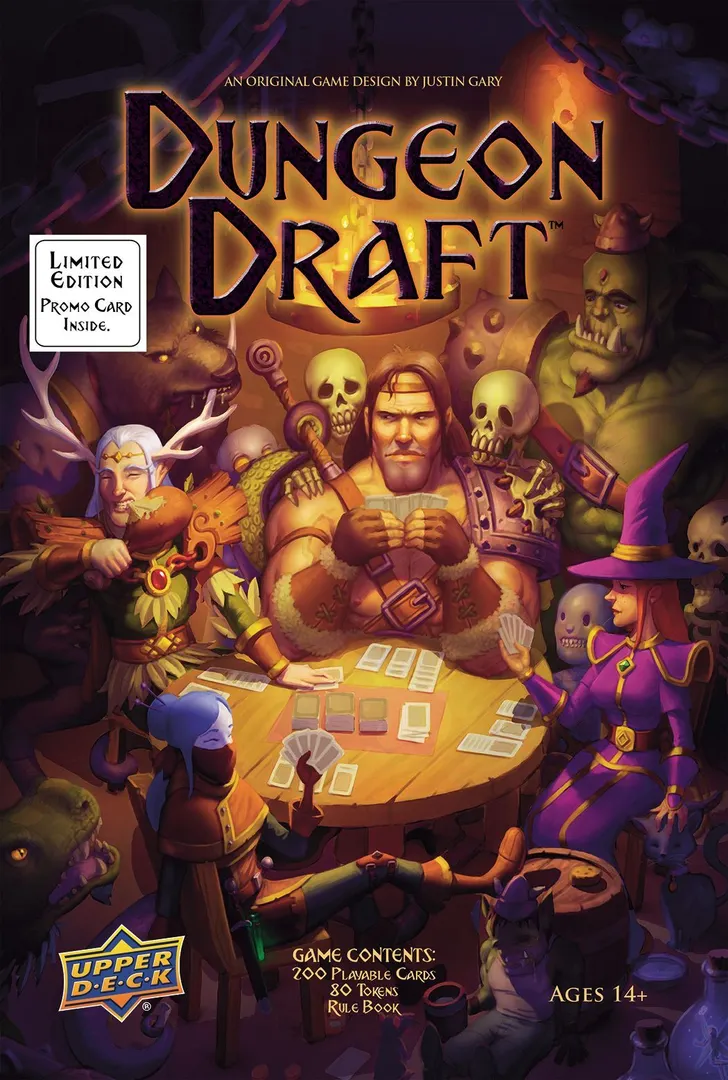
Dungeon Draft est un jeu de société sorti en 2017 pour 2 à 5 joueurs, avec des parties de 30 à 45 minutes et à partir de 8 ans. Il a été conçu par Justin Gary et ses principales mécaniques sont Hand Management, Turn Order: Progressive et Closed Drafting.
En anglais
Over the course of four rounds in Dungeon Draft, 2-5 players draft heroes and weapons — using gold to pay for them — then use them to defeat monsters, acquire additional gold, and complete quests in an effort to earn the most experience points (XP). Set-up: At the beginning of the game each player is dealt 5 Quest cards. Then, each player selects 3 of their Quests to keep and returns the remainder facedown to the bottom of the Quest Deck. Each round players draft a 7 card hand. Cards are passed either clockwise or counter clockwise depending on the round. Players then take turns playing as many cards as they can from their hand, provided they have the resources to do so. Randomly determine which player will play first during the Play Phase. The starting player will alternate in a clockwise fashion during each of the four rounds. Playing Cards: To play Heroes and Weapons, players must spend Gold equal to the Gold Cost in the upper left corner of the card. Spent Gold is returned to the common pool of available Gold. Heroes and Weapons remain in front of you when played. Some Heroes and Weapons have special text abilities that take effect when played. All Heroes and Weapons will only have effects that last for the remainder of the round, with the exception of providing Attack, Gold, and XP (i.e. ignore everything but the numbers and symbols on the left side of the card during future rounds). Class Icons: Each Hero and Weapon has a class. Classes are indicated by card color and icon. Class is very important! Many powers on Heroes and Weapons can only be used if you control enough cards of the appropriate class. Monsters To defeat Monsters, players must have Attack equal to or greater than the Monster Attack Cost in the upper left corner of the card. Attack is not “spent” like Gold, so a player can defeat any number of Monsters whose Attack Cost is lower than or equal to the combined Attack of all cards you control. Some Monsters have a text box with special effects on the card. After you defeat one of these Monsters, follow the instructions and then put the Monster into the Draft Deck Discard Pile. Some Monsters have XP or Gold values on the card. After you defeat one of these Monsters, take the corresponding XP and/or Gold from the corresponding pool and then put the Monster into the Draft Deck Discard Pile. Quests To play Quests, players must have Heroes and Weapons of the appropriate class. Quests have no cost other than this requirement. Unlike Heroes and Weapons, Quest Cards may have abilities that can be used over multiple rounds. End of Turn Once a player has finished playing any cards they wish to play (and has the resources to play), they must: • Discard all unplayed Draft Cards to the Draft Deck Discard Pile (do not discard Quest Cards OR played Heroes and Weapons). • Gain 5 Gold plus additional Gold equal to the total Gold Production on all cards in front of you. • Play passes to the next player. End of Round Once all players have completed the Play Phase, the next round will begin. In each round, the starting player will rotate clockwise (i.e. the player who played second in the previous round will start the next round). TIP: At the end of each round, it is helpful to stack all of your played Heroes and Weapons so that only their icons are visible. This clears room for the next round’s cards and helps to avoid confusion since only the icon powers remain in effect for future rounds. After four rounds have been completed, players tally up XP to determine the winner. The player with the most XP at the end of the game is the winner! Huzzah!
Selon le catalogue, Dungeon Draft se joue de 2 à 5 personnes. Cette fourchette correspond au nombre de joueurs indiqué par l’éditeur : le jeu s’installe donc pour toute taille de groupe dans cette limite. La mise en place, certaines règles et le décompte peuvent varier selon l’effectif ; vérifiez la configuration exacte dans la règle de votre édition.
La durée indiquée pour Dungeon Draft est de 30 à 45 minutes, selon l’estimation de l’éditeur pour une partie complète. La durée réelle dépend du groupe, de l’effectif et de la connaissance des règles : les premières parties sont plus longues, les groupes expérimentés terminent plus vite. Mise en place et explication des règles ne sont pas comprises.
Le catalogue indique Dungeon Draft à partir de 8 ans. C’est la recommandation de l’éditeur ; elle tient compte de la lecture nécessaire, de la complexité des règles et des petits composants, pas seulement du thème. Les plus jeunes peuvent souvent participer avec l’aide d’un adulte : vérifiez l’âge indiqué sur votre édition et tenez compte de l’expérience de votre groupe.
Dungeon Draft obtient une note de complexité de 1,9 sur 5 auprès des joueurs de BoardGameGeek, ce qui en fait un jeu léger. Cette note reflète la quantité de règles, de planification et de décisions qu’exige une partie typique. Prévoyez une explication plus longue pour les jeux exigeants et utilisez un guide de préparation avant la soirée.
Dungeon Draft appartient à ces catégories : Card Game et Fantasy. Ses principales mécaniques sont Hand Management, Turn Order: Progressive et Closed Drafting. Les catégories décrivent le thème et l’univers d’un jeu, tandis que les mécaniques décrivent ce que les joueurs font réellement pendant leur tour. Chaque mécanique mène à une page du catalogue avec des jeux similaires.
Les auteurs crédités pour Dungeon Draft sont : Justin Gary. Ces crédits proviennent des données publiées du jeu et désignent les personnes responsables de sa conception, et non les illustrateurs ou les éditeurs. Les pages d’auteurs sur MeepleRules regroupent les autres titres des mêmes auteurs, ce qui est utile lorsqu’un jeu vous plaît et que vous en cherchez de similaires.
Le catalogue présente Dungeon Draft comme un jeu de base. Il se joue seul avec le matériel contenu dans la boîte et ne nécessite aucun autre titre. Les extensions, s’il en existe, y ajoutent du contenu ou des règles et sont répertoriées séparément dans le catalogue, avec un lien vers ce jeu de base.