

- Rang BGG
- BGG #5 135
- Note BGG
- 7,3
Stalingrad Pocket: 2nd Edition – The Wehrmacht's Greatest Disaster
- 1–2 joueurs
- 180–900 min
- Complexité 2,6/5
- 1996
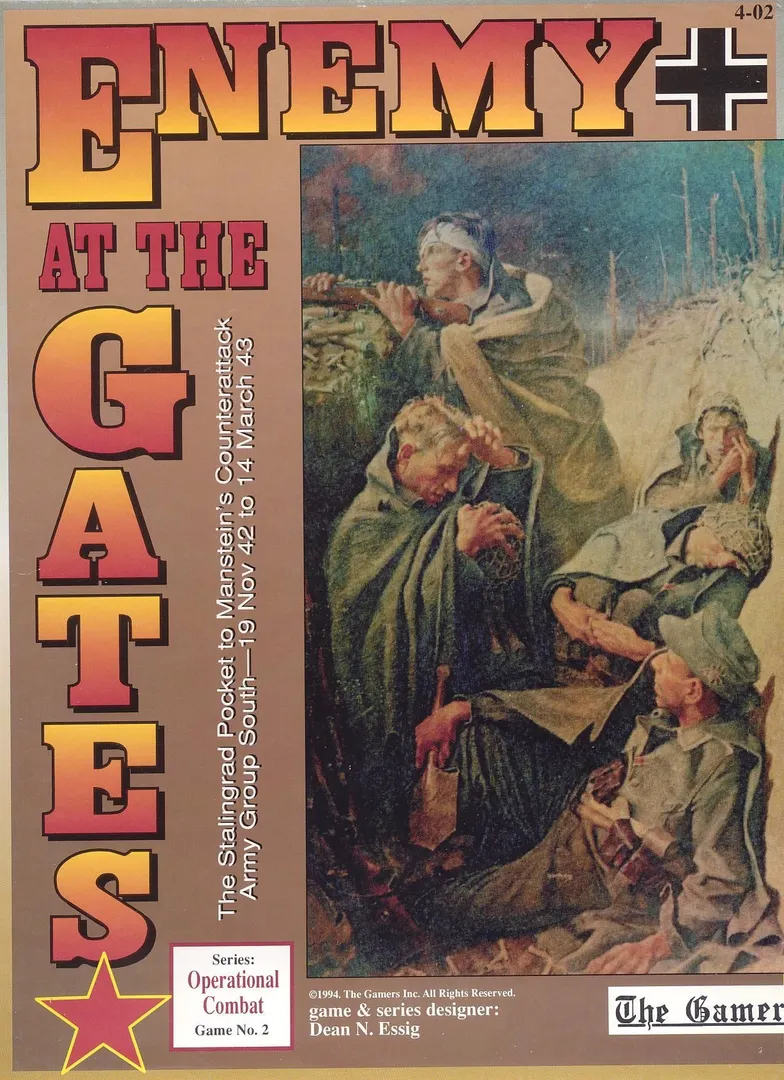
1994
Aide aux règles de Enemy at the Gates
Des explications claires des tours, effets de cartes et situations litigieuses, avec des références aux sources officielles et un historique des questions sauvegardé.
Pour 1 joueur
Que voulez-vous savoir ?
Les réponses viennent du livret officiel, avec la page à vérifier.
Enemy at the Gates est un jeu de société sorti en 1994 pour 1 à 4 joueurs, avec des parties de 240 à 6000 minutes et à partir de 12 ans. Il a été conçu par Dean Essig et ses principales mécaniques sont Dice Rolling, Hexagon Grid et Simulation.




En anglais
On a cold, foggy morning in November, 1942, a four-hour artillery barrage rocked the Rumanian lines north and south of Stalingrad. Countless swarms of Red infantry, tanks, and guns then swept the lines. In four days, the pincers met near Kalach-um-Don – entombing the 6th Army in Stalingrad. During the next three months, the Germans will reel from successive Soviet hammer blows, try in vain to relieve the 6th Army, and fail to supply it from the air. The 6th Army surrenders, and only the counter-attack by von Manstein’s panzers stop the red tide. The turning point of World War II in Europe has passed. Enemy at the Gates, the second Operational Combat Series release by The Gamers, offers players different challenges from those in the very popular game Guderian’s Blitzkrieg. The Soviet army has rearmed and reorganized their Tank Corps – their challenge to the Panzer Divisions. The unique force structures of each side force players to fight differently in order to maximize their strengths. And, of course, players must face the toughest operation and strategic choices they have ever faced. When to stand, when to run…and when to strike. Enemy at the Gates covers the entire period from 19 November 1942 to mid-March 1943. There are numerous one and two map scenarios. The game covers Operation Uranus, Operation Little Saturn, the German Relief and airlift efforts, and Operation Star and Gallup (to include von Manstein’s famous “backhand blow”). Extensively researched, playtested, and developed, Enemy at the Gates will satisfy the Eastern Front interest of any gamer who wants to know more than the pulp-history version of these pivotal events! Features: Dynamic and fluid situation All of the pivotal battles in AG South The creation of the Stalingrad pocket The relief effort and airlift Mansteins famous Backhand Blow! Follow-on to the popular Guderian's Blitzkrieg: The Drive on Moscow game and system- refined based on player feedback Player skill is highly rewarded Game Scale: Turn: Half-week Hex: 5 miles / 8 Km Units: Battalion to Army Game Inventory: Four 22 x 34" maps (Maps A, B, C & D) One 8 x 11" Stalingrad 'Blow-Up' map Eight dual-side printed countersheets (5 combat, 3 markers - 2,800 1/2" counters) One 36-page OCS rules booklet One 36-page Enemy at the Gate game specific rules booklet Two 6-page OCS version 2.0 Charts & Tables Folders Four Player Aid cards Two 6-sided dice Complexity: High Solitaire Suitability: High Playing Time: 4-100 hours Players: 1 or more (from the Game Box) All 4 maps were changed and reprinted in 2001. Updated and replaced by Case Blue.
Selon le catalogue, Enemy at the Gates se joue de 1 à 4 personnes. Cette fourchette correspond au nombre de joueurs indiqué par l’éditeur : le jeu s’installe donc pour toute taille de groupe dans cette limite. La mise en place, certaines règles et le décompte peuvent varier selon l’effectif ; vérifiez la configuration exacte dans la règle de votre édition.
La durée indiquée pour Enemy at the Gates est de 240 à 6000 minutes, selon l’estimation de l’éditeur pour une partie complète. La durée réelle dépend du groupe, de l’effectif et de la connaissance des règles : les premières parties sont plus longues, les groupes expérimentés terminent plus vite. Mise en place et explication des règles ne sont pas comprises.
Le catalogue indique Enemy at the Gates à partir de 12 ans. C’est la recommandation de l’éditeur ; elle tient compte de la lecture nécessaire, de la complexité des règles et des petits composants, pas seulement du thème. Les plus jeunes peuvent souvent participer avec l’aide d’un adulte : vérifiez l’âge indiqué sur votre édition et tenez compte de l’expérience de votre groupe.
Enemy at the Gates obtient une note de complexité de 4,3 sur 5 auprès des joueurs de BoardGameGeek, ce qui en fait un jeu exigeant. Cette note reflète la quantité de règles, de planification et de décisions qu’exige une partie typique. Prévoyez une explication plus longue pour les jeux exigeants et utilisez un guide de préparation avant la soirée.
Enemy at the Gates appartient à ces catégories : Wargame et World War II. Ses principales mécaniques sont Dice Rolling, Hexagon Grid et Simulation. Les catégories décrivent le thème et l’univers d’un jeu, tandis que les mécaniques décrivent ce que les joueurs font réellement pendant leur tour. Chaque mécanique mène à une page du catalogue avec des jeux similaires.
Les auteurs crédités pour Enemy at the Gates sont : Dean Essig. Ces crédits proviennent des données publiées du jeu et désignent les personnes responsables de sa conception, et non les illustrateurs ou les éditeurs. Les pages d’auteurs sur MeepleRules regroupent les autres titres des mêmes auteurs, ce qui est utile lorsqu’un jeu vous plaît et que vous en cherchez de similaires.
Le catalogue présente Enemy at the Gates comme un jeu de base. Il se joue seul avec le matériel contenu dans la boîte et ne nécessite aucun autre titre. Les extensions, s’il en existe, y ajoutent du contenu ou des règles et sont répertoriées séparément dans le catalogue, avec un lien vers ce jeu de base.