
- Rang BGG
- BGG #617
- Note BGG
- 7,0
Alhambra
- 2–6 joueurs
- 45–60 min
- Complexité 2,1/5
- 2003
2009
Aide aux règles de Granada
Des explications claires des tours, effets de cartes et situations litigieuses, avec des références aux sources officielles et un historique des questions sauvegardé.
Pour 2 joueurs
Que voulez-vous savoir ?
Les réponses viennent du livret officiel, avec la page à vérifier.
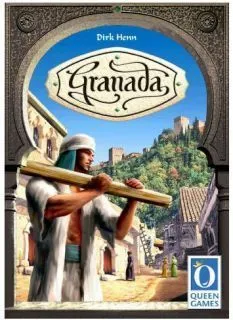
Granada est un jeu de société sorti en 2009 pour 2 à 6 joueurs, avec des parties de 45 à 60 minutes et à partir de 8 ans. Il a été conçu par Dirk Henn et ses principales mécaniques sont Set Collection, Tile Placement et Commodity Speculation.


En anglais
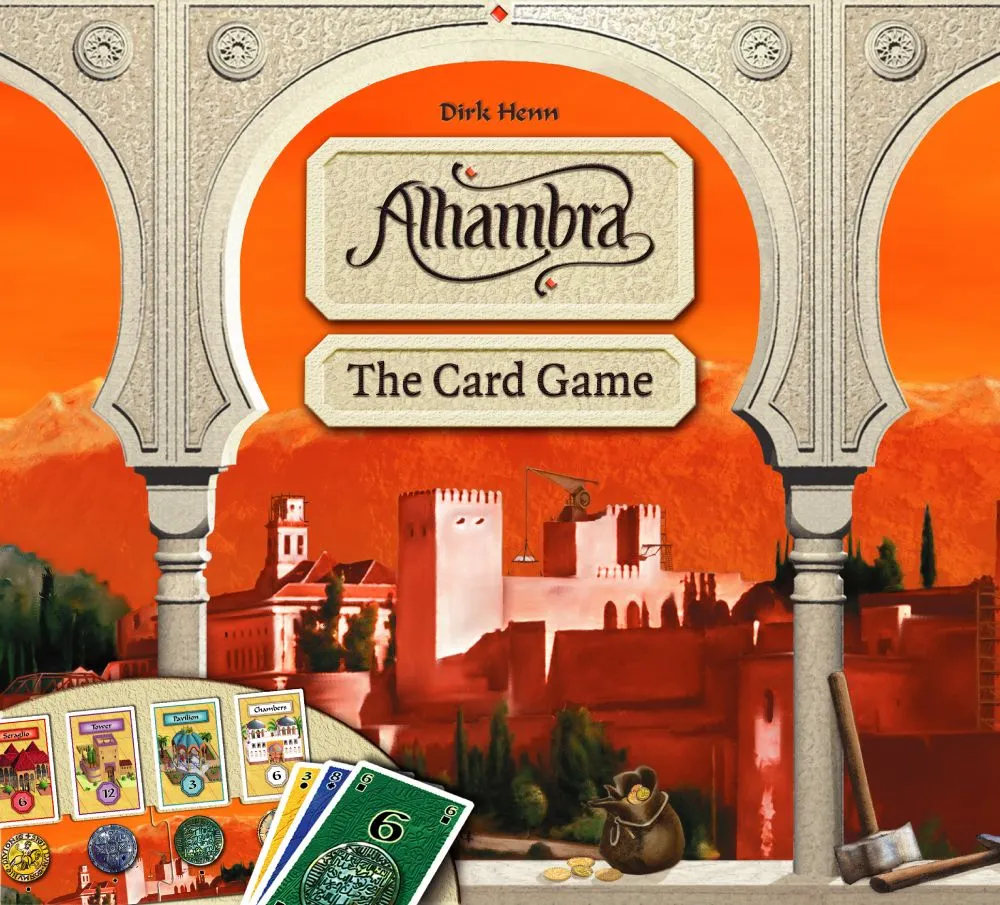
Granada – many artisans, traders and entire families have settled at the foot of the Sierra Nevada because the Palace of Alhambra promises all people work, contracts and above all prosperity. (From the publisher's blurb.) Granada is new member of the Game: Alhambra family with a more challenging character: in this standalone game the players develop the city of Granada next to Sierra Nevada, where the famous Alhambra stands, by buying building tiles to construct the city which will earn the most victory points. Building tiles now have two sides and there are new building types for which the value is set during the game. Link to Trailer http://www.queen-games.de/index.php?id=2537----2 Play Differences from Alhambra Alhambra advanced. Play is the same: buy a building tile, take money or remodel. If you buy a tile for the exact amount, you can take another action, same as in Alhambra. The differences: new building types, building values are dynamic, two-sided tiles, and moats instead of walls. There are 9 building types in Granada. Unlike Alhambra, the buildings do not have a set value. Instead, building value is determined by the count of that type of building in all players' cities times a multiplier. As in Alhambra, there are 3 scoring rounds during which each building type is examined and points awarded for the player with the majority of that type of building. In the first scoring round, A, only the player with the most tiles of a particular building type scores for that building type (1 times the total count). In the second scoring round, B, the top 2 players score (2 times the total count and 1 times the total count respectively), and in the final round, the top 3 score (3x, 2x, and 1x the total count of that building type). Scoring for a "Beginners Game" is a little different. There are no ties in Granada: points are never divided like in Alhambra. In the case of two players having the same number of tiles of a particular type in their cities, the player with the highest valued tile of that type wins, and the other player takes next place. So, in Granada, it pays to buy the more expensive buildings. For example: When the A round-scoring card is turned up, Cindy has 2 Schools, Diana has 2, Tim has 1, Tina and Bailey each have 0, for a total of 5 Schools currently in cities. Cindy's highest School is a 10, Diana's is a 7. So, in round A, Cindy would score 1 x 5 = 5 points. When the B round-scoring card is turned up, the count for Schools is: Cindy 2, Diana 3, Tim 1, Tina and Bailey 0 each for a total of 6 Schools. So, Diana scores 2 x 6 = 12 points and Cindy scores 1 x 6 = 6 points. In the final round, the School count is Cindy 2, Diana 3, Tim 1, Tina 2, Bailey 0 for a total of 8 Schools in cities. Cindy's highest School is a 10, Tina's is a 4. So, Diana scores 3 x 8 = 24 points, Cindy score 2 x 8 = 16 points and Tina score 1 x 8 = 8 points. Another difference in Granada is that the tiles are two-sided: on one side an even-numbered building of some type, on the other a different, odd-numbered building valued exactly one higher. The configuration of the buildings on both sides is identical in terms of moat placement or lack thereof on each side. When purchasing a building, a player can immediately place the building, as is, into her city or may flip it to the other side and place it in her supply for later placement during a remodel action. The Building Market is initially filled with tiles even-side up. The next time the market is filled, the odd side will be placed up, then even, then odd, etc. A handy toggle feature is provided on the board near the Building Market to facilitate this. The last difference between Alhambra and Granada, moats instead of walls, is really just a difference in artwork. As in Alhambra, during each scoring round, each player scores points for her longest continuous moat, instead of wall, surrounding her city. The rules are the same regarding tile placement: must be able to trace an unbroken path back to the city's center, moat can touch moat, etc. In games I've played, players have often commented that it seems to be harder to build with the moat tiles of Granada than with the wall tiles of Alhambra. Just one more way to make Granada an advanced version of Alhambra? Re-implements: Alhambra
Selon le catalogue, Granada se joue de 2 à 6 personnes. Cette fourchette correspond au nombre de joueurs indiqué par l’éditeur : le jeu s’installe donc pour toute taille de groupe dans cette limite. La mise en place, certaines règles et le décompte peuvent varier selon l’effectif ; vérifiez la configuration exacte dans la règle de votre édition.
La durée indiquée pour Granada est de 45 à 60 minutes, selon l’estimation de l’éditeur pour une partie complète. La durée réelle dépend du groupe, de l’effectif et de la connaissance des règles : les premières parties sont plus longues, les groupes expérimentés terminent plus vite. Mise en place et explication des règles ne sont pas comprises.
Le catalogue indique Granada à partir de 8 ans. C’est la recommandation de l’éditeur ; elle tient compte de la lecture nécessaire, de la complexité des règles et des petits composants, pas seulement du thème. Les plus jeunes peuvent souvent participer avec l’aide d’un adulte : vérifiez l’âge indiqué sur votre édition et tenez compte de l’expérience de votre groupe.
Granada obtient une note de complexité de 2,2 sur 5 auprès des joueurs de BoardGameGeek, ce qui en fait un jeu plutôt léger. Cette note reflète la quantité de règles, de planification et de décisions qu’exige une partie typique. Prévoyez une explication plus longue pour les jeux exigeants et utilisez un guide de préparation avant la soirée.
Granada appartient à ces catégories : City Building et Renaissance. Ses principales mécaniques sont Set Collection, Tile Placement et Commodity Speculation. Les catégories décrivent le thème et l’univers d’un jeu, tandis que les mécaniques décrivent ce que les joueurs font réellement pendant leur tour. Chaque mécanique mène à une page du catalogue avec des jeux similaires.
Les auteurs crédités pour Granada sont : Dirk Henn. Ces crédits proviennent des données publiées du jeu et désignent les personnes responsables de sa conception, et non les illustrateurs ou les éditeurs. Les pages d’auteurs sur MeepleRules regroupent les autres titres des mêmes auteurs, ce qui est utile lorsqu’un jeu vous plaît et que vous en cherchez de similaires.
Le catalogue présente Granada comme un jeu de base. Il se joue seul avec le matériel contenu dans la boîte et ne nécessite aucun autre titre. Les extensions, s’il en existe, y ajoutent du contenu ou des règles et sont répertoriées séparément dans le catalogue, avec un lien vers ce jeu de base.