
- Rang BGG
- BGG #11 396
- Note BGG
- 7,1
SOPAC: Naval Action in the South Pacific 1942–1943
- 2 joueurs
- 240 min
- Complexité 3,1/5
- 1999
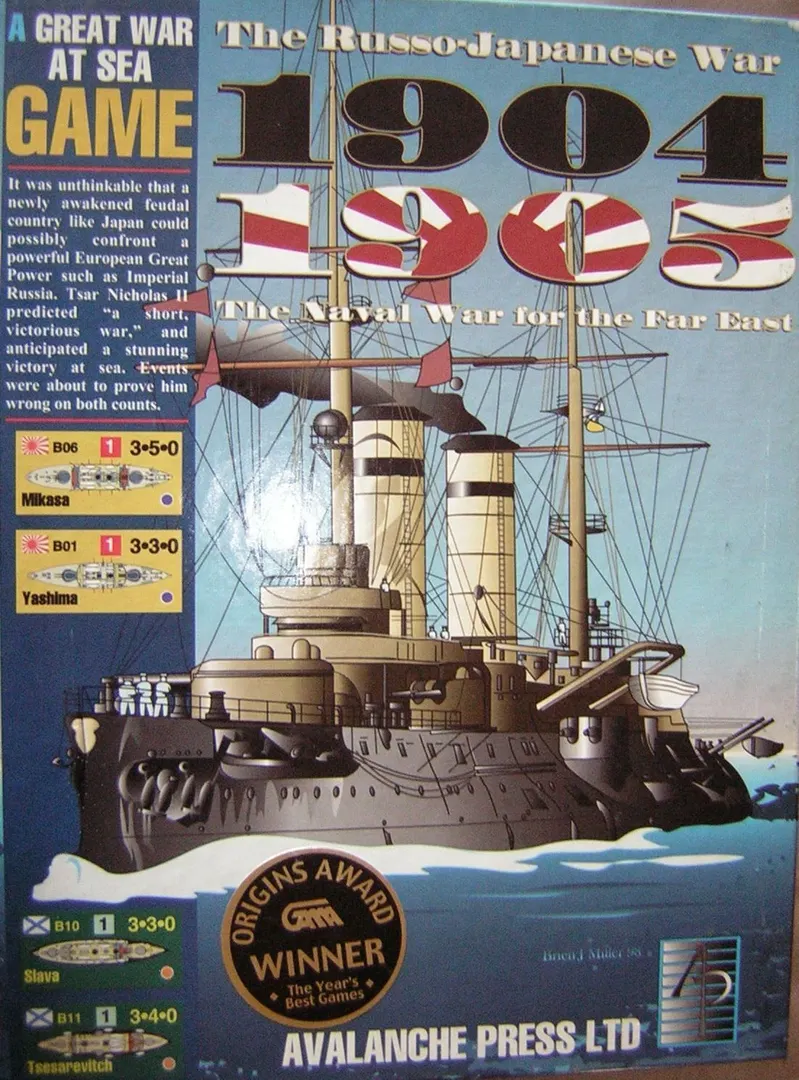
1999
Aide aux règles de Great War at Sea: 1904-1905, The Russo-Japanese War
Des explications claires des tours, effets de cartes et situations litigieuses, avec des références aux sources officielles et un historique des questions sauvegardé.
Pour 2 joueurs
Que voulez-vous savoir ?
Les réponses viennent du livret officiel, avec la page à vérifier.
Great War at Sea: 1904-1905, The Russo-Japanese War est un jeu de société sorti en 1999 pour 2 à 4 joueurs, avec des parties de 30 minutes et à partir de 12 ans. Il a été conçu par Michael Bennighof, Brian L. Knipple et Joe Keller et ses principales mécaniques sont Dice Rolling et Hexagon Grid.





En anglais
From the original company website entry: Japan entered the modern age in 1868, with a new young emperor determined to make his island nation a world power. After decades of steady progress, Japan began its own practice of colonialism, defeating China in 1894. As the Japanese began to infiltrate the semi-independent Kingdom of Korea, they ran into Russian agents doing the same. Despite Japanese offers to negotiate, the Russian Tsar Nicholas II was set on war. Great War at Sea: 1904-1905, The Russo-Japanese War covers the naval side of this turn-of-the-century conflict, which opened with a Japanese surprise attack on the Russian Pacific Fleet’s base at Port Arthur in northern China. There are 19 scenarios, or game situations, provided, including the climactic Battle of Tsushima. There’s also a campaign game, in which players can “game” the entire naval war. The Russian fleet is a mixed bag of modern battleships and ancient ironclads better suited for a museum. The Pacific Fleet that begins the game in the Far East has modern ships stationed at Port Arthur and a cruiser squadron in Vladivostok. Between them lies Korea, occupied by Japan. The Russian strategic situation is difficult. The Japanese have a better fleet; though not as large, their armored cruisers outclass their Russian counterparts and their torpedo boats are more numerous and more effective. They are also better-led after the death of the Russian Admiral Makarov. The map covers the Japanese home islands and the seas around them. As with other games in the series, it’s divided into zones approximately 31 nautical miles across. Fleets attempt to locate one another on this map. When contact is made, play moves to a tactical map where ships manuever and fight. There are special overlays for Port Arthur and Chemulpo, so players can use the actual terrain of these key coastal zones. The original 1999 game included: 210 Counters One 25"x30" strategic map One 25"x25" tactical map 16 page Rulebook 12 page Scenario book The game is being re-implemented in 2013 as Great War at Sea: Russo-Japanese War with a revised map, updated counters, new scenario book and new box.
Selon le catalogue, Great War at Sea: 1904-1905, The Russo-Japanese War se joue de 2 à 4 personnes. Cette fourchette correspond au nombre de joueurs indiqué par l’éditeur : le jeu s’installe donc pour toute taille de groupe dans cette limite. La mise en place, certaines règles et le décompte peuvent varier selon l’effectif ; vérifiez la configuration exacte dans la règle de votre édition.
La durée indiquée pour Great War at Sea: 1904-1905, The Russo-Japanese War est de 30 minutes, selon l’estimation de l’éditeur pour une partie complète. La durée réelle dépend du groupe, de l’effectif et de la connaissance des règles : les premières parties sont plus longues, les groupes expérimentés terminent plus vite. Mise en place et explication des règles ne sont pas comprises.
Le catalogue indique Great War at Sea: 1904-1905, The Russo-Japanese War à partir de 12 ans. C’est la recommandation de l’éditeur ; elle tient compte de la lecture nécessaire, de la complexité des règles et des petits composants, pas seulement du thème. Les plus jeunes peuvent souvent participer avec l’aide d’un adulte : vérifiez l’âge indiqué sur votre édition et tenez compte de l’expérience de votre groupe.
Great War at Sea: 1904-1905, The Russo-Japanese War obtient une note de complexité de 2,5 sur 5 auprès des joueurs de BoardGameGeek, ce qui en fait un jeu plutôt léger. Cette note reflète la quantité de règles, de planification et de décisions qu’exige une partie typique. Prévoyez une explication plus longue pour les jeux exigeants et utilisez un guide de préparation avant la soirée.
Great War at Sea: 1904-1905, The Russo-Japanese War appartient à ces catégories : Wargame, Nautical et Post-Napoleonic. Ses principales mécaniques sont Dice Rolling et Hexagon Grid. Les catégories décrivent le thème et l’univers d’un jeu, tandis que les mécaniques décrivent ce que les joueurs font réellement pendant leur tour. Chaque mécanique mène à une page du catalogue avec des jeux similaires.
Les auteurs crédités pour Great War at Sea: 1904-1905, The Russo-Japanese War sont : Michael Bennighof, Brian L. Knipple et Joe Keller. Ces crédits proviennent des données publiées du jeu et désignent les personnes responsables de sa conception, et non les illustrateurs ou les éditeurs. Les pages d’auteurs sur MeepleRules regroupent les autres titres des mêmes auteurs, ce qui est utile lorsqu’un jeu vous plaît et que vous en cherchez de similaires.
Le catalogue présente Great War at Sea: 1904-1905, The Russo-Japanese War comme un jeu de base. Il se joue seul avec le matériel contenu dans la boîte et ne nécessite aucun autre titre. Les extensions, s’il en existe, y ajoutent du contenu ou des règles et sont répertoriées séparément dans le catalogue, avec un lien vers ce jeu de base.