
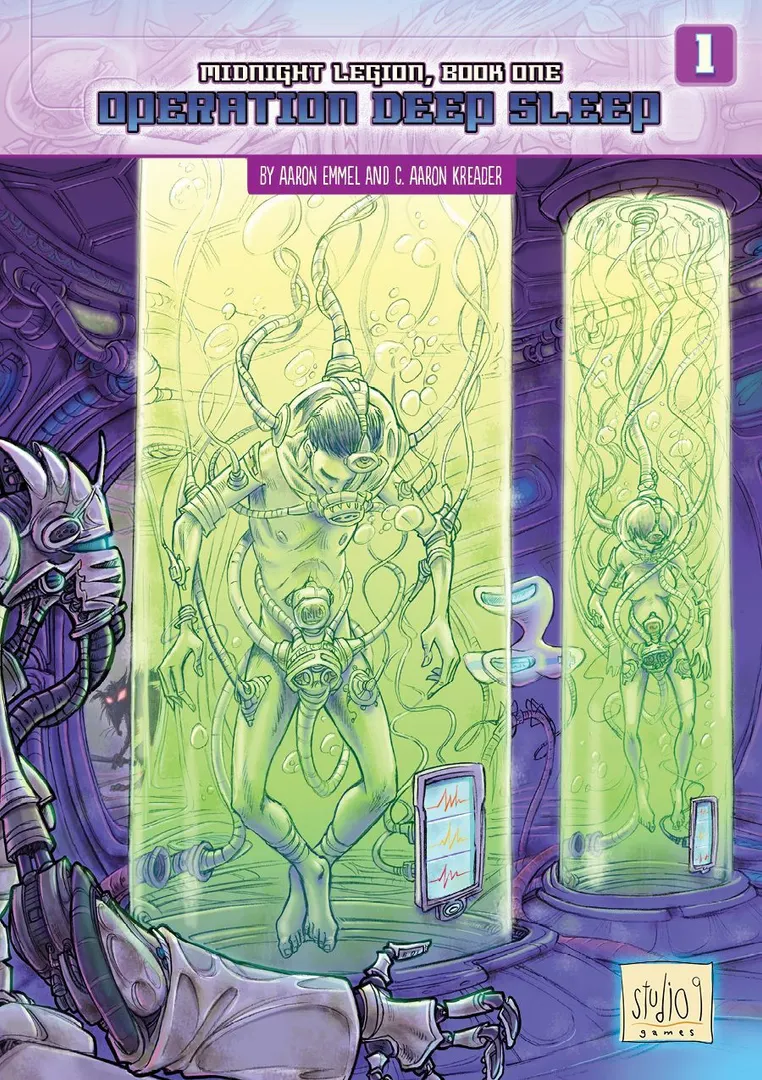
- Rang BGG
- BGG #16 982
- Note BGG
- 7,3
Midnight Legion: Operation Deep Sleep
- 1–2 joueurs
- 15–60 min
- Complexité 2,0/5
- 2016

2013
Aide aux règles de HERO versus GUARDIAN: A Game of Dungeon Craft
Des explications claires des tours, effets de cartes et situations litigieuses, avec des références aux sources officielles et un historique des questions sauvegardé.
Que voulez-vous savoir ?
Les réponses viennent du livret officiel, avec la page à vérifier.
HERO versus GUARDIAN: A Game of Dungeon Craft est un jeu de société sorti en 2013 pour 2 à 4 joueurs, avec des parties de 60 minutes et à partir de 9 ans. Il a été conçu par C. Aaron Kreader et ses principales mécaniques sont Dice Rolling, Modular Board et Cooperative Game.




En anglais
HERO versus GUARDIAN: A Game of Dungeon Craft is a 2-4 player card- and dice-based strategy game that takes 45-90 minutes to play. The game has two distinct roles: the role of the Guardian who builds a dungeon and the role of the Hero who builds a party of adventurers to loot the dungeon built by the Guardian. At the start of the game the Guardian secretly designs a dungeon using a set of 16 room cards. Additional room cards are set aside and drawn from as the game progresses. There are 4 basic room types: Traps, Brutes, Evil and Magic. Brute and Evil rooms are more common and Magic and Trap rooms less common. Each room in the game is unique and has specific ways in which it can assist in the dungeon defense. For example, some rooms, like the RUST BEAST, destroy items, others, like the PRISON CELL, give the HERO player an addition adventurer if the room is captured by the HERO. In addition, there are empty rooms that when coupled with other rooms create a modifier to the chance of that room being overtaken. The Treasure Vault is the most valuable of those rooms and the goal is to keep the adventurers from finding and capturing it. Once the Guardian places entrances outside the dungeon, the game begins. Within a round, players spend tokens to take actions in an alternating sequence. The game combines elements of chance with your ability to read your opponent's strategy. The Guardian and Hero do not HAVE to take an action and can pass and wait to see what the other is doing, however, each round the Guardian has last option which means he or she can act last forcing the hero to either act, or end their turn and turn over all but 1 of their action tokens. In addition, the Hero has first option, meaning if both players wish to act first in a round, the Hero gets to go first. Each player has action tokens to spend on a variety of actions. Players use tokens to make plays during a round. After all players have spent their tokens, a new round begins with a new set of tokens. The Heroes use tokens to prepare adventurers, and move them through the dungeon. Actions include: scouting a room (a less lethal option but slower and thus can waste precious time), venturing a room (a potentially lethal action where the hero charges adventurers into a room), play a card (spell, item or adventurer), draw a card, retreat, or pass. Heroes earn points by defeating rooms. The Guardian uses action tokens to build more rooms into the dungeon, alter room locations in the dungeon, create dungeon effects to slow down the Hero's progress, or draw cards from the dungeon deck. Each card drawn brings the game closer to the end, because when the dungeon deck is emptied the game ends. The Guardian earns points by capturing adventurers and their gear, and by keeping his dungeon rooms from being captured. The game ends either when the Guardian has drawn all the dungeon cards or when the Hero captures the Treasure Vault. A major component of the game is how the Hero moves through the dungeon and captures rooms. The Hero must enter from one of the 2 entrances, and then must always move to rooms that are adjacent (not DIAGONAL) to the entrance, or adjacent to any cleared room connected to the entrance by other cleared rooms. To clear a room the Hero uses action tokens to form a party. Selecting between 1 and 4 of his adventurers with skills suited for the room at hand. The Hero can save time by charging into an unknown room or use action tokens to scout the room and then pick the best party for the job. The advantage of charging is that it saves time and throws off the Guardian, however, it can mean certain death. Scouting is safer, but eats precious time. The Hero is trying to put the best adventurers in the rooms most suited to their skills—while the Guardian tries to ambush and surprise the Hero with rooms that challenge the adventurers. This is where spells (for the Hero) and Dungeon Effects (for the Guardian) help tip the scales of a close combat. The 4 basic Adventurers WARRIOR, ROGUE, WIZARD, and CLERIC each have a room they are best at defeating. However, they are also capable and somewhat skilled in other rooms. In addition they each have a power which gives them strategic advantages, for example the warrior is better at venturing, the rogue at scouting, the wizard can cast spells without eating action points, and the cleric can save party members by sacrificing himself. Using their skills and talents at the right time in a well balanced group can mean the difference between a wipe-out and a victory. Of course, the Guardian can see the party composition and their equipment, but the Hero cannot see what is in the rooms. So the Guardian is constantly shifting and bolstering his rooms to create the most havoc for the party at hand. Equipment also scores points for the Guardian if captured, but is important to boost the adventurers skills vs. various rooms. It also takes time (action tokens) to equip. The advantage of the bonus vs. the consumption of time becomes a key strategic choice. In a multi-player game there are multiple Heroes who each take a turn in sequence against the Guardian. Each Hero builds a party of adventurers and equips them separately. In the end if the Heroes have more combined points they win as a team against the Guardian. The game currently can play 1 to 3 Heroes vs. 1 Guardian.
Selon le catalogue, HERO versus GUARDIAN: A Game of Dungeon Craft se joue de 2 à 4 personnes. Cette fourchette correspond au nombre de joueurs indiqué par l’éditeur : le jeu s’installe donc pour toute taille de groupe dans cette limite. La mise en place, certaines règles et le décompte peuvent varier selon l’effectif ; vérifiez la configuration exacte dans la règle de votre édition.
La durée indiquée pour HERO versus GUARDIAN: A Game of Dungeon Craft est de 60 minutes, selon l’estimation de l’éditeur pour une partie complète. La durée réelle dépend du groupe, de l’effectif et de la connaissance des règles : les premières parties sont plus longues, les groupes expérimentés terminent plus vite. Mise en place et explication des règles ne sont pas comprises.
Le catalogue indique HERO versus GUARDIAN: A Game of Dungeon Craft à partir de 9 ans. C’est la recommandation de l’éditeur ; elle tient compte de la lecture nécessaire, de la complexité des règles et des petits composants, pas seulement du thème. Les plus jeunes peuvent souvent participer avec l’aide d’un adulte : vérifiez l’âge indiqué sur votre édition et tenez compte de l’expérience de votre groupe.
HERO versus GUARDIAN: A Game of Dungeon Craft obtient une note de complexité de 1,8 sur 5 auprès des joueurs de BoardGameGeek, ce qui en fait un jeu léger. Cette note reflète la quantité de règles, de planification et de décisions qu’exige une partie typique. Prévoyez une explication plus longue pour les jeux exigeants et utilisez un guide de préparation avant la soirée.
HERO versus GUARDIAN: A Game of Dungeon Craft appartient à ces catégories : Fantasy et Adventure. Ses principales mécaniques sont Dice Rolling, Modular Board et Cooperative Game. Les catégories décrivent le thème et l’univers d’un jeu, tandis que les mécaniques décrivent ce que les joueurs font réellement pendant leur tour. Chaque mécanique mène à une page du catalogue avec des jeux similaires.
Les auteurs crédités pour HERO versus GUARDIAN: A Game of Dungeon Craft sont : C. Aaron Kreader. Ces crédits proviennent des données publiées du jeu et désignent les personnes responsables de sa conception, et non les illustrateurs ou les éditeurs. Les pages d’auteurs sur MeepleRules regroupent les autres titres des mêmes auteurs, ce qui est utile lorsqu’un jeu vous plaît et que vous en cherchez de similaires.
Le catalogue présente HERO versus GUARDIAN: A Game of Dungeon Craft comme un jeu de base. Il se joue seul avec le matériel contenu dans la boîte et ne nécessite aucun autre titre. Les extensions, s’il en existe, y ajoutent du contenu ou des règles et sont répertoriées séparément dans le catalogue, avec un lien vers ce jeu de base.