

- Rang BGG
- BGG #175
- Note BGG
- 8,2
Vantage
- 1–6 joueurs
- 120–180 min
- Complexité 2,3/5
- 2025
2017
Aide aux règles de In Tenebris Lux
Des explications claires des tours, effets de cartes et situations litigieuses, avec des références aux sources officielles et un historique des questions sauvegardé.
Que voulez-vous savoir ?
Les réponses viennent du livret officiel, avec la page à vérifier.
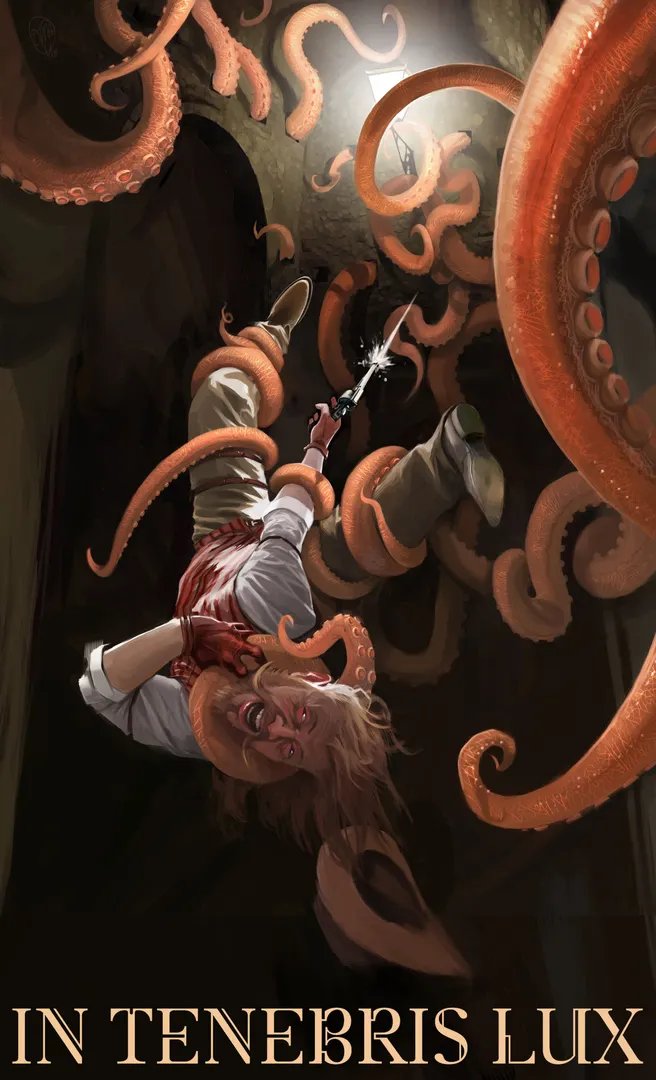
In Tenebris Lux est un jeu de société sorti en 2017 pour 1 à 4 joueurs et à partir de 13 ans. Il a été conçu par Owen Aurelio et ses principales mécaniques sont Dice Rolling, Solo / Solitaire Game et Narrative Choice / Paragraph.





En anglais
ENTER A WORLD OF VICTORIAN HORROR! In 19th-century Rome, ancient crypts have been discovered beneath the Capuchin tombs. Take on the role of a dauntless explorer and plunder these catacombs of their secrets and spoils. Build your catacomb as you go, seeking finds and surviving horrors. End your story before the evils of the catacomb devour you all! IN TENEBRIS LUX is a game for 1-4 players ages 13 and up, and can be played in about 45 minutes to an hour. Players rush to explore and resolve personal quests, called narratives, before their opponents can resolve their own, or the dark catacombs close in on them, ending the game. The game is played in turns, each broken into 3 Steps, with several Phases. STEP 1: BREATHE The first Step adds Rooms to the Catacombs, by drawing them from a random pile. This builds up the game board out of playing card sized map pieces, or Rooms. This step also has a phase allowing Explorers to change their gear, referred to as Equipment or Finds… this is critical as these important items strengthen an Explorer so that they may deal with the dangers to come. Following phases allow an Explorer to adjust their card hand and play any non-room cards, if so desired. STEP 2: SEEK The second step allows Explorers to actually explore and navigate through the Catacombs, or growing game board. This dangerous course allows Explorers to search for new Finds and gear. More phases allow for adding extra Rooms, or cards, onto the board, moving around from card to card, and interacting with Room Cards in order to complete Naratives, or the game’s objectives. This is the Phase where Explorers are most at risk of stumbling upon Horrors, as they are actively exploring the Catacombs. STEP 3: SURVIVE In Step 3 Horrors, the game’s many monsters in the dark, may attack your Explorer! Canny and brave Explorers may also strike out and attack each other in hopes of thwarting each other’s progress in pursuit of personal Narratives. This phase resolves each combat one by one, and adjusts health and loot bodies. Basic combat is simple. As the attacker, role one of the game’s 14 included dice, and add it to your chosen Trait (Grit, Wit or Daring). The Defender rolls one die and adds it to their same Trait, as they defend along the same lines as the incoming attack. Whichever result is highest wins. The game’s “Combat Reference Card” will take players through any extra steps, notably the way in which rooms impact the outcomes with rolls in combat. Each Horror and Explorer features an affinity with different Room types, this gives an edge or disadvantage in combat. Be careful of the Room you land on, it will have dire consequences! After each Step is resolved a player finishes their turn and, moving clockwise, the next player goes, and so on. The game is ended when one player completes their randomly drawn Narrative objective, all Explorers are killed, or the Doom Counter (the Game’s timer) has run its course, sending the catacombs crashing in on the hapless Explorers. In Tenebris Lux comes with 13 Jumbo Explorer cards, 4 jumbo Combat and Turn Cycle reference cards, a full color rule book, 24 Horror cards, 18 Equipment cards, 21 Find cards, 12 Narrative cards, 32 Room cards, 3 Great Room Jumbo cards, one Jumbo Doom Counter card, 14 Dice, 13 Double Sided Explorer counters with 4 stands, and a counter for each Horror as well as many counters to help record progress for Narratives.
Selon le catalogue, In Tenebris Lux se joue de 1 à 4 personnes. Cette fourchette correspond au nombre de joueurs indiqué par l’éditeur : le jeu s’installe donc pour toute taille de groupe dans cette limite. La mise en place, certaines règles et le décompte peuvent varier selon l’effectif ; vérifiez la configuration exacte dans la règle de votre édition.
Le catalogue indique In Tenebris Lux à partir de 13 ans. C’est la recommandation de l’éditeur ; elle tient compte de la lecture nécessaire, de la complexité des règles et des petits composants, pas seulement du thème. Les plus jeunes peuvent souvent participer avec l’aide d’un adulte : vérifiez l’âge indiqué sur votre édition et tenez compte de l’expérience de votre groupe.
In Tenebris Lux obtient une note de complexité de 2,0 sur 5 auprès des joueurs de BoardGameGeek, ce qui en fait un jeu plutôt léger. Cette note reflète la quantité de règles, de planification et de décisions qu’exige une partie typique. Prévoyez une explication plus longue pour les jeux exigeants et utilisez un guide de préparation avant la soirée.
In Tenebris Lux appartient à ces catégories : Adventure, Science Fiction et Post-Napoleonic. Ses principales mécaniques sont Dice Rolling, Solo / Solitaire Game et Narrative Choice / Paragraph. Les catégories décrivent le thème et l’univers d’un jeu, tandis que les mécaniques décrivent ce que les joueurs font réellement pendant leur tour. Chaque mécanique mène à une page du catalogue avec des jeux similaires.
Les auteurs crédités pour In Tenebris Lux sont : Owen Aurelio. Ces crédits proviennent des données publiées du jeu et désignent les personnes responsables de sa conception, et non les illustrateurs ou les éditeurs. Les pages d’auteurs sur MeepleRules regroupent les autres titres des mêmes auteurs, ce qui est utile lorsqu’un jeu vous plaît et que vous en cherchez de similaires.
Le catalogue présente In Tenebris Lux comme un jeu de base. Il se joue seul avec le matériel contenu dans la boîte et ne nécessite aucun autre titre. Les extensions, s’il en existe, y ajoutent du contenu ou des règles et sont répertoriées séparément dans le catalogue, avec un lien vers ce jeu de base.