
- Rang BGG
- BGG #2 295
- Note BGG
- 7,1
Xiangqi
- 2 joueurs
- 60 min
- Complexité 3,6/5
- 762
2025
Aide aux règles de IYE
Des explications claires des tours, effets de cartes et situations litigieuses, avec des références aux sources officielles et un historique des questions sauvegardé.
Pour 2 joueurs
Que voulez-vous savoir ?
Les réponses viennent du livret officiel, avec la page à vérifier.
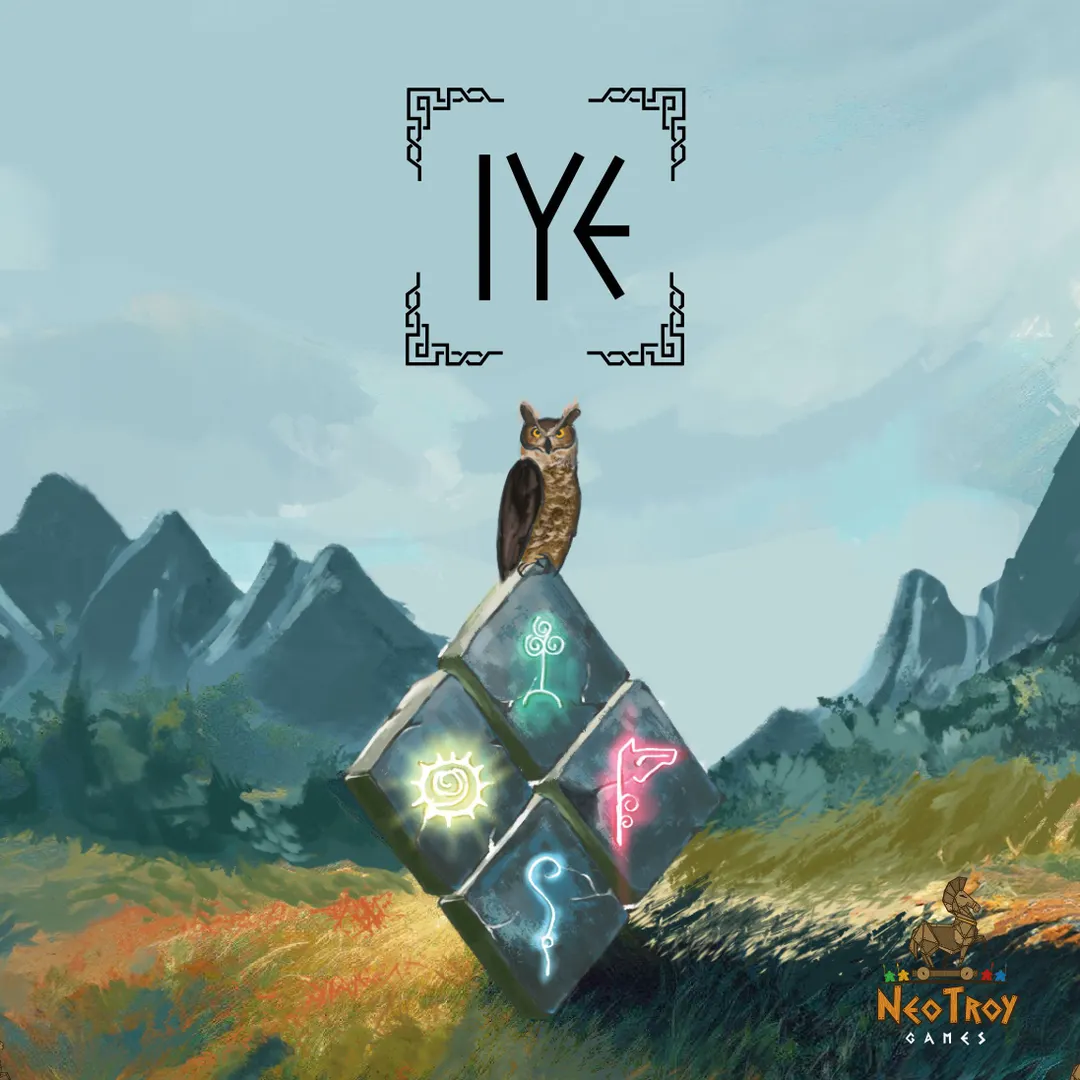
IYE est un jeu de société sorti en 2025 pour 2 joueurs, avec des parties de 15 à 30 minutes et à partir de 8 ans. Il a été conçu par Onur Şencan et ses principales mécaniques sont Set Collection, Square Grid et Grid Movement.



En anglais
The clan’s Shaman has gotten long in the tooth; it is time for him to pass on his drum. The drum shall be passed down to either one of his apprentices. The successor shall be chosen not through a competition nor a contest, but through a traditional ritual of calling and gathering the İye. The Shaman candidates, raised through apprenticeship, shall prove themselves capable of being the clan’s new spiritual leader. Albeit they are in a way competing against one another, cooperation is still a necessity. For such is the way to build a bridge between men and İye. In this game, the two Shaman candidates endeavour to gather the İyes through the beat of the Shaman’s drum. The candidates need to calculate which İye shall be left to their opponent; moreover,they need to make the most logical choice on when to ask the İye to lend a hand and to let them go. The one who proves to be the most skilful in gathering the İye and utilising their abilities shall be appointed as the clan’s next Shaman. İye (pronounced EE-yeah): Belonging to the animist mythologies of Central Asia, İye are nature spirits that inhabit various things. It is believed that they are the protectors of whatever object or part of nature they inhabit, and hold extraordinary powers. Kam (pronounced like English word ‘come’): A shaman in the Altaic, Mongol and Turkic cultures. They serve as the sages and spiritual leaders of their clans. They handcraft their own drums with which they contact the İyes. Utilising the power of an İye is described as “asking the İye to lend a hand”. GAME STRUCTURE AND RULES The first player is the one who is most interested in Shamanism. You can also use any other method to determine the first player. On their turn, a player chooses to perform a A: “Natural Movement” or an B: “İye Tile Movement” to move the Shaman’s drum. Whichever İye Tile the drum moves onto is given to the opponent along with the turn. When there is but a single İye Tile left on the game board, the cycle ends and scoring begins. Natural Movement: The players can move the Shaman’s drum for 1 or 2 spaces on a vertical or horizontal axis. The drum cannot be moved diagonally through a Natural Movement, only vertically or horizontally. The drum cannot be placed on an empty tile, but it can move over them. Moving over an empty tile still counts as moving 2 spaces. İye Tile Movement: The İye Tiles that have been gathered on previous turns can be utilised by the players to move the Shaman’s drum beyond what is naturally possible. In such an instance, whichever İye Tile the drum lands on is still given to the opponent. An İye Tile that has been utilised thusly is spent and ‘discarded’ next to the game board. It will not be included in scoring. The number and types of discarded İye Tiles musty always be visible to both players. The Premature End Of A Cycle If a player is unable to execute any legal moves during their turn, the cycle ends then and there. The player who was last able to execute a movement, becomes the winner. This can only occur if a player has no possible “Natural Movement” to execute and no applicable İye Tiles that can be used for an “İye Tile Movement”. End of a cycle and scoring If a cycle ends because a player was not able to move, the player who played the last move wins the cycle. In this case, there is no need for scoring. If a cycle ends because there is a single İye Tile left on the game board, scoring ensues. Each type of İye is scored separately. Whoever holds the greatest count of a particular type of İye, receives all the points for that type. If both players hold an equal number of tiles regarding a type of İye, neither player wins any points. Moreover, any İye Tile that was used for an “İye Tile Movement” is not counted during scoring; it has been spent and ‘discarded’.
Selon le catalogue, IYE se joue à 2 personnes. C’est le nombre de joueurs indiqué par l’éditeur : le jeu est donc conçu pour exactement ce nombre de participants. Les variantes pour d’autres tailles de groupe, s’il en existe, sont décrites dans la règle de votre édition ; consultez-la avant d’installer une autre configuration.
La durée indiquée pour IYE est de 15 à 30 minutes, selon l’estimation de l’éditeur pour une partie complète. La durée réelle dépend du groupe, de l’effectif et de la connaissance des règles : les premières parties sont plus longues, les groupes expérimentés terminent plus vite. Mise en place et explication des règles ne sont pas comprises.
Le catalogue indique IYE à partir de 8 ans. C’est la recommandation de l’éditeur ; elle tient compte de la lecture nécessaire, de la complexité des règles et des petits composants, pas seulement du thème. Les plus jeunes peuvent souvent participer avec l’aide d’un adulte : vérifiez l’âge indiqué sur votre édition et tenez compte de l’expérience de votre groupe.
IYE obtient une note de complexité de 1,7 sur 5 auprès des joueurs de BoardGameGeek, ce qui en fait un jeu léger. Cette note reflète la quantité de règles, de planification et de décisions qu’exige une partie typique. Prévoyez une explication plus longue pour les jeux exigeants et utilisez un guide de préparation avant la soirée.
IYE appartient à ces catégories : Abstract Strategy. Ses principales mécaniques sont Set Collection, Square Grid et Grid Movement. Les catégories décrivent le thème et l’univers d’un jeu, tandis que les mécaniques décrivent ce que les joueurs font réellement pendant leur tour. Chaque mécanique mène à une page du catalogue avec des jeux similaires.
Les auteurs crédités pour IYE sont : Onur Şencan. Ces crédits proviennent des données publiées du jeu et désignent les personnes responsables de sa conception, et non les illustrateurs ou les éditeurs. Les pages d’auteurs sur MeepleRules regroupent les autres titres des mêmes auteurs, ce qui est utile lorsqu’un jeu vous plaît et que vous en cherchez de similaires.
Le catalogue présente IYE comme un jeu de base. Il se joue seul avec le matériel contenu dans la boîte et ne nécessite aucun autre titre. Les extensions, s’il en existe, y ajoutent du contenu ou des règles et sont répertoriées séparément dans le catalogue, avec un lien vers ce jeu de base.