

- Rang BGG
- BGG #623
- Note BGG
- 7,0
Sheriff of Nottingham
- 3–5 joueurs
- 60 min
- Complexité 1,7/5
- 2014
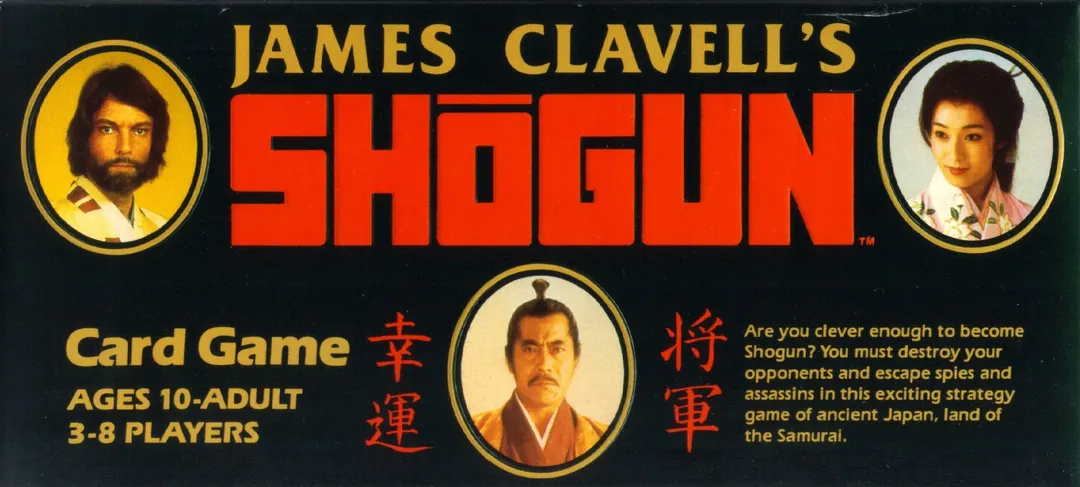
1983
Aide aux règles de James Clavell's Shogun Card Game
Des explications claires des tours, effets de cartes et situations litigieuses, avec des références aux sources officielles et un historique des questions sauvegardé.
Que voulez-vous savoir ?
Les réponses viennent du livret officiel, avec la page à vérifier.
James Clavell's Shogun Card Game est un jeu de société sorti en 1983 pour 3 à 8 joueurs, avec des parties de 60 minutes et à partir de 10 ans. Il a été conçu par Allen Shipps et ses principales mécaniques sont Hand Management, Set Collection et Betting and Bluffing.






En anglais
In this mini-series tie-in card game, 3-7 players in the basic game and 3-8 players in the advanced game try to score points by collecting cards not unlike in traditional card games. The artwork features characters from the movie "Shogun", and the game can be played in a simple (beginner) or an advanced version, which makes use of all the cards. There are two "colors" of cards, peasants and samurai, which are organized into several subclasses like Farmer, Servant, Samurai Wife, or Hatamoto, which all have different point values. Basically, you try to score points by getting either a complete hand of one color (but no doubles), or several cards of the same type. Furthermore, there are wild cards like the Priest, the Emperor, the Heir and of course the Shogun which all have special values in certain combinations. Several other cards like a joker (the "Buddha") or an elimination card (the "Ninja") are also part of the deck. Unlike many other card games, you don't hold the cards in your hand; four of your five cards are displayed face up in front of you, while the fifth lies face down to be kept secret till the end of the turn. This makes bluffing as important a factor as luck and strategy in this game. But that's not all. Right before the end (and before revealing their face-down card), players can choose a final strategy, represented by small strategy markers. "Passive" means you get the points your hand is worth (if any), while "Power Play" can double your score (or even turn a zero point hand into 20 points), but only if either you're the only one to play "Power Play", or if you're the player with the highest score this round. For every other "Power Player" there's a hefty point penalty. There are even more special cards that I won't go into detail about (such as the "Spy" or the "Hostage"), as well as an intricate turn sequence that allows players to play their cards almost simultaneously. Also, the deck is only reshuffled when all the cards have been used up, which may take a few rounds and will make sure that certain powerful cards only show up ever so often, and not always in the right order to be played. Another noteworthy part of this game is it's unique atmosphere. The rules successfully impose a courteous oriental gameplay where cards aren't simply dealt, but offered, and where Favors can be used to influence a hand. At the same time, there's always the shadow of the Ninja looming over the table, and even though it rarely strikes, it can re-arrange the whole score sheet. The game ends when a player has reached 500 points (or 1,000 points for "epic games"). A regular game lasts about 45 minutes.
Selon le catalogue, James Clavell's Shogun Card Game se joue de 3 à 8 personnes. Cette fourchette correspond au nombre de joueurs indiqué par l’éditeur : le jeu s’installe donc pour toute taille de groupe dans cette limite. La mise en place, certaines règles et le décompte peuvent varier selon l’effectif ; vérifiez la configuration exacte dans la règle de votre édition.
La durée indiquée pour James Clavell's Shogun Card Game est de 60 minutes, selon l’estimation de l’éditeur pour une partie complète. La durée réelle dépend du groupe, de l’effectif et de la connaissance des règles : les premières parties sont plus longues, les groupes expérimentés terminent plus vite. Mise en place et explication des règles ne sont pas comprises.
Le catalogue indique James Clavell's Shogun Card Game à partir de 10 ans. C’est la recommandation de l’éditeur ; elle tient compte de la lecture nécessaire, de la complexité des règles et des petits composants, pas seulement du thème. Les plus jeunes peuvent souvent participer avec l’aide d’un adulte : vérifiez l’âge indiqué sur votre édition et tenez compte de l’expérience de votre groupe.
James Clavell's Shogun Card Game obtient une note de complexité de 2,0 sur 5 auprès des joueurs de BoardGameGeek, ce qui en fait un jeu plutôt léger. Cette note reflète la quantité de règles, de planification et de décisions qu’exige une partie typique. Prévoyez une explication plus longue pour les jeux exigeants et utilisez un guide de préparation avant la soirée.
James Clavell's Shogun Card Game appartient à ces catégories : Card Game, Movies / TV / Radio theme et Novel-based. Ses principales mécaniques sont Hand Management, Set Collection et Betting and Bluffing. Les catégories décrivent le thème et l’univers d’un jeu, tandis que les mécaniques décrivent ce que les joueurs font réellement pendant leur tour. Chaque mécanique mène à une page du catalogue avec des jeux similaires.
Les auteurs crédités pour James Clavell's Shogun Card Game sont : Allen Shipps. Ces crédits proviennent des données publiées du jeu et désignent les personnes responsables de sa conception, et non les illustrateurs ou les éditeurs. Les pages d’auteurs sur MeepleRules regroupent les autres titres des mêmes auteurs, ce qui est utile lorsqu’un jeu vous plaît et que vous en cherchez de similaires.
Le catalogue présente James Clavell's Shogun Card Game comme un jeu de base. Il se joue seul avec le matériel contenu dans la boîte et ne nécessite aucun autre titre. Les extensions, s’il en existe, y ajoutent du contenu ou des règles et sont répertoriées séparément dans le catalogue, avec un lien vers ce jeu de base.