
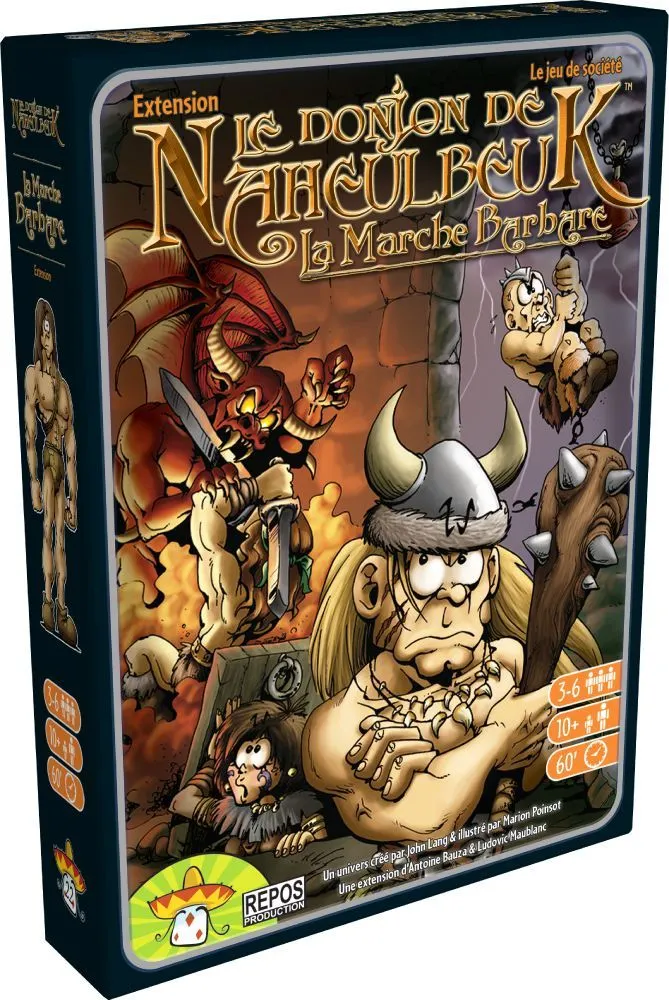
- Note BGG
- 7,1
Le Donjon de Naheulbeuk: La marche Barbare
- 3–6 joueurs
- 60 min
- Complexité 1,0/5
- 2012
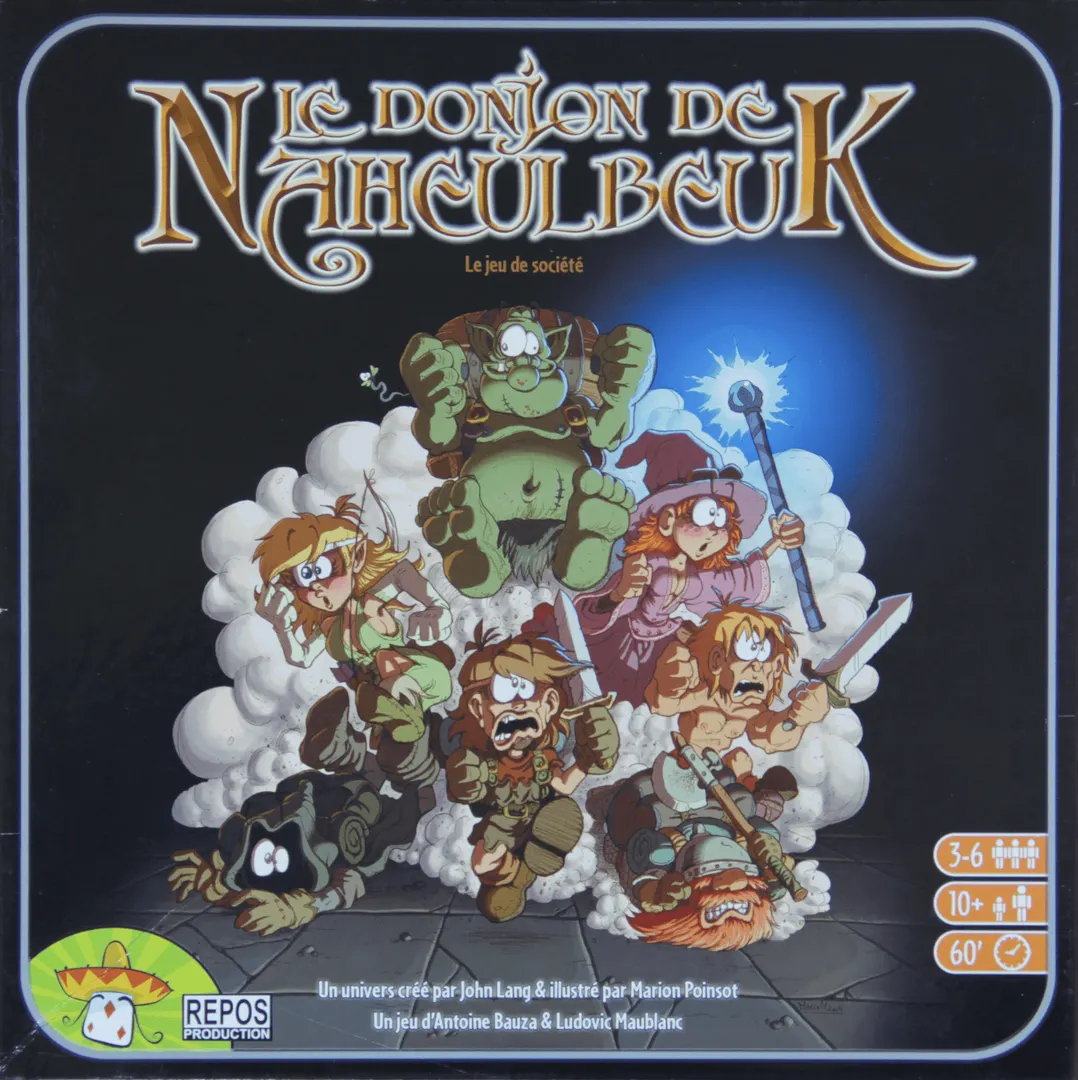
2010
Aide aux règles de Le Donjon de Naheulbeuk
Des explications claires des tours, effets de cartes et situations litigieuses, avec des références aux sources officielles et un historique des questions sauvegardé.
Pour 3 joueurs
Que voulez-vous savoir ?
Les réponses viennent du livret officiel, avec la page à vérifier.
Le Donjon de Naheulbeuk est un jeu de société sorti en 2010 pour 3 à 6 joueurs, avec des parties de 60 minutes et à partir de 10 ans. Il a été conçu par Antoine Bauza et Ludovic Maublanc et ses principales mécaniques sont Variable Player Powers et Cooperative Game.

En anglais
"Le Donjon de Naheulbeuk" is a cooperative game in which the players try to recover the last of Gladeulfeurha's statuettes. Players embody adventurers in this dungeon-crawling quest, each with a different class, skill and personality: there're the stupid barbarian, the belching ogre, the haughty sorceress, the dumb elf, the coward thief, the ever-singing bard, the cranky dwarf and the ranger who wishes he were a leader… (all the characters and elements of the game are inspired by the audio and comics saga by the same name, parodies of Fantasy RPG — à la Munchkin). In each game, the group must go through 14 of the 56 available dungeon rooms in order to defeat the powerful sorcerer Zangdar. In every room, players will face choices, skill checks or battles, and maybe rewards (as xp, gold or loot cards) There're 8 kind of skill checks, and each checks can slightly differ from the others of the same kind (number of players involved, special rule, etc.). Most of the skill checks use Destiny Tiles (which are 16 thick cards, which also represents monsters) and a special timer (with 3 difficulty levels) Balance Check: the player must put a Destiny Tile on the top of his head, walk/run around and sit down again without letting the tile fall. Climbing Check: the player must put a Destiny Tile on the top of his head, stand up on his chair, then sit down again without letting the tile fall. Dexterity Check: the player must build a house of cards using Destiny Tiles. Speed Check: the player must put a Destiny Tile on the edge of the table, then slap it up the air and catch it before it falls back down. Precision Check: a player stands 3 steps from the table, holding the game box, and the others must throw Destiny Tiles into the box from the other side of the table. Intelligence Check: players play a memory game with the 16 Destiny Tiles Coordination Check: players stands a step from the table, and must circle all the Destiny Tiles around the table, throwing them from one player to the next. Stamina Check: the player must stand on one leg, with a Destiny Tile on his other knee and another one on both of his forefingers, without dropping down either one. The battles are also timed and are played with Letter Cards, that can be exchanged one by one between 2 players. They are used to spell special words (several different words for each character) as blows to the enemy. Every time a player plays cards to spell a word, he draw 3 new cards and keep on playing. At the end of the battle, if there're enough blows, the enemy is defeated. For instance, the sorceress can cast a spell by spelling "wazaaa" with any number of a's at the end, wounding the enemy for every extra a's. The barbarian can misspell a letter in each of his word. The bard and the ranger can make other players draw cards. And so on… For every 3 cards played with a punch symbol on it, a player takes one wound him/herself. Using gold and/or xp, characters can level up (up to level 3) and gain access to more powerful attacks or skills. The party can rest up to 3 times a game to recover from one wound each. If a player dies, he shuffles his character sheet with the other available sheets and pick one : if it's the same, he recovers all his health and keep all his loot, gold and xp; if it's another one, he dies, loses everything, and continues the game as a totally new character. If the players defeat Zangdar the Sorcerer in the 14th room (4 tiles with different rules so every game doesn't end the same way), they win the game.
Selon le catalogue, Le Donjon de Naheulbeuk se joue de 3 à 6 personnes. Cette fourchette correspond au nombre de joueurs indiqué par l’éditeur : le jeu s’installe donc pour toute taille de groupe dans cette limite. La mise en place, certaines règles et le décompte peuvent varier selon l’effectif ; vérifiez la configuration exacte dans la règle de votre édition.
La durée indiquée pour Le Donjon de Naheulbeuk est de 60 minutes, selon l’estimation de l’éditeur pour une partie complète. La durée réelle dépend du groupe, de l’effectif et de la connaissance des règles : les premières parties sont plus longues, les groupes expérimentés terminent plus vite. Mise en place et explication des règles ne sont pas comprises.
Le catalogue indique Le Donjon de Naheulbeuk à partir de 10 ans. C’est la recommandation de l’éditeur ; elle tient compte de la lecture nécessaire, de la complexité des règles et des petits composants, pas seulement du thème. Les plus jeunes peuvent souvent participer avec l’aide d’un adulte : vérifiez l’âge indiqué sur votre édition et tenez compte de l’expérience de votre groupe.
Le Donjon de Naheulbeuk obtient une note de complexité de 1,8 sur 5 auprès des joueurs de BoardGameGeek, ce qui en fait un jeu léger. Cette note reflète la quantité de règles, de planification et de décisions qu’exige une partie typique. Prévoyez une explication plus longue pour les jeux exigeants et utilisez un guide de préparation avant la soirée.
Le Donjon de Naheulbeuk appartient à ces catégories : Fantasy, Humor et Comic Book / Strip. Ses principales mécaniques sont Variable Player Powers et Cooperative Game. Les catégories décrivent le thème et l’univers d’un jeu, tandis que les mécaniques décrivent ce que les joueurs font réellement pendant leur tour. Chaque mécanique mène à une page du catalogue avec des jeux similaires.
Les auteurs crédités pour Le Donjon de Naheulbeuk sont : Antoine Bauza et Ludovic Maublanc. Ces crédits proviennent des données publiées du jeu et désignent les personnes responsables de sa conception, et non les illustrateurs ou les éditeurs. Les pages d’auteurs sur MeepleRules regroupent les autres titres des mêmes auteurs, ce qui est utile lorsqu’un jeu vous plaît et que vous en cherchez de similaires.
Le catalogue présente Le Donjon de Naheulbeuk comme un jeu de base. Il se joue seul avec le matériel contenu dans la boîte et ne nécessite aucun autre titre. Les extensions, s’il en existe, y ajoutent du contenu ou des règles et sont répertoriées séparément dans le catalogue, avec un lien vers ce jeu de base.