
- Rang BGG
- BGG #823
- Note BGG
- 7,0
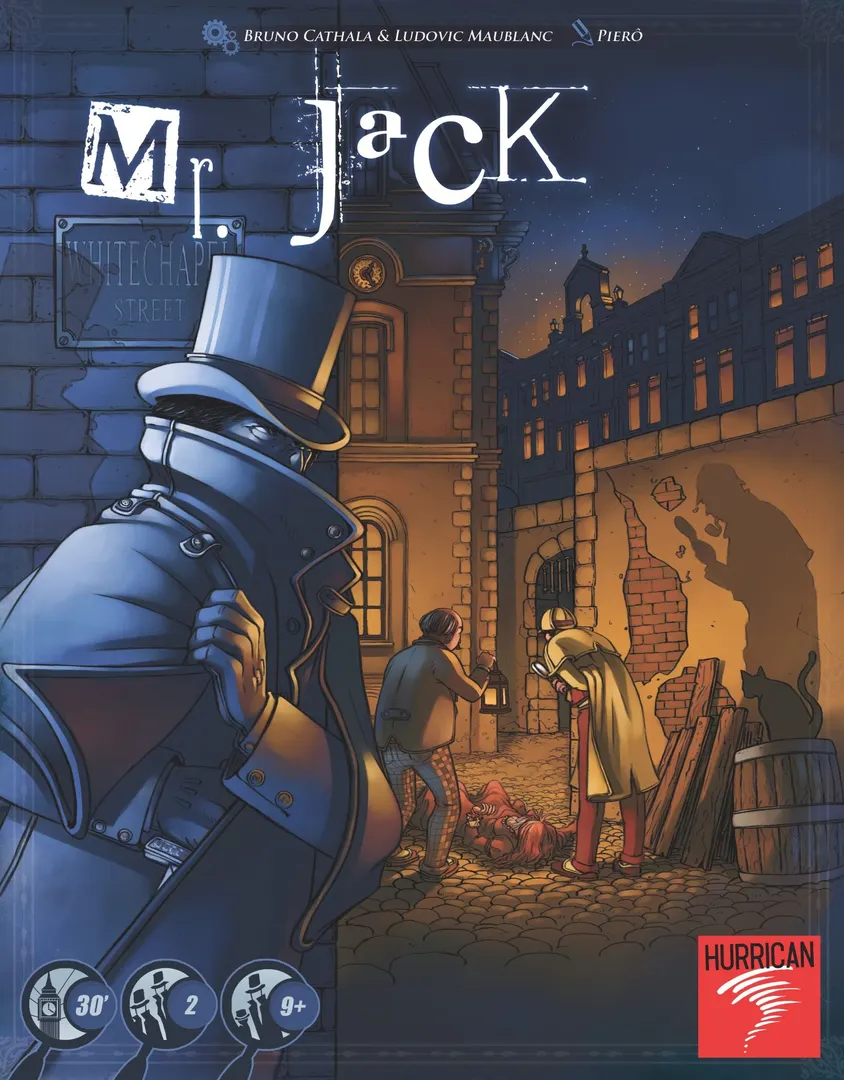
Mr. Jack
- 2 joueurs
- 30 min
- Complexité 2,2/5
- 2006
2013
Aide aux règles de Le Fantôme de l'Opéra
Des explications claires des tours, effets de cartes et situations litigieuses, avec des références aux sources officielles et un historique des questions sauvegardé.
Pour 2 joueurs
Que voulez-vous savoir ?
Les réponses viennent du livret officiel, avec la page à vérifier.
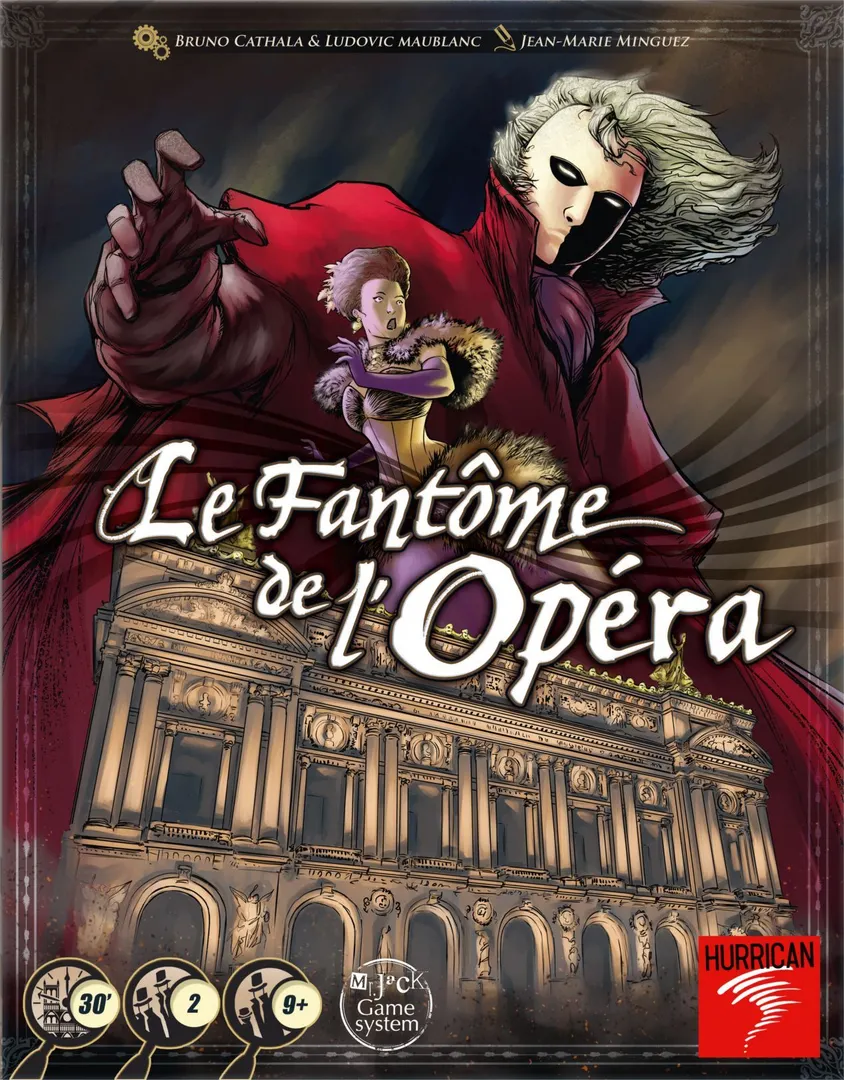
Le Fantôme de l'Opéra est un jeu de société sorti en 2013 pour 2 joueurs, avec des parties de 30 minutes et à partir de 9 ans. Il a été conçu par Bruno Cathala et Ludovic Maublanc et ses principales mécaniques sont Variable Player Powers et Grid Movement.






En anglais
Le Fantôme de l’Opéra is a two-player game based on the Mr. Jack game system – that is, the game is an asymmetric affair in which one player wants to reveal which suspect token on the game board represents the opponent, with both players taking turns moving all of the suspects to alternately reveal and hide information. That said, the game differs in a number of ways from Mr. Jack. In more detail... In Le Fantôme de l’Opéra, eight suspect tokens stand in the ten rooms of the Opéra Garnier. Each suspect has a reason to drive the opera singer La Carlotta away from the production, and at the start of the game one of the suspects is randomly determined to be the true identity of the Phantom player. The other player is the Investigator, and he wants to discover the Phantom's identity; if he does so before La Carlotta flees the Opéra Garnier, then he wins. Otherwise, he loses. (To balance play between newcomers and experienced players La Carlotta's starting position can changed.) At the start of each odd round, eight suspect cards are shuffled and four of them revealed. The Investigator moves one suspect and (likely) uses this suspect's unique ability, then the Phantom moves two of the remaining three suspects, then the Investigator moves the final suspect. The Phantom player then reveals whether he can or cannot cause a disturbance in the Opéra Garnier, thus scaring La Carlotta; he can cause a disturbance only if he's alone or if he's in the room with the blackout token. If he can cause a disturbance, the Investigator clears all suspects sharing a lit room; if not, the Investigator clears all suspects in the dark or on their own. After this, La Carlotta moves one step closer to fleeing for each suspect that hasn't been declared innocent (and an additional step if the Phantom did create a disturbance). For each even round, the remaining four suspect cards are revealed, and the players again move characters and use their special abilities, with the Phantom going first. The game continues until only a single suspect is not innocent or La Carlotta flees France for the safety of Milan. When a character moves, it can move up to as many spaces as the number of characters in the room from which it moves. Most characters can move only through open corridors, but Meg Giry can use secret passageways that connect many of the rooms. The players must use Meg's ability and the other characters' special abilities to hide or reveal information. One character, for example, moves a padlock that blocks one corridor, while another is responsible for the roaming blackout that allows the Phantom to operate in darkness (or at least provide cover for his activity elsewhere). One sweet character can draw everyone from adjacent rooms to her side, while an unpleasant fellow can drive everyone away. Still another reveals (or hides) an alibi card, clearing one suspect (or keeping his true nature unknown). Every character is useful in the right situation. You just have to learn what those situations are...
Selon le catalogue, Le Fantôme de l'Opéra se joue à 2 personnes. C’est le nombre de joueurs indiqué par l’éditeur : le jeu est donc conçu pour exactement ce nombre de participants. Les variantes pour d’autres tailles de groupe, s’il en existe, sont décrites dans la règle de votre édition ; consultez-la avant d’installer une autre configuration.
La durée indiquée pour Le Fantôme de l'Opéra est de 30 minutes, selon l’estimation de l’éditeur pour une partie complète. La durée réelle dépend du groupe, de l’effectif et de la connaissance des règles : les premières parties sont plus longues, les groupes expérimentés terminent plus vite. Mise en place et explication des règles ne sont pas comprises.
Le catalogue indique Le Fantôme de l'Opéra à partir de 9 ans. C’est la recommandation de l’éditeur ; elle tient compte de la lecture nécessaire, de la complexité des règles et des petits composants, pas seulement du thème. Les plus jeunes peuvent souvent participer avec l’aide d’un adulte : vérifiez l’âge indiqué sur votre édition et tenez compte de l’expérience de votre groupe.
Le Fantôme de l'Opéra obtient une note de complexité de 2,2 sur 5 auprès des joueurs de BoardGameGeek, ce qui en fait un jeu plutôt léger. Cette note reflète la quantité de règles, de planification et de décisions qu’exige une partie typique. Prévoyez une explication plus longue pour les jeux exigeants et utilisez un guide de préparation avant la soirée.
Le Fantôme de l'Opéra appartient à ces catégories : Deduction, Music et Novel-based. Ses principales mécaniques sont Variable Player Powers et Grid Movement. Les catégories décrivent le thème et l’univers d’un jeu, tandis que les mécaniques décrivent ce que les joueurs font réellement pendant leur tour. Chaque mécanique mène à une page du catalogue avec des jeux similaires.
Les auteurs crédités pour Le Fantôme de l'Opéra sont : Bruno Cathala et Ludovic Maublanc. Ces crédits proviennent des données publiées du jeu et désignent les personnes responsables de sa conception, et non les illustrateurs ou les éditeurs. Les pages d’auteurs sur MeepleRules regroupent les autres titres des mêmes auteurs, ce qui est utile lorsqu’un jeu vous plaît et que vous en cherchez de similaires.
Le catalogue présente Le Fantôme de l'Opéra comme un jeu de base. Il se joue seul avec le matériel contenu dans la boîte et ne nécessite aucun autre titre. Les extensions, s’il en existe, y ajoutent du contenu ou des règles et sont répertoriées séparément dans le catalogue, avec un lien vers ce jeu de base.