

- Rang BGG
- BGG #14 807
- Note BGG
- 7,4
Partizan!
- 1–2 joueurs
- 240 min
- Complexité 2,6/5
- 2011
2017
Aide aux règles de Lion of Judah: The War for Ethiopia, 1935-1941
Des explications claires des tours, effets de cartes et situations litigieuses, avec des références aux sources officielles et un historique des questions sauvegardé.
Pour 2 joueurs
Que voulez-vous savoir ?
Les réponses viennent du livret officiel, avec la page à vérifier.
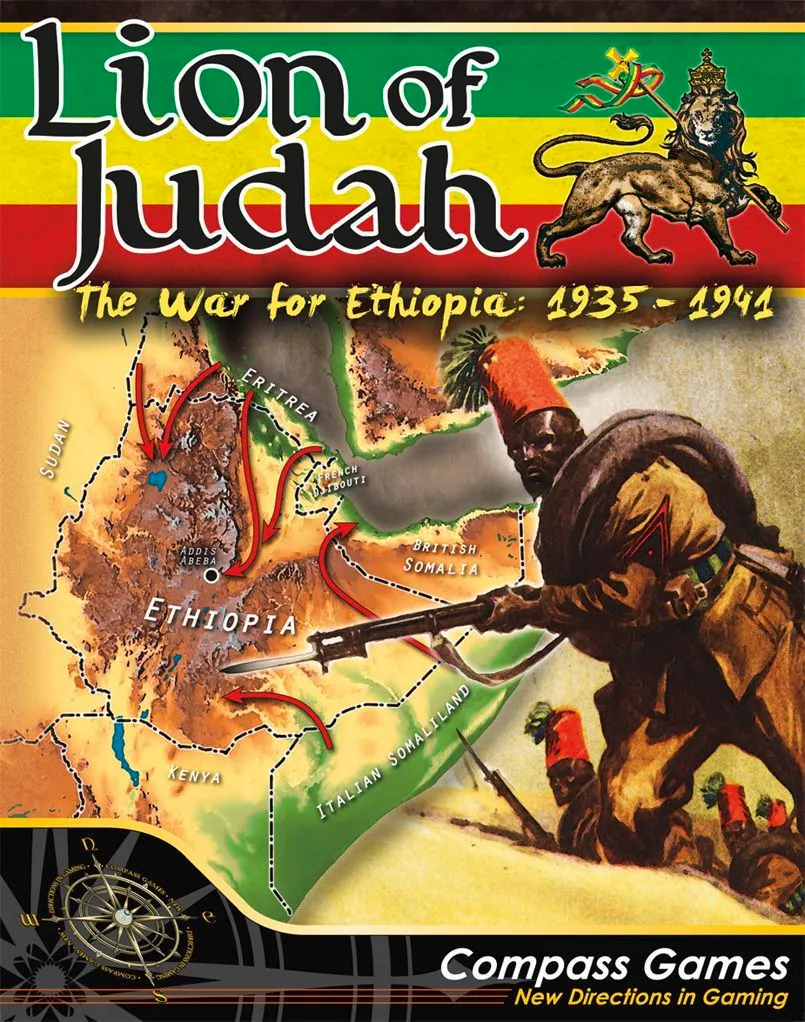
Lion of Judah: The War for Ethiopia, 1935-1941 est un jeu de société sorti en 2017 pour 2 joueurs et avec des parties de 180 à 240 minutes. Il a été conçu par Javier Romero et ses principales mécaniques sont Hexagon Grid.



En anglais
Lion of Judah: The War for Ethiopia, 1935-1941 is a two-player wargame simulating two campaigns located in the Horn of Africa - Italy vs. Ethiopia in 1935-1936, and the British Commonwealth and Ethiopia vs. Italy in 1940-1941. The scenarios use a common rule set combined with scenario-specific rules. Regular units are mostly divisions, brigades and regiments, while irregular units include warrior levies and tribal bands. Armor, transports, air power, and headquarters (which represent corps-level artillery assets, engineers, and administrative and command centers) are also represented. Lion of Judah has one large-hex map and approximately 400 counters representing Italian, Ethiopian, Commonwealth, French and German units. In addition to the military units, there are markers to track game and unit status, as well as several Random Event markers used in the historical scenarios for added historical flavor. Colonial Warfare in Unforgiving Conditions. The campaigns for Ethiopia were fought in extremely inhospitable terrain. Logistics was one of the key issues of these battles. This is simulated in Lion of Judah by supply counters: everything a modern army requires to operate, from replacements to ammunition to artillery, has to be moved across the harsh terrain. Western units have far more firepower that the Ethiopians, but much lower movement rates. This simulates the “safe” rate of movement for western units when moving across difficult terrain. They had to move through jungles, mountains and marshes, relying on local guides to move through this mostly-unmapped terrain. Supplies often had to go by air due to lack of a road network. Western forces may attempt to move at a more “normal” movement rate (using the “Forced march” table), but this entails risks: units may get lost, run out of supply, lose their pack mules, or even be ambushed. Unlike the Italians, the Ethiopian army of 1935 was a medieval-style collection of warriors, with little or no central command. This is simulated through activation rules: Ethiopian forces are activated randomly, and some may end up not activating at all during an entire turn! The Italian player may also “bribe” certain Ethiopian formations into inactivity, as they did historically. Conventional and Guerrilla Warfare. Both historical campaigns, have conventional and unconventional warfare. In 1935-36, the Ethiopian army engaged a conventional Italian army in the north and south, while at the same time fighting rebels and tribal guerrillas in the far off corners of the Empire. In 1940-41, it was the Italian Army who had to face both a conventional, professional enemy (the Commonwealth forces) and Ethiopian guerrillas and Commonwealth special forces operating in its rear. To win, players must successfully manage both kinds of warfare, guerrilla and conventional. When invading Ethiopia in 1935-36, the Italian player must invest resources to encourage trouble within the Ethiopian Empire, recruiting irregulars, bribing and encouraging rebellions. If the Italian player concentrates exclusively on the conventional military front, then the Ethiopian Empire will have a chance to concentrate its armies and achieve a resounding, glorious Adowa-like victory over the Italian invaders. Similarly, in the 1940-41 campaign the Commonwealth/Ethiopian player must raise rebel forces to force the Italian player to use desperately needed units to defend their lines of communications and cities. Furthermore, the Italian player has an 'Italian Prestige Index', which determines the chance of internal revolts. He must attack British held territories and outposts as much as possible to keep his Prestige high, especially early in the game before the full might of the Commonwealth army can be brought to bear. The uncertainty regarding Italian defeats in Libya (handled via event chits) adds further randomness as it is not guaranteed that the British and Indian units that were historically available in January 1941 will arrive in time for the Allied counteroffensive in Ethiopia. Diplomacy and other Chrome A random events system similar to that used in The Spanish Civil War 1936-1939 accounts for political and diplomatic events, rebellions in the rear, the arrival of combat units, the purchase of foreign weapons (in the 1935-1936 Scenario) or the arrival of blockade runners to Italian East Africa. Pressure exerted by various political actors is also simulated through events chits: for instance, the event “Pressure by Mussolini” (1935-36 Scenario), simulates pressure from il Duce when he demanded a rapid advance on to Addis Ababa before he lost the favorable international situation. The Italian player may use chemical weapons, but at the risk of losing Italian Victory Points if the “League of Nations” event is pulled that turn. Special units and rules cover the above mentioned Italian chemical warfare, as well as road building, supply dumps, Italian fuel and ammo shortages (1940-1941 scenario), open cities, the Red Sea Flotilla and blockade runners. The countersheet includes exotic units, such as the Somali Camel Corps, the Italo-German motorized company (a German volunteer unit that was recruited among German refugees from Kenya and crews of interned German ships), and Mission 101 or Gideon Force (Orde Wingate’s guerrilla force operating in the Italian rear).
Selon le catalogue, Lion of Judah: The War for Ethiopia, 1935-1941 se joue à 2 personnes. C’est le nombre de joueurs indiqué par l’éditeur : le jeu est donc conçu pour exactement ce nombre de participants. Les variantes pour d’autres tailles de groupe, s’il en existe, sont décrites dans la règle de votre édition ; consultez-la avant d’installer une autre configuration.
La durée indiquée pour Lion of Judah: The War for Ethiopia, 1935-1941 est de 180 à 240 minutes, selon l’estimation de l’éditeur pour une partie complète. La durée réelle dépend du groupe, de l’effectif et de la connaissance des règles : les premières parties sont plus longues, les groupes expérimentés terminent plus vite. Mise en place et explication des règles ne sont pas comprises.
Lion of Judah: The War for Ethiopia, 1935-1941 obtient une note de complexité de 3,4 sur 5 auprès des joueurs de BoardGameGeek, ce qui en fait un jeu de complexité moyenne. Cette note reflète la quantité de règles, de planification et de décisions qu’exige une partie typique. Prévoyez une explication plus longue pour les jeux exigeants et utilisez un guide de préparation avant la soirée.
Lion of Judah: The War for Ethiopia, 1935-1941 appartient à ces catégories : Wargame et World War II. Ses principales mécaniques sont Hexagon Grid. Les catégories décrivent le thème et l’univers d’un jeu, tandis que les mécaniques décrivent ce que les joueurs font réellement pendant leur tour. Chaque mécanique mène à une page du catalogue avec des jeux similaires.
Les auteurs crédités pour Lion of Judah: The War for Ethiopia, 1935-1941 sont : Javier Romero. Ces crédits proviennent des données publiées du jeu et désignent les personnes responsables de sa conception, et non les illustrateurs ou les éditeurs. Les pages d’auteurs sur MeepleRules regroupent les autres titres des mêmes auteurs, ce qui est utile lorsqu’un jeu vous plaît et que vous en cherchez de similaires.
Le catalogue présente Lion of Judah: The War for Ethiopia, 1935-1941 comme un jeu de base. Il se joue seul avec le matériel contenu dans la boîte et ne nécessite aucun autre titre. Les extensions, s’il en existe, y ajoutent du contenu ou des règles et sont répertoriées séparément dans le catalogue, avec un lien vers ce jeu de base.