

- Rang BGG
- BGG #7 962
- Note BGG
- 7,0
Bismarck (Second Edition)
- 2 joueurs
- 150–240 min
- Complexité 3,2/5
- 1978
2011
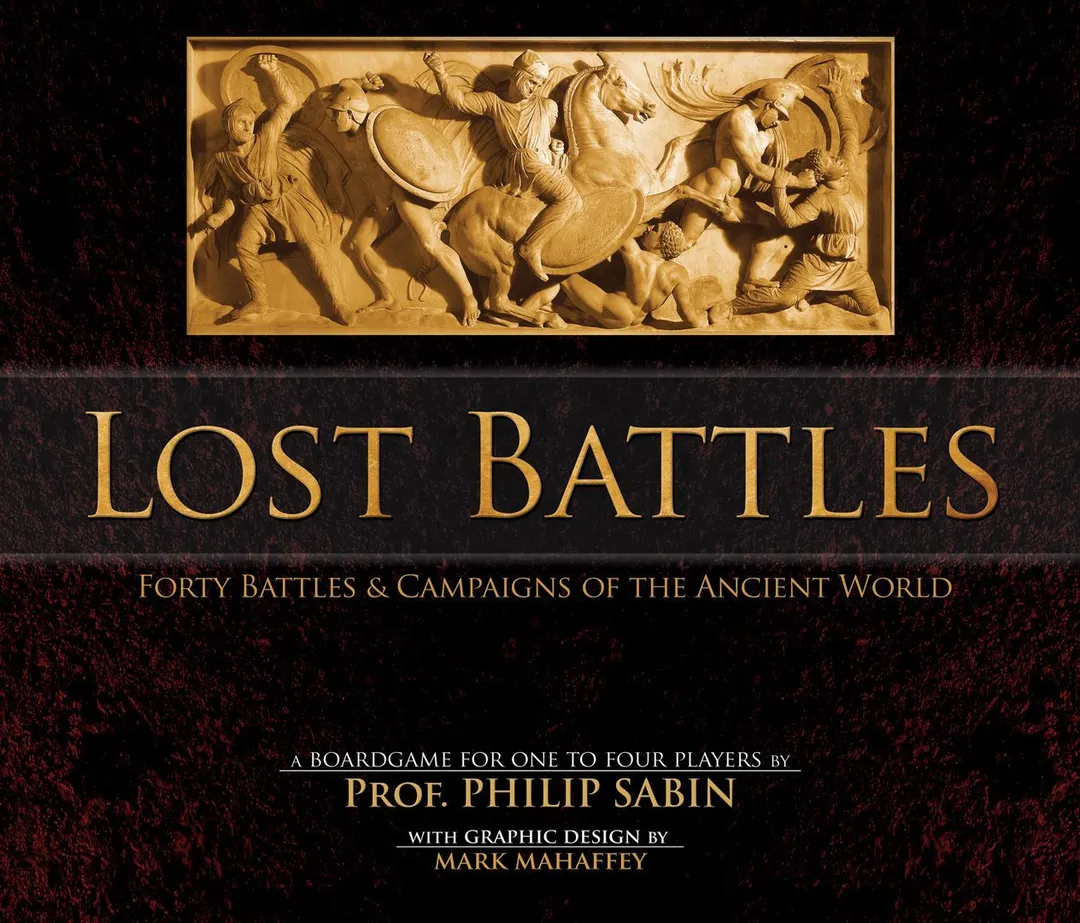
Aide aux règles de Lost Battles: Forty Battles & Campaigns of the Ancient World
Des explications claires des tours, effets de cartes et situations litigieuses, avec des références aux sources officielles et un historique des questions sauvegardé.
Pour 1 joueur
Que voulez-vous savoir ?
Les réponses viennent du livret officiel, avec la page à vérifier.
Lost Battles: Forty Battles & Campaigns of the Ancient World est un jeu de société sorti en 2011 pour 1 à 4 joueurs, avec des parties de 140 minutes et à partir de 12 ans. Il a été conçu par Philip Sabin et ses principales mécaniques sont Dice Rolling, Grid Movement et Modular Board.








En anglais
"Lost Battles" is forty games in one. The game covers battles and campaigns in the Mediterranean and Near East from the Persian defeat at Marathon in 490 BC to Caesar's victory at Pharsalus in 48 BC. It has been exhaustively tested and refined over the past several years, and is based on Professor Philip Sabin's decades of research and simulation design on ancient warfare; and it includes an updated copy of his book, with extensive historical and design notes on every scenario. The game can be fought on three levels - the grand tactical, the grand strategic, or a combination of the two. At the grand tactical level, 1 or 2 players may refight any of 35 different land battles such as Leuctra, Gaugamela, Raphia, Cannae, Cynoscephalae or the Sambre - far more than in any other single boxed game. At the grand strategic level, 1 to 4 players may refight the epic duels of the two centuries from 350 to 150 BC, starting with the eclipse of Achaemenid Persia by Alexander of Macedon, and ending with Hannibal's campaigns and the conquest of Carthage and the Hellenistic states by the resurgent Roman republic. The most ambitious games combine these two levels, and see 1 to 4 players using tactical battles to resolve strategic campaigns across part or all of this two century period, or else refighting a series of historical battles to decide conflicts such as the three-cornered contest for dominance between Athens, Sparta and Thebes from the start of the Peloponnesian War to the death of Epaminondas. The accent throughout is on combining historical accuracy with speed and accessibility. The free-standing strategic game may be completed in just 30 minutes, while individual land battles may be re-fought in two hours or less. There is constant player interaction, and a series of tortuous dilemmas - how should the scarce command points be allocated across the battlefront, which troop types should be put in the lead against particular opponents, should units attack all-out at the cost of becoming exhausted themselves, and should generals join the fighting to rally their disheartened men at the risk of being killed and so making things far worse? The game includes all the many troop types from hoplites, legionaries, phalangites and archers to cataphracts, scythed chariots and war elephants, and it includes simple rules to reflect the huge differences in generalship and troop quality and to allow outclassed armies to win a handicapped 'game victory' even if they are defeated on the field, as long as they do better than they did historically. All aspects of the game are avowedly solitaire-friendly, and can be run by a single player swapping sides just as easily as by one or more players per side. Tactical battles are fought on a 5 x 4 grid of full-colour 5 inch square hard mounted terrain tiles, which dovetail to form any desired battlefield. The individually die-cut counters have rounded corners and are also in full-colour; they depict the various different troop types. The strategic game is fought on a hard mounted map showing the area from Spain to India.
Selon le catalogue, Lost Battles: Forty Battles & Campaigns of the Ancient World se joue de 1 à 4 personnes. Cette fourchette correspond au nombre de joueurs indiqué par l’éditeur : le jeu s’installe donc pour toute taille de groupe dans cette limite. La mise en place, certaines règles et le décompte peuvent varier selon l’effectif ; vérifiez la configuration exacte dans la règle de votre édition.
La durée indiquée pour Lost Battles: Forty Battles & Campaigns of the Ancient World est de 140 minutes, selon l’estimation de l’éditeur pour une partie complète. La durée réelle dépend du groupe, de l’effectif et de la connaissance des règles : les premières parties sont plus longues, les groupes expérimentés terminent plus vite. Mise en place et explication des règles ne sont pas comprises.
Le catalogue indique Lost Battles: Forty Battles & Campaigns of the Ancient World à partir de 12 ans. C’est la recommandation de l’éditeur ; elle tient compte de la lecture nécessaire, de la complexité des règles et des petits composants, pas seulement du thème. Les plus jeunes peuvent souvent participer avec l’aide d’un adulte : vérifiez l’âge indiqué sur votre édition et tenez compte de l’expérience de votre groupe.
Lost Battles: Forty Battles & Campaigns of the Ancient World obtient une note de complexité de 3,1 sur 5 auprès des joueurs de BoardGameGeek, ce qui en fait un jeu de complexité moyenne. Cette note reflète la quantité de règles, de planification et de décisions qu’exige une partie typique. Prévoyez une explication plus longue pour les jeux exigeants et utilisez un guide de préparation avant la soirée.
Lost Battles: Forty Battles & Campaigns of the Ancient World appartient à ces catégories : Wargame et Ancient. Ses principales mécaniques sont Dice Rolling, Grid Movement et Modular Board. Les catégories décrivent le thème et l’univers d’un jeu, tandis que les mécaniques décrivent ce que les joueurs font réellement pendant leur tour. Chaque mécanique mène à une page du catalogue avec des jeux similaires.
Les auteurs crédités pour Lost Battles: Forty Battles & Campaigns of the Ancient World sont : Philip Sabin. Ces crédits proviennent des données publiées du jeu et désignent les personnes responsables de sa conception, et non les illustrateurs ou les éditeurs. Les pages d’auteurs sur MeepleRules regroupent les autres titres des mêmes auteurs, ce qui est utile lorsqu’un jeu vous plaît et que vous en cherchez de similaires.
Le catalogue présente Lost Battles: Forty Battles & Campaigns of the Ancient World comme un jeu de base. Il se joue seul avec le matériel contenu dans la boîte et ne nécessite aucun autre titre. Les extensions, s’il en existe, y ajoutent du contenu ou des règles et sont répertoriées séparément dans le catalogue, avec un lien vers ce jeu de base.