
- Rang BGG
- BGG #289
- Note BGG
- 7,5
Dinosaur Island
- 1–4 joueurs
- 90–120 min
- Complexité 3,1/5
- 2017
2018
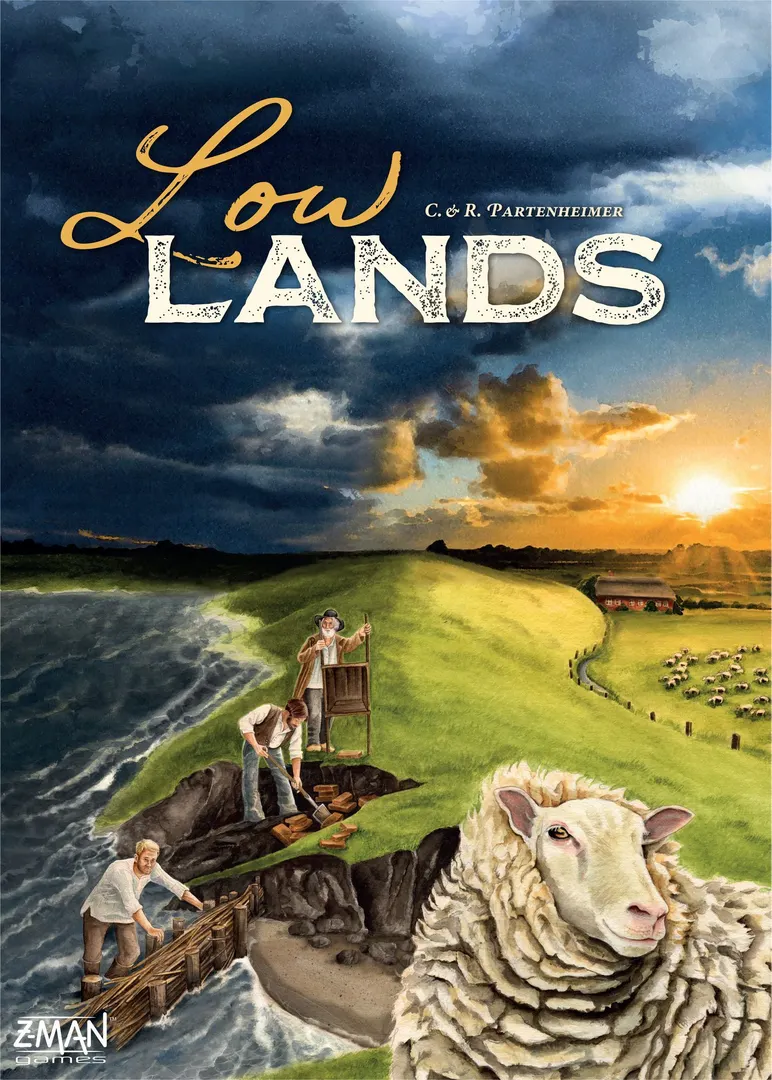
Aide aux règles de Lowlands
Des explications claires des tours, effets de cartes et situations litigieuses, avec des références aux sources officielles et un historique des questions sauvegardé.
Pour 2 joueurs
Que voulez-vous savoir ?
Les réponses viennent du livret officiel, avec la page à vérifier.
Lowlands est un jeu de société sorti en 2018 pour 2 à 4 joueurs, avec des parties de 50 à 100 minutes et à partir de 12 ans. Il a été conçu par Claudia Partenheimer et Ralf Partenheimer et ses principales mécaniques sont Set Collection, Tile Placement et Action Points.


En anglais
The low land is a rough area where hard-working folk make a living by the sweat of their brow. Under constant threat of storm and flood, communities here rally together to build dikes that keep the rising water at bay. But every citizen constructing a dike is one fewer citizen tending flocks and maintaining the family farm. The residents here are constantly torn between selflessness and self-interest, and only those who can strike this delicate balance can thrive in this harsh landscape. In Lowlands, you carve your farm out of this unforgiving land, gathering and spending resource cards to transform your farmyard into pastures that allow you to profit from breeding sheep. Adding expansions to your farm will unlock new options and score you victory points, but helping to build the dike that collectively protects all players is also rewarded. No matter what, the tide will rise and, if the dike isn't high enough, it could rush in and sweep away your hard-earned profits. Will you sacrifice your own farm for the good of the community, or will you pursue your own agenda? The choice is yours. Even without the poor weather, life on a farm is one of constant work where you find yourself tending flocks of sheep, extending their pastures, and looking for the right moment to sell them for a profit. To complete all these tasks, Lowlands gives you a group of farmers that you can assign to various tasks around your farm. To get the most out of them, you must think strategically, deciding which actions you want to take and the best time to take them. Once they've been assigned, your farmers help you build a bustling farm where there was once scrubby bushes, trees, and lakes. You begin the game with only two sheep and a small pasture, but your farmyard is rife with possibilities, its many empty spaces inviting you to customize your farm as you see fit. While you could simply focus on creating more area for your sheep to roam, the game also provides plenty of options for customizing your farm with various buildings and features. Not only are these tiles worth victory points at the end of the game, they also make your farm more efficient and more profitable. You might add a feeding trough to your farm, for example, to immediately earn another sheep and the ability to house two sheep per pasture space instead of just one. Or you could construct a lake cabin on your property to get away from it all for a bit. While this tile doesn't give you any special abilities, it increases the value in victory points of the farmyard spaces immediately adjacent to it. Ultimately, you are free to pursue whatever strategy you see fit, building a farm wholly your own. On top of the challenges of building a successful farm, of course, you also have to deal with the tempestuous weather that comes with living on the wave-battered coast of the North Sea. Here, the tides always seem to rise a little higher, threatening to take a dent out of your profits by sweeping away some of your flock. To ensure that this doesn't happen, you always have the opportunity to send your farmers to contribute to the dike instead of working on your farm. When you do, you also commit resources to creating dike elements that are added to the board as a buffer against the rising waters. Add enough of these pieces and you might prevent disaster for everyone. The tide turns repeatedly, bringing with it new flood pieces. If there are enough dike elements in place to hold back the rising waters, players' farms are spared. If the dike breaks, however, you could be forced to take dike breach tokens that have adverse effects at the end of the game. While lending a hand with the dike at the expense of your own farm is certainly a nice gesture that keeps everyone safe from the floodwaters, it has rewards of its own. For each resource you contribute to the dike, you advance one step up the dike track. Not only does advancing far enough on this track grant victory points, it also amplifies your reward if the dike holds and lessens the blow when it breaks. It is in your best interest, then, to keep pace with other players on the dike in order to protect your investments back home one the farm. —description from the publisher
Selon le catalogue, Lowlands se joue de 2 à 4 personnes. Cette fourchette correspond au nombre de joueurs indiqué par l’éditeur : le jeu s’installe donc pour toute taille de groupe dans cette limite. La mise en place, certaines règles et le décompte peuvent varier selon l’effectif ; vérifiez la configuration exacte dans la règle de votre édition.
La durée indiquée pour Lowlands est de 50 à 100 minutes, selon l’estimation de l’éditeur pour une partie complète. La durée réelle dépend du groupe, de l’effectif et de la connaissance des règles : les premières parties sont plus longues, les groupes expérimentés terminent plus vite. Mise en place et explication des règles ne sont pas comprises.
Le catalogue indique Lowlands à partir de 12 ans. C’est la recommandation de l’éditeur ; elle tient compte de la lecture nécessaire, de la complexité des règles et des petits composants, pas seulement du thème. Les plus jeunes peuvent souvent participer avec l’aide d’un adulte : vérifiez l’âge indiqué sur votre édition et tenez compte de l’expérience de votre groupe.
Lowlands obtient une note de complexité de 3,1 sur 5 auprès des joueurs de BoardGameGeek, ce qui en fait un jeu de complexité moyenne. Cette note reflète la quantité de règles, de planification et de décisions qu’exige une partie typique. Prévoyez une explication plus longue pour les jeux exigeants et utilisez un guide de préparation avant la soirée.
Lowlands appartient à ces catégories : Farming. Ses principales mécaniques sont Set Collection, Tile Placement et Action Points. Les catégories décrivent le thème et l’univers d’un jeu, tandis que les mécaniques décrivent ce que les joueurs font réellement pendant leur tour. Chaque mécanique mène à une page du catalogue avec des jeux similaires.
Les auteurs crédités pour Lowlands sont : Claudia Partenheimer et Ralf Partenheimer. Ces crédits proviennent des données publiées du jeu et désignent les personnes responsables de sa conception, et non les illustrateurs ou les éditeurs. Les pages d’auteurs sur MeepleRules regroupent les autres titres des mêmes auteurs, ce qui est utile lorsqu’un jeu vous plaît et que vous en cherchez de similaires.
Le catalogue présente Lowlands comme un jeu de base. Il se joue seul avec le matériel contenu dans la boîte et ne nécessite aucun autre titre. Les extensions, s’il en existe, y ajoutent du contenu ou des règles et sont répertoriées séparément dans le catalogue, avec un lien vers ce jeu de base.