
- Note BGG
- 4,3
Moscow '41: Soviet Aviation and Strategic Tools
- 1–4 joueurs
- 60–240 min
- 2025

2016
Aide aux règles de Moscow '41
Des explications claires des tours, effets de cartes et situations litigieuses, avec des références aux sources officielles et un historique des questions sauvegardé.
Pour 1 joueur
Que voulez-vous savoir ?
Les réponses viennent du livret officiel, avec la page à vérifier.
Moscow '41 est un jeu de société sorti en 2016 pour 1 à 2 joueurs, avec des parties de 60 à 120 minutes et à partir de 14 ans. Il a été conçu par Emanuele Santandrea et ses principales mécaniques sont Area Movement, Dice Rolling et Variable Set-up.





En anglais
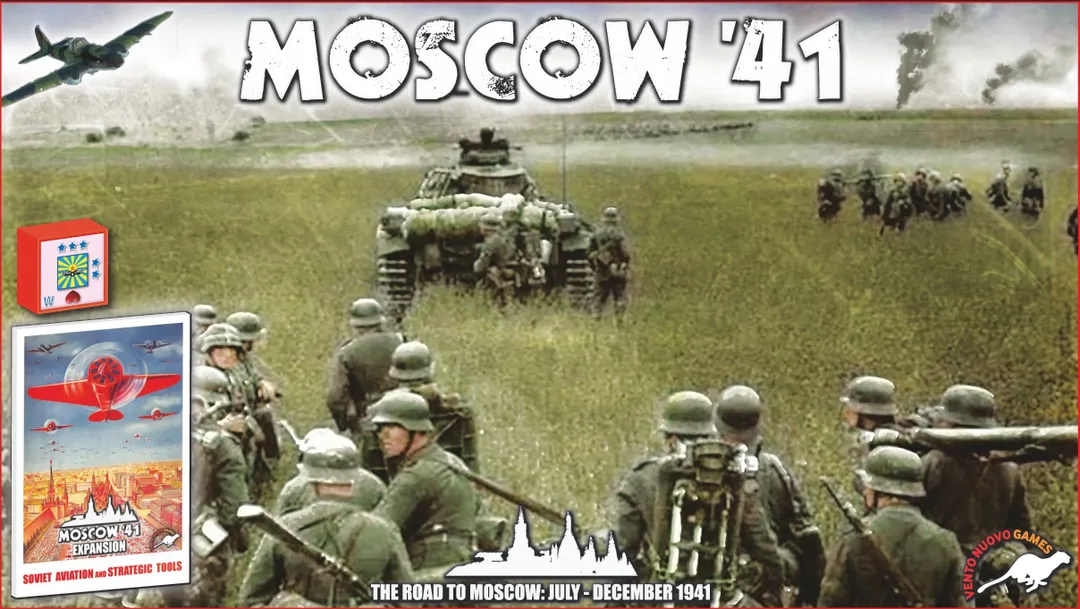
Released July 8, 2016 - 3 months ahead. Second Edition released in 2020, Expansion in 2025: Moscow '41: Soviet Aviation and Strategic Tools Moscow '41 is the first chapter of the Barbarossa Trilogy (the other two are Leningrad '41 and Kiev '41). MOSCOW '41 is a light/medium wargame covering the German Army Group Centre offensive aimed to seize Moscow, after having successfully defeated several Soviet armies in the great encirclement battles at the frontier and established two bridgeheads on the Dnieper. Although based on a historical event, the two players can modify the course of the operations, with the Germans trying to achieve a decisive victory before the winter comes, and the Soviets playing a fighting withdrawal, until ready to strike a decisive blow at the invaders. The game is recommended for two players, but has excellent solitaire suitability. Historical Introduction "At the beginning of each campaign, one pushes a door into a dark, unseen room. One can never know what is hiding inside." - Adolf Hitler, June '41 In December of 1940, Hitler made the decision to invade Russia and set the date for the middle of 1941. He had good reason to be confident that Russia would collapse under an uncompromising assault. Since the outbreak of hostilities, the German Wehrmacht had accomplished a stunning and unparalleled series of victories: Poland had fallen in one month, Denmark in one day; France, till then regarded as the strongest power in Europe, had capitulated in under six weeks, Holland in under six days; Belgium, Norway, Yugoslavia and Greece took less than three weeks each. The German military might was at its peak and the word Blitzkrieg had entered the language. Russia, on the other hand had taken over three months to bring Finland to heel, despite overwhelming strength of numbers. The Russian army had not yet recovered from Stalin's purges of 1937-1938 where 400 generals were “removed” including three field marshals and 13 Army commanders. It was well that Hitler could say, “Before three months have passed, we shall witness a collapse in Russia, the like of which has never been seen in history. We have only to kick in the front door and the whole rotten Russian edifice will come tumbling down.” On the 22nd of June, 1941, Operation Barbarossa - the invasion of Russia, began. Three million Axis troops in three Army Groups attacked on a front that stretched from the Baltic to the Black Sea: Army Group North under Field Marshal von Leeb was tasked with taking Leningrad; Army Group South under Field Marshal von Rundstedt was to capture Kiev and seize the Caucasus; Field Marshal von Bock's Army Group Centre, the one that concerns us, had Moscow as an objective, with Timoshenko undertaking the task of defending the capital. Initially, the operation succeeded beyond Hitler's wildest dreams. Within a day, the Russian Air Force was destroyed on the ground, then vast inroads were made on all fronts accompanied by large scale surrenders of encircled Russian troops. Army Group Centre with its four armies consisting of a total of 48 Divisions, of which nine were armoured, and backed by the Second Air Fleet, had reached the outskirts of Smolensk by the 15th July. This was two-thirds of the way to Moscow and it seemed that nothing could stop von Bock from blowing up the Kremlin within another three or four weeks... or could something stand in his way? Four things could now cause problems to von Bock: firstly, his supply line is stretched and had almost reached breaking point; secondly, Russian resistance is stiffening; thirdly, his infantry divisions are having difficulty keeping up with the Panzers and finally, a new Russian ally is about to enter the field: General Winter. Additional concerns may come in November, with three-quarters of a million experienced Siberian veterans freed by garrisoning Soviet Far East, thanks to Stalin's spies in Tokyo revealing Japanese intentions to attack America, and not Russia. As the German Commander, you must push on to Moscow before it is too late. As the Russian Commander you must re-evoke the Patriotic War and stop the invaders at any cost.
Selon le catalogue, Moscow '41 se joue de 1 à 2 personnes. Cette fourchette correspond au nombre de joueurs indiqué par l’éditeur : le jeu s’installe donc pour toute taille de groupe dans cette limite. La mise en place, certaines règles et le décompte peuvent varier selon l’effectif ; vérifiez la configuration exacte dans la règle de votre édition.
La durée indiquée pour Moscow '41 est de 60 à 120 minutes, selon l’estimation de l’éditeur pour une partie complète. La durée réelle dépend du groupe, de l’effectif et de la connaissance des règles : les premières parties sont plus longues, les groupes expérimentés terminent plus vite. Mise en place et explication des règles ne sont pas comprises.
Le catalogue indique Moscow '41 à partir de 14 ans. C’est la recommandation de l’éditeur ; elle tient compte de la lecture nécessaire, de la complexité des règles et des petits composants, pas seulement du thème. Les plus jeunes peuvent souvent participer avec l’aide d’un adulte : vérifiez l’âge indiqué sur votre édition et tenez compte de l’expérience de votre groupe.
Moscow '41 obtient une note de complexité de 2,9 sur 5 auprès des joueurs de BoardGameGeek, ce qui en fait un jeu plutôt léger. Cette note reflète la quantité de règles, de planification et de décisions qu’exige une partie typique. Prévoyez une explication plus longue pour les jeux exigeants et utilisez un guide de préparation avant la soirée.
Moscow '41 appartient à ces catégories : Wargame et World War II. Ses principales mécaniques sont Area Movement, Dice Rolling et Variable Set-up. Les catégories décrivent le thème et l’univers d’un jeu, tandis que les mécaniques décrivent ce que les joueurs font réellement pendant leur tour. Chaque mécanique mène à une page du catalogue avec des jeux similaires.
Les auteurs crédités pour Moscow '41 sont : Emanuele Santandrea. Ces crédits proviennent des données publiées du jeu et désignent les personnes responsables de sa conception, et non les illustrateurs ou les éditeurs. Les pages d’auteurs sur MeepleRules regroupent les autres titres des mêmes auteurs, ce qui est utile lorsqu’un jeu vous plaît et que vous en cherchez de similaires.
Le catalogue présente Moscow '41 comme un jeu de base. Il se joue seul avec le matériel contenu dans la boîte et ne nécessite aucun autre titre. Les extensions, s’il en existe, y ajoutent du contenu ou des règles et sont répertoriées séparément dans le catalogue, avec un lien vers ce jeu de base.