
- Note BGG
- 7,9
Origin: Ranger Die
- 2–4 joueurs
- 45 min
- Complexité 2,0/5
- 2013
2013
Aide aux règles de Origin
Des explications claires des tours, effets de cartes et situations litigieuses, avec des références aux sources officielles et un historique des questions sauvegardé.
Pour 2 joueurs
Que voulez-vous savoir ?
Les réponses viennent du livret officiel, avec la page à vérifier.
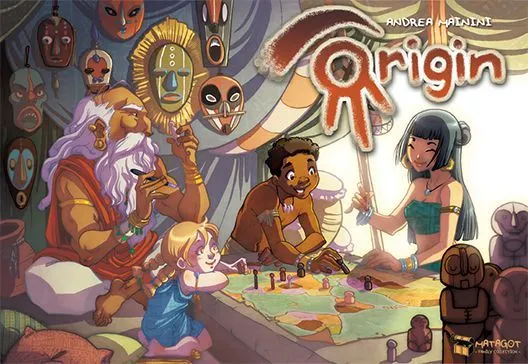
Origin est un jeu de société sorti en 2013 pour 2 à 4 joueurs, avec des parties de 45 à 60 minutes et à partir de 8 ans. Il a été conçu par Andrea Mainini et ses principales mécaniques sont Hand Management, Set Collection et Area Movement.





En anglais
Starting from the heart of Africa, players in Origin will determine the course of mankind's expansion on our planet, with the tribes gradually growing more diversified over time while still maintaining links to their ancestors and to all inhabitants of Earth. The game tokens in Origin come in three colors, three heights, and three thicknesses, and at the start of the game one of the smallest, skinniest pieces is placed in the center of Africa. In addition, you place three technology tiles at random on the tan, orange and violet sections of the tech chart and six random tiles on the brown section; the tech tiles show 1-5 arrows. You also shuffle tan, orange and violet decks of cards and place them in the appropriate places. Tan cards provide an one-shot effect, orange cards give you a permanent power, and violet cards present you with an objective you must meet; if you do so, you can play the objective card on your turn, and immediately draw another. You can play at most one card of each color each turn. On a turn, a player takes one of three actions: Place a new piece on a region of the game board, with this piece sharing two of the three characteristics of a piece in a neighboring region; the new piece cannot be shorter than the original piece. Mark this piece with a token of your player color. Move one of your pieces on the board to an empty region, with short pieces moving only one space, medium height pieces moving up to two spaces, and tall pieces up to three. Take over a region controlled by an opponent by moving one of your pieces into this region and relocating the opponent's piece to the region your piece left. You can do this only if the attacking piece is thicker than the opponent's piece. When you place a new piece on the board or move an existing piece, you're rewarded based on the color of the space you occupy. If you place in or move into a tan, orange or violet region, either you take a tile and the top card of this color or you draw three cards of this color and keep one of them. For a brown region, you either draw two tiles from the brown section of the tech board or draw one tile from anywhere. The technology tiles must be acquired from low to high – so you can't acquire a 4 unless you have a 3 – but you can have multiple tech stacks. You must meet a certain technology threshold in order to play the orange cards and acquire their special power. In addition, you can score points during the game by occupying a grassland on a continent or the two regions on opposite sides of a waterway strait. Players take turns until either all of the pieces are on the game board or all the tiles have been acquired or all the cards of one color have been drawn. Once this happens, players tally their points for objectives, grasslands, straits, tech tiles, and cards still in hand to see who wins!
Selon le catalogue, Origin se joue de 2 à 4 personnes. Cette fourchette correspond au nombre de joueurs indiqué par l’éditeur : le jeu s’installe donc pour toute taille de groupe dans cette limite. La mise en place, certaines règles et le décompte peuvent varier selon l’effectif ; vérifiez la configuration exacte dans la règle de votre édition.
La durée indiquée pour Origin est de 45 à 60 minutes, selon l’estimation de l’éditeur pour une partie complète. La durée réelle dépend du groupe, de l’effectif et de la connaissance des règles : les premières parties sont plus longues, les groupes expérimentés terminent plus vite. Mise en place et explication des règles ne sont pas comprises.
Le catalogue indique Origin à partir de 8 ans. C’est la recommandation de l’éditeur ; elle tient compte de la lecture nécessaire, de la complexité des règles et des petits composants, pas seulement du thème. Les plus jeunes peuvent souvent participer avec l’aide d’un adulte : vérifiez l’âge indiqué sur votre édition et tenez compte de l’expérience de votre groupe.
Origin obtient une note de complexité de 2,2 sur 5 auprès des joueurs de BoardGameGeek, ce qui en fait un jeu plutôt léger. Cette note reflète la quantité de règles, de planification et de décisions qu’exige une partie typique. Prévoyez une explication plus longue pour les jeux exigeants et utilisez un guide de préparation avant la soirée.
Origin appartient à ces catégories : Exploration et Prehistoric. Ses principales mécaniques sont Hand Management, Set Collection et Area Movement. Les catégories décrivent le thème et l’univers d’un jeu, tandis que les mécaniques décrivent ce que les joueurs font réellement pendant leur tour. Chaque mécanique mène à une page du catalogue avec des jeux similaires.
Les auteurs crédités pour Origin sont : Andrea Mainini. Ces crédits proviennent des données publiées du jeu et désignent les personnes responsables de sa conception, et non les illustrateurs ou les éditeurs. Les pages d’auteurs sur MeepleRules regroupent les autres titres des mêmes auteurs, ce qui est utile lorsqu’un jeu vous plaît et que vous en cherchez de similaires.
Le catalogue présente Origin comme un jeu de base. Il se joue seul avec le matériel contenu dans la boîte et ne nécessite aucun autre titre. Les extensions, s’il en existe, y ajoutent du contenu ou des règles et sont répertoriées séparément dans le catalogue, avec un lien vers ce jeu de base.