

- Rang BGG
- BGG #9 724
- Note BGG
- 8,0
Grasse: Mestres Perfumistas
- 2–4 joueurs
- 60–90 min
- Complexité 2,4/5
- 2018
2018
Aide aux règles de Overdrive
Des explications claires des tours, effets de cartes et situations litigieuses, avec des références aux sources officielles et un historique des questions sauvegardé.
Que voulez-vous savoir ?
Les réponses viennent du livret officiel, avec la page à vérifier.
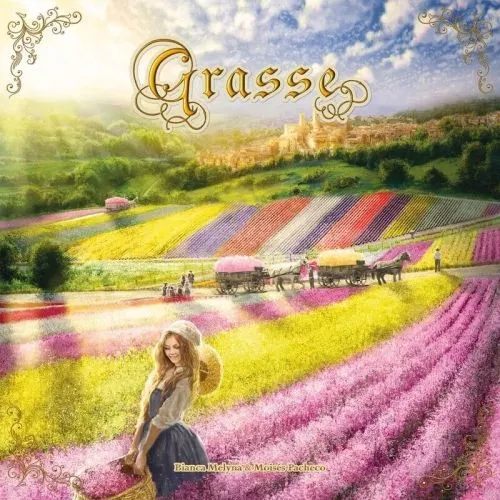
Overdrive est un jeu de société sorti en 2018 pour 2 à 4 joueurs, avec des parties de 30 à 50 minutes et à partir de 8 ans. Il a été conçu par Moisés Pacheco de Souza et Bianca Melyna et ses principales mécaniques sont Variable Player Powers, Take That et Set Collection.





En anglais
OVERDRIVE is a game of dice allocation, which represents the members of your band. Each player takes on the role of the best rock band in their universe, whose goal is to get the most points until the last battle of bands. Use unique techniques, optimize your bandwidth and invest in improvements to prove who is the biggest band in the whole multiverse. This is rock'n roll, baby! LIST OF COMPONENTS 1 Rules Book 5 Band Sheet 1 Game Board 4 Disc Award Tiles 16 cards of Opportunities 20 Cancellation tiles 1 First Player token 24 Custom dices The game board contains the most basic actions of dice allocation. With a combination of dice faces, the player allocates their dice in the spaces available to perform the specific actions. If a space already contains dices from other players, you can not use that space. All players receive at the beginning of the match 4 dices of their color, which represents the members of their band. On your turn, you use the faces of your rolled dice, and allocate them on the board. In addition to the board, there are the Hit Cards, which work the same way, as there are spaces available to allocate dice and receive the bonuses. The difference is that a player can buy a Hit, and when another player allocates dices on his Hit, you are also benefited. For this reason, there is a deck of Hits with 18 different cards to be restored to the table as the players buy them (only 3 are revealed). Each player also receives a Band Sheet from their band, and each of them has the Fan, Fame, Overdrive and Money tracks, which are marked with cubes. Throughout the match, each player, through their actions, can improve these attributes to try to improve their score at the end of the game. Each band also has special abilities that are unlocked throughout the match, optimizing their technique and improving their performance. At the table, there are 4 discs of awards, which are goals that bands can achieve to claim them, and increase their score. When you take an award disc (bronze, silver, gold or diamond), you become the owner of it, and another player can not take it from you. You still have the option of swapping it for another better scoring disc when you can meet your requirements, but you will have to return the lower scoring score, making it available to other players. Finally, at the end of rounds 3, 6 and 8 (total of 8 rounds) the Battle of Bands takes place. Players use their dices to fight between them, trying to eliminate opponents' dices for 2 scrolling acts and comparing results. You can only defeat an opponent's dice if you have more equal faces than the symbol you want to remove from it. For example, you can use 2 skull faces to defeat the only skull result of one of your target foes. At the end of the battle, the remaining dice will provide bonuses to the players. In addition to the game, there is also a concern to accumulate symbols for the collection, which are printed on the Hit Cards, the Band Sheet, and Dices at the end of the last battle. This will give you more points towards the end of the match, as you score with each collection of at least 3 identical or different symbols. The goal of the game is, at the end of round 8, to have more victory points than its opponents, thus becoming the best band of the multiverse. The game is for 2 to 4 players, and the starting time is around 45 minutes.
Selon le catalogue, Overdrive se joue de 2 à 4 personnes. Cette fourchette correspond au nombre de joueurs indiqué par l’éditeur : le jeu s’installe donc pour toute taille de groupe dans cette limite. La mise en place, certaines règles et le décompte peuvent varier selon l’effectif ; vérifiez la configuration exacte dans la règle de votre édition.
La durée indiquée pour Overdrive est de 30 à 50 minutes, selon l’estimation de l’éditeur pour une partie complète. La durée réelle dépend du groupe, de l’effectif et de la connaissance des règles : les premières parties sont plus longues, les groupes expérimentés terminent plus vite. Mise en place et explication des règles ne sont pas comprises.
Le catalogue indique Overdrive à partir de 8 ans. C’est la recommandation de l’éditeur ; elle tient compte de la lecture nécessaire, de la complexité des règles et des petits composants, pas seulement du thème. Les plus jeunes peuvent souvent participer avec l’aide d’un adulte : vérifiez l’âge indiqué sur votre édition et tenez compte de l’expérience de votre groupe.
Overdrive obtient une note de complexité de 2,0 sur 5 auprès des joueurs de BoardGameGeek, ce qui en fait un jeu plutôt léger. Cette note reflète la quantité de règles, de planification et de décisions qu’exige une partie typique. Prévoyez une explication plus longue pour les jeux exigeants et utilisez un guide de préparation avant la soirée.
Overdrive appartient à ces catégories : Dice et Music. Ses principales mécaniques sont Variable Player Powers, Take That et Set Collection. Les catégories décrivent le thème et l’univers d’un jeu, tandis que les mécaniques décrivent ce que les joueurs font réellement pendant leur tour. Chaque mécanique mène à une page du catalogue avec des jeux similaires.
Les auteurs crédités pour Overdrive sont : Moisés Pacheco de Souza et Bianca Melyna. Ces crédits proviennent des données publiées du jeu et désignent les personnes responsables de sa conception, et non les illustrateurs ou les éditeurs. Les pages d’auteurs sur MeepleRules regroupent les autres titres des mêmes auteurs, ce qui est utile lorsqu’un jeu vous plaît et que vous en cherchez de similaires.
Le catalogue présente Overdrive comme un jeu de base. Il se joue seul avec le matériel contenu dans la boîte et ne nécessite aucun autre titre. Les extensions, s’il en existe, y ajoutent du contenu ou des règles et sont répertoriées séparément dans le catalogue, avec un lien vers ce jeu de base.