

- Rang BGG
- BGG #3 329
- Note BGG
- 7,4
Flat Top
- 2 joueurs
- 360 min
- Complexité 4,2/5
- 1977
Aide aux règles de Pacific Theatre Via Midway
Des explications claires des tours, effets de cartes et situations litigieuses, avec des références aux sources officielles et un historique des questions sauvegardé.
Que voulez-vous savoir ?
Les réponses viennent du livret officiel, avec la page à vérifier.
Pacific Theatre Via Midway est une extension de Midway sortie en 1979 pour 2 joueurs, avec des parties de 120 minutes et à partir de 12 ans. Il a été conçu par Alan R. Moon et ses principales mécaniques sont Dice Rolling, Square Grid et Grid Movement.







En anglais
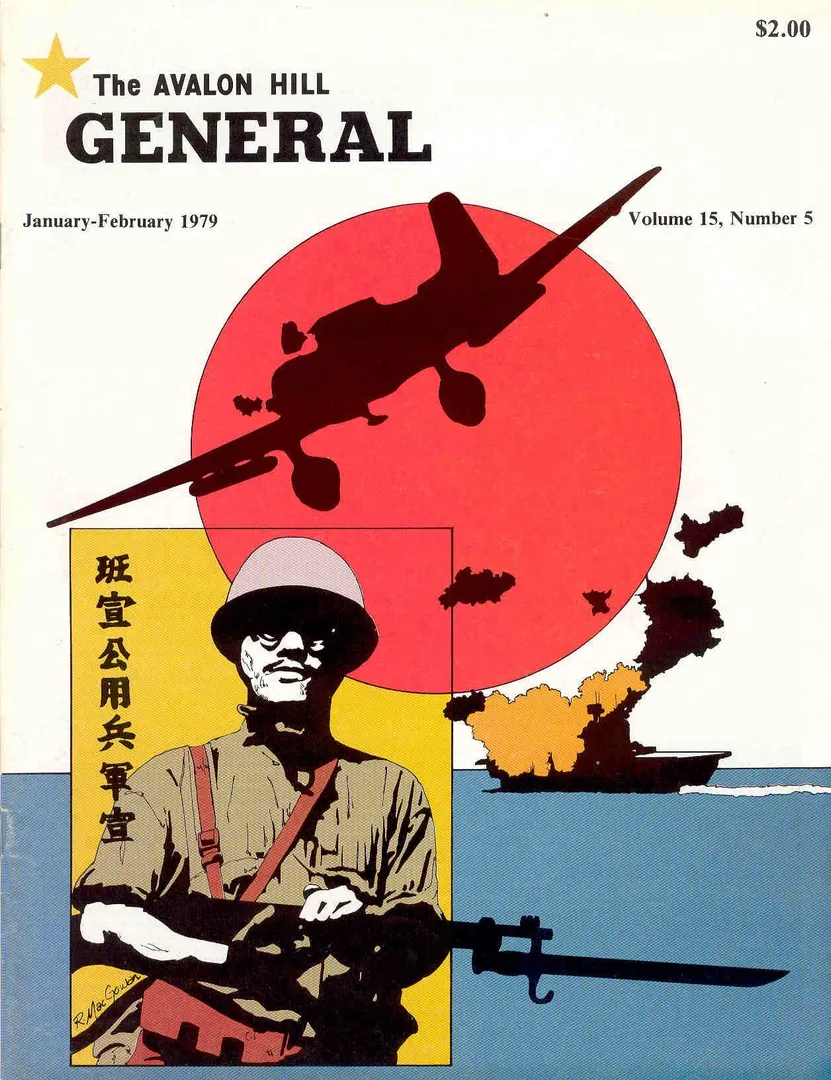
Pacific Theatre Via Midway is a variant/expansion to the Midway wargame (1975 Avalon Hill) that appeared in The GENERAL Vol.15,No.5, Jan-Feb 1979. The basic idea is each player has his or her own map of the area (in this case the South Pacific) behind a screen. Each player "searches" for the enemy fleet by flying search planes to the hex and calling the hex number. Once found, bombers can be sent in to sink the enemy fleet. The actual attack is fought on a separate battle board where the ships are first placed on hexes and the attacking planes are placed in hexes to indicate which ship it is attacking. The basic game is very simple. But there are many additional rules, which add realism (and complexity): CAP fighters, surface actions, bases, inaccurate search reports, etc. The game is superior with a neutral referee for true double blind play. Note: the rules and maps for the Coral Sea Variant were published in General Magazine Vol. 15, #5, counters were available separately via ordering through Avalon Hill.
Selon le catalogue, Pacific Theatre Via Midway se joue à 2 personnes. C’est le nombre de joueurs indiqué par l’éditeur : le jeu est donc conçu pour exactement ce nombre de participants. Les variantes pour d’autres tailles de groupe, s’il en existe, sont décrites dans la règle de votre édition ; consultez-la avant d’installer une autre configuration.
La durée indiquée pour Pacific Theatre Via Midway est de 120 minutes, selon l’estimation de l’éditeur pour une partie complète. La durée réelle dépend du groupe, de l’effectif et de la connaissance des règles : les premières parties sont plus longues, les groupes expérimentés terminent plus vite. Mise en place et explication des règles ne sont pas comprises.
Le catalogue indique Pacific Theatre Via Midway à partir de 12 ans. C’est la recommandation de l’éditeur ; elle tient compte de la lecture nécessaire, de la complexité des règles et des petits composants, pas seulement du thème. Les plus jeunes peuvent souvent participer avec l’aide d’un adulte : vérifiez l’âge indiqué sur votre édition et tenez compte de l’expérience de votre groupe.
Pacific Theatre Via Midway obtient une note de complexité de 2,4 sur 5 auprès des joueurs de BoardGameGeek, ce qui en fait un jeu plutôt léger. Cette note reflète la quantité de règles, de planification et de décisions qu’exige une partie typique. Prévoyez une explication plus longue pour les jeux exigeants et utilisez un guide de préparation avant la soirée.
Pacific Theatre Via Midway appartient à ces catégories : Wargame, Nautical et World War II. Ses principales mécaniques sont Dice Rolling, Square Grid et Grid Movement. Les catégories décrivent le thème et l’univers d’un jeu, tandis que les mécaniques décrivent ce que les joueurs font réellement pendant leur tour. Chaque mécanique mène à une page du catalogue avec des jeux similaires.
Les auteurs crédités pour Pacific Theatre Via Midway sont : Alan R. Moon. Ces crédits proviennent des données publiées du jeu et désignent les personnes responsables de sa conception, et non les illustrateurs ou les éditeurs. Les pages d’auteurs sur MeepleRules regroupent les autres titres des mêmes auteurs, ce qui est utile lorsqu’un jeu vous plaît et que vous en cherchez de similaires.
Le catalogue présente Pacific Theatre Via Midway comme une extension de Midway. Les extensions ajoutent du contenu, des règles ou des scénarios au jeu de base et ne se jouent généralement pas seules : il vous faut donc Midway pour l’utiliser. Vérifiez que votre édition de Midway est compatible, car certaines extensions ont été révisées d’une édition à l’autre.