

- Rang BGG
- BGG #4 062
- Note BGG
- 6,8
Magnastorm
- 2–4 joueurs
- 70–100 min
- Complexité 3,1/5
- 2018
2009
Aide aux règles de Power Struggle
Des explications claires des tours, effets de cartes et situations litigieuses, avec des références aux sources officielles et un historique des questions sauvegardé.
Pour 3 joueurs
Que voulez-vous savoir ?
Les réponses viennent du livret officiel, avec la page à vérifier.
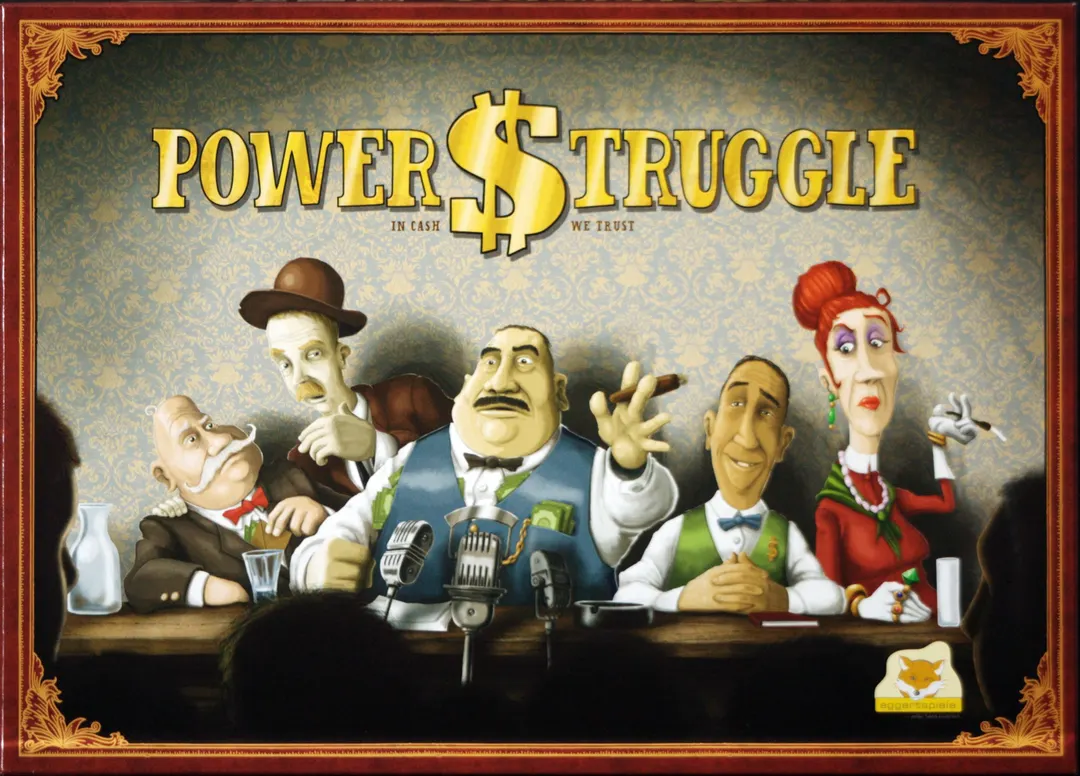
Power Struggle est un jeu de société sorti en 2009 pour 3 à 5 joueurs, avec des parties de 105 minutes et à partir de 12 ans. Il a été conçu par Maximilian Maria Thiel et Bauldric & Friends et ses principales mécaniques sont Area Majority / Influence et Bribery.




En anglais
This description was originally based on a review from BoardgameNews.com. In this corporation-themed game, players compete to be the first to acquire four out of six possible victory points. You earn a point by reaching certain numbers along tracks, such as at least 7 on the influence track or 8 on the majority track. You also may earn a point by beating your secretly assigned archenemy on three specified tracks. The game lasts a number of rounds, with each round consisting of a directors' meeting, followed by 4-7 turns. At the meeting, the "company chairman" is replaced (the next token in line moves up) and the "division heads" are named (by seeing who has the majority in each column of placed cubes). Chairmen and heads get salary bonuses and a card detailing a single advantage for the cardholder. The player who's the "communications" head then secretly looks at the Event cards and determines in which order they will be played (and so how many turns will be in the current round). Other heads' cards will let them pay less for stocks, for example, or place or remove bits. After each event card is revealed, players select one action to perform, such as "hiring and relocating employees" (placing or moving cubes), resigning as a department head, using an advantage card, or bribing players for their advantage cards. These actions result in points on the scoring tracks and sometimes money (which is only used for bribery and buying blocks of stock). A bribed card has more power than an earned one, giving incentive to accept bribes (the card is less useful or even useless to the original owner, depending on the workers' happiness scale). In addition to bribery getting you a power you want, it also moves you up the corruption track. A player who rejects a bribe, however, loses one cube on the majority columns. It's not a business simulation, and gameplay isn't as dastardly as the theme implies. The event cards provide most of the humor. (The card may read that you have failed to fix the breakroom game table, or vacations were canceled, so worker satisfaction goes down, which is what you want). The feel of rising through the ranks (getting more points) is there, and there are many things to attempt to excel in, by doing various business-related (at least in name) actions. Efficient manipulating of your opportunities will win you victory points and, if you gain four, the game. Awards: Machtspiele (Power $truggle) is derived from "Die Firma", which won a special prize in the 2009 Hippodice game design competition for best full-length game.
Selon le catalogue, Power Struggle se joue de 3 à 5 personnes. Cette fourchette correspond au nombre de joueurs indiqué par l’éditeur : le jeu s’installe donc pour toute taille de groupe dans cette limite. La mise en place, certaines règles et le décompte peuvent varier selon l’effectif ; vérifiez la configuration exacte dans la règle de votre édition.
La durée indiquée pour Power Struggle est de 105 minutes, selon l’estimation de l’éditeur pour une partie complète. La durée réelle dépend du groupe, de l’effectif et de la connaissance des règles : les premières parties sont plus longues, les groupes expérimentés terminent plus vite. Mise en place et explication des règles ne sont pas comprises.
Le catalogue indique Power Struggle à partir de 12 ans. C’est la recommandation de l’éditeur ; elle tient compte de la lecture nécessaire, de la complexité des règles et des petits composants, pas seulement du thème. Les plus jeunes peuvent souvent participer avec l’aide d’un adulte : vérifiez l’âge indiqué sur votre édition et tenez compte de l’expérience de votre groupe.
Power Struggle obtient une note de complexité de 3,4 sur 5 auprès des joueurs de BoardGameGeek, ce qui en fait un jeu de complexité moyenne. Cette note reflète la quantité de règles, de planification et de décisions qu’exige une partie typique. Prévoyez une explication plus longue pour les jeux exigeants et utilisez un guide de préparation avant la soirée.
Power Struggle appartient à ces catégories : Humor et Negotiation. Ses principales mécaniques sont Area Majority / Influence et Bribery. Les catégories décrivent le thème et l’univers d’un jeu, tandis que les mécaniques décrivent ce que les joueurs font réellement pendant leur tour. Chaque mécanique mène à une page du catalogue avec des jeux similaires.
Les auteurs crédités pour Power Struggle sont : Maximilian Maria Thiel et Bauldric & Friends. Ces crédits proviennent des données publiées du jeu et désignent les personnes responsables de sa conception, et non les illustrateurs ou les éditeurs. Les pages d’auteurs sur MeepleRules regroupent les autres titres des mêmes auteurs, ce qui est utile lorsqu’un jeu vous plaît et que vous en cherchez de similaires.
Le catalogue présente Power Struggle comme un jeu de base. Il se joue seul avec le matériel contenu dans la boîte et ne nécessite aucun autre titre. Les extensions, s’il en existe, y ajoutent du contenu ou des règles et sont répertoriées séparément dans le catalogue, avec un lien vers ce jeu de base.