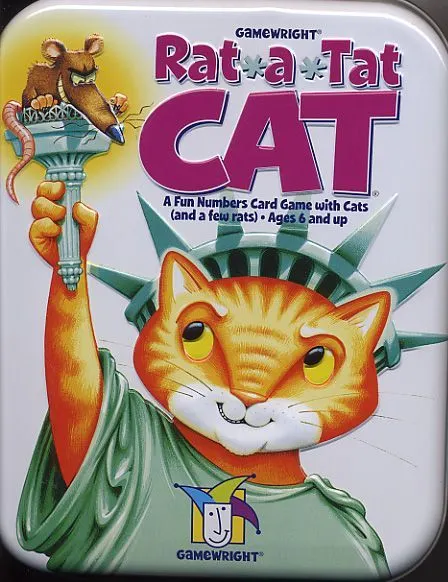
- Rang BGG
- BGG #3 605
- Note BGG
- 6,3
Rat-a-Tat Cat
1995
Aide aux règles de Rat-a-Tat Cat
Des explications claires des tours, effets de cartes et situations litigieuses, avec des références aux sources officielles et un historique des questions sauvegardé.
- 2–6 joueurs
- 10 min
- 6+
- Complexité 1,1/5

À propos du jeu
Get rid of the rats and go for the cats! In Rat-a-Tat Cat, less is always better, and you want to go out with the lowest score. Can you remember the numbers on the other players' cards? Can you keep a poker face, but notice when another player looks pleased? Sharpen your memory and your timing, and have fun with the cool cats and bad rats of Rat-a-Tat Cat. This is the Gamewright version. 1996 Mensa Select Republished 2002 by Amigo as Biberbande: Biberbande is a card game for Ages 6 and up, the object of which is to improve your initial unknown 4-card hand so that you have a lower sum of cards than the other players. There are 66 cards in the deck, which consists of ranks 0-9 (four of ranks 0-8 and nine 9's) and 3 different types of action cards (9 "Exchange", 7 "Spy", and 5 "2 X draw"). Four cards are dealt face down to each player so that no player knows the values of her cards. The four cards are then arranged in a row and each player may briefly look at her outer two cards. A player's turn consists of drawing a card from the top of the draw pile or discard pile. If the player drew from the draw pile, there are several possible actions: If it is a number card, she may replace one of her face down cards with it (placing it face down) or she may simply discard it. If it is an action card, she may carry out the action or ignore the action. If a player draws the top card of the discard pile, she must replace one of her face down cards with it (placed face down). A player may knock at the end of her turn meaning that each other player has one more turn before the round is over. When the round ends, players turn over their cards and add up their values. The player with the lowest total value wins. Generally the game is played with as many rounds as there are players. Player interaction comes in the form of the action cards. The 'Exchange' card allows a player to exchange one of his cards with one of his opponents. The 'Spy' card allows a player to look at one of his own cards. Finally the "2X look" card allows a player to look at the top card of the draw pile, then keep it or throw it away. If she throws it away, she must use the next card in the draw pile.
Catégories
Auteurs
Éditeurs
- Kaissa Chess & Games
- KADABRA
- Piatnik
- AMIGO
- Copag Cards (Copag)
- 999 Games
- Albi
- Gigamic
- Lifestyle Boardgames Ltd
- Gamewright
- Educa Korea
- förlAgo AB
- Top Toys
- FoxMind Israel
- Art Games
Questions et réponses
L’assistant de règles pour Rat-a-Tat Cat aidera à comprendre les tours, effets de cartes et situations litigieuses, avec des sources officielles vérifiées et un historique des questions sauvegardé. Il n’est pas encore prêt ; les sources vérifiées pour votre édition sont en préparation.
Selon le catalogue, Rat-a-Tat Cat se joue de 2 à 6 personnes.
La durée indiquée pour Rat-a-Tat Cat est de 10 minutes. La durée réelle dépend du groupe et de sa connaissance du jeu.
Le catalogue indique Rat-a-Tat Cat à partir de 6 ans. Vérifiez l’âge recommandé sur votre édition.
Les auteurs crédités pour Rat-a-Tat Cat sont : Monty Stambler et Ann Stambler.
Le catalogue présente Rat-a-Tat Cat comme un jeu de base.
Assistant de règles pour Rat-a-Tat Cat
Chargement…