
- Rang BGG
- BGG #28 191
- Note BGG
- 5,3
Wetland
- 2–4 joueurs
- 30 min
- Complexité 1,0/5
- 2013
2013
Aide aux règles de Red Code
Des explications claires des tours, effets de cartes et situations litigieuses, avec des références aux sources officielles et un historique des questions sauvegardé.
Pour 2 joueurs
Que voulez-vous savoir ?
Les réponses viennent du livret officiel, avec la page à vérifier.
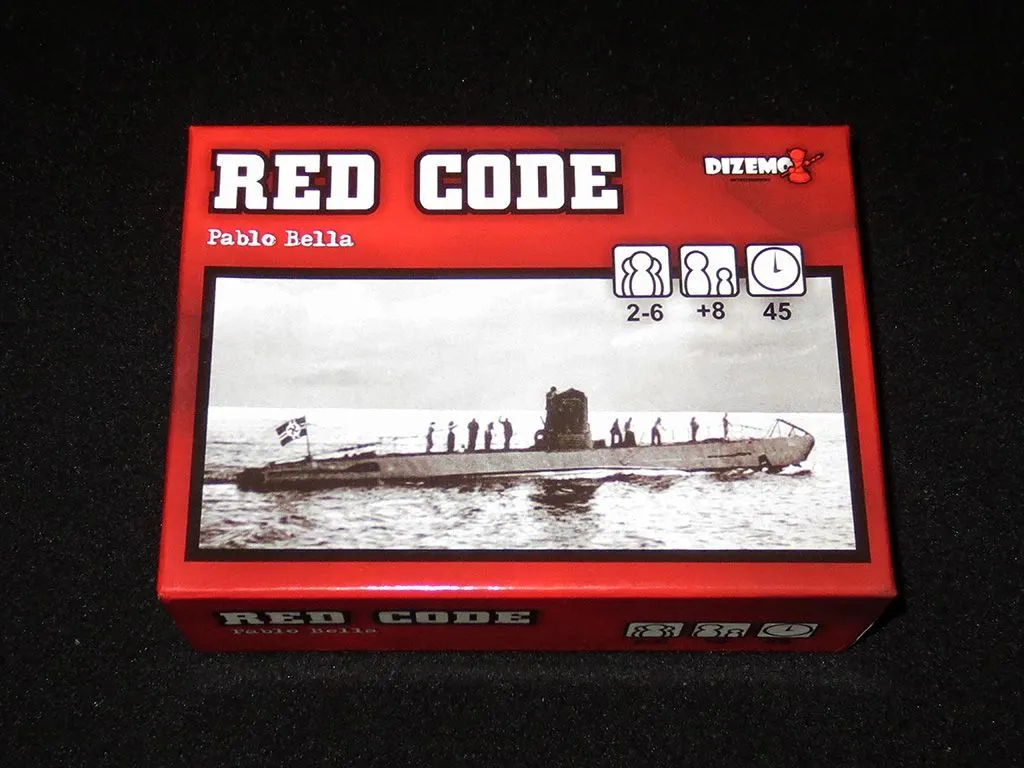
Red Code est un jeu de société sorti en 2013 pour 2 à 6 joueurs, avec des parties de 45 minutes et à partir de 8 ans. Il a été conçu par Pablo Bella et ses principales mécaniques sont Hand Management, Modular Board et Simulation.

En anglais
Red Code instructions. 1.0. Welcome to Red Code, a board game where you take control of a WWII military ship. Re-live epic battles with your family and friends. Manage your crew to carry out manoeuvres with your ship, attack the other players’ ships and co-operate with players in your faction to achieve victory. 1.1. Characteristics: The players play 1 on 1, or combine into 2 factions of 1 vs 1, 2 vs 2 or 3 vs 3. The game takes about 45 minutes and is for players over 8 years old. 1.2. Prologue: The game combines simple mechanics, the placement of crew, to choose different manoeuvres. Take advantage of the possibilities offered by the terrain and your boat to sink the enemy. 2.0. Objective of the game: 2.1. Arena mode The first group to sink the enemy ships is the winner. You don’t use the score card for this mode, as the sinking of all the enemy’s ships implies that the enemy player has been eliminated. (Games of 2 vs 2) The first side to lose a ship receives 2 order cards. There is no effect for ships sunk after that. (Games of 3 vs 3) The first side to lost 2 ships receives 2 order cards between the players of that side. In other words the first team to be reduced to just 1 ship will receive 2 order cards. There is no effect when other teams are reduced to 1 ship later. 2.2. War mode The first side to get 5 victory points is the winner. Sinking an enemy ship earns you 1 victory point. This is shown by advancing your score token on the score card by 1 position. When a ship is sunk, it is returned to the beginning map card and flipped over to show that it will miss the next turn. When the ship is restored after being sunk, it is fully restored (crew, repairs and breakdowns) and you can choose any one of the available spaces on the beginning card to place it in. A player who sinks a ship receives an order card. 3.0. Contents: 15 map cards 30 order cards 3 blue control cards 3 red control cards 1 scorecard 18 red cubes 18 yellow cube 36 white cubes 6 ship pieces 2 score tokens 3.1. Map cards: The map cards are divided into 4 boxes, which each count as one space for movement. Only 1 ship can occupy a box. Islands: These are impassable, so ships can not move over them, and they block line-of-sight for firing. Running water: When a ship enters this box, it automatically receives +1 movement which must be used to move to a neighbouring box. If that neighbouring box also has running water, the ship gains another +1 movement, and so on. 3.2. Control cards There are 3 kinds of ship in Red Code: Submarine; Destroyer; Aircraft carrier. These have some similar manoeuvres, but also some manoeuvres which are unique to that kind. On the control card, yellow cubes (repairs) and red cubes (breakdowns) are used to show the state of the ship. Once both of these characteristics have been reduced to 0, the ship is sunk. During the game, any damage taken by the ship reduces the amount of repairs. When the number of repairs hits 0, remove a breakdown token and put 3 repair tokens back on the control card (1 breakdown = 3 repairs). You are not allowed to exceed the amount of breakdown and repair spaces available on the control card. Another area of the control card shows what your crew (white cubes) are doing, and this is used to manage the different manoeuvres. At the start, all ships have 6 crew, placed on the crew area on the control card. The control cards each have 4 common manoeuvre boxes and 4 unique manoeuvre boxes. Crew: These are used to pay the cost of your ship’s manoeuvres. You use up your crew during the battle, but also recover crew each turn during the battle. [Representing the energy of your crew, rather than individual crew members] The crew are the engine of this game, and so good management of your crew is what makes your ship more lethal. Manoeuvres: You must choose appropriate attack or defence actions at particular points to manage your ship effectively. Manoeuvres with a crew member already on the square can not be used during that turn. • Movement: Move one square. Can not be responded to. • Repair: Regain 1 repair cube. • Torpedo: Does 1 repair damage, at a maximum distance of 2 spaces. • Orders: Draw one order card. Can not be responded to. • Immersion: Move two squares. Can not be responded to. • Countermeasure: Does 1 repair damage, at a maximum of 2 spaces, and you regain 1 repair cube. • Heavy torpedo: Does 2 repair damage, at a maximum distance of 3 spaces. • Floating mine: Does 2 repair damage plus 1 crew damage, at a maximum distance of 1 space. • Missile: Does 1 repair damage, at a maximum distance of 2 spaces. Can not be responded to. • Depth charge: Does 2 repair damage, at a maximum distance of 1 space. • Shield: Cancels the current manoeuvre, at a maximum distance of 3 spaces. • Assault: Does 1 repair damage, at a maximum distance of 1 space. • Air support: Does 1 repair damage, at a maximum distance of 3 spaces. • Radio support: Regain 1 repair cube at a maximum distance of 2 spaces. Can not be responded to. • Medical equipment: Regain 1 breakdown cube, at a maximum distance of 2 spaces. • Radar: Does 1 repair damage plus 1 crew damage at a maximum distances of 3 spaces. Can not be responded to. Available manoeuvres: Manoeuvres that do not have any crew on their squares are available to be used. The players can only use these manoeuvres on their turn and can only use the manoeuvres on their ship, except for the response manoeuvres. Manoeuvres that can be used as responses are marked in yellow on the control card and can be used both on your turn and the other players’ turns. Note that the manoeuvre selected must be available to use - it must not have any crew on it. And responses can only be made when the player whose turn it is has executed a manoeuvre that allows responses. For example: The counter measure manoeuvre has a distance of two, and can repair 1 damage and do 1 damage. Visual field: This shows what your ship can see and where it can carry out actions. It includes the boxes in a straight line horizontally, vertically and diagonally from your ship and depends on the distance that the specific manoeuvre you want to use has. For example: If an manoeuvre has no distance, you can only carry it out on yourself, but if a manoeuvre has a distance of 2, then it can be used on any ship that distance or less (horizontally, vertically or diagonally only) including your own ship. [In the example picture, the red destroyer can target the blue submarine but can not target the blue destroyer.] Note that the enemy ships have the same effect as islands in blocking your line of sight. 3.3. Order cards. These provide certain advantages in the game, providing bonuses, hurting the enemy or modifying the characteristics of the ship (movement, repairs, manoeuvres, etc.). Only 1 order card can be used per turn, but the effects can be used on any target on the table, regardless of distance or objects blocking line of sight. In other words, order cards are not affected by the visual field. In addition, order cards will always be executed and offer no chance for the enemy to respond. Each player may not have more than 3 order cards in their hand at any time. • Ambush: The target ship loses 2 repair. • Deserter: The target ship loses 1 crew from the reserve. This crew member can be recovered in the crew recovery phase. • Boatswain: The target ship recovers 2 crew. • Atomic bomb: 2 repair damage to all ships in a 2 by 2 square (4 spaces in total). • Evasion: The target ship gains +3 movement. • Captain: 1 repair damage to the target ship, and then you draw 1 order card. • Mechanic: The target ship gains 2 repair. • Intercept: 1 repair damage to the target ship, and can not carry out any manoeuvres until their next turn. This means that the target ship will not be able to respond to any manoeuvres until its next turn. • Kamikaze: 1 breakdown damage to the target ship (remember, 1 breakdown equals 3 repairs). 4.0. Beginning of the game 4.1. Preparation of the table: Shuffle the map cards and place face up a 3 by 4 formation (see example picture). The 3 cards left over are not used in the game. 4.2. Preparation of the ships: The players are divided 1 vs 1, 2 vs 2 or 3 vs 3, depending on the number of players. Next, each player selects a ship from the 3 available, and also takes the corresponding control card. Each player fills up that control card with the red and yellow cubes (repairs and breakdowns) indicated on the control card, plus 6 crew members. The two teams have a starting card in opposite corners of the board, and the team members put their ships into one of the 4 squares in their starting card. 4.3. Start the game. Shuffle the order cards and deal out one initial order card to each player. Place the remaining deck of order cards in a pile face-down next to the board. 5.0. Turn phases 5.1. Recover crew At the start of your turn, you always replace 2 crew into your reserve, either from the manoeuvre spaces or from the pile of withdrawn crew (see the radar and floating mine manoeuvres and the deserter order card). You choose where to recover the crew from depending on what manoeuvres are needed for your next turn. 5.2. Management of manoeuvres You use the manoeuvres available to your ship to try to sink the enemy. The manoeuvres cost crew to carry out the action (according to the number of boxes for that manoeuvre), but also depend on the line of vision of the ship. The target must be within the action’s range and on a straight line either vertically, horizontally or diagonally. 5.3. Possible responses: Responses are manoeuvres but can be used in your turn or the turn of another player. For example: Immersion can not be used as a response, but torpedo can be used as a response. The last manoeuvre declared is the first to be carried out. For example, if a player launches an action in front of an enemy and they launch a response which the initial player then responds too, then the response of the first player is completed, then the response of the opponent, and finally the initial manoeuvre. If in the middle of this chain of events a ship is sunk, further manoeuvres in the chain targeting that ship will be wasted but the manoeuvres will still be treated as spent, which means that the crew spent on the manoeuvres will remain spent and the manoeuvres will be unavailable.
Selon le catalogue, Red Code se joue de 2 à 6 personnes. Cette fourchette correspond au nombre de joueurs indiqué par l’éditeur : le jeu s’installe donc pour toute taille de groupe dans cette limite. La mise en place, certaines règles et le décompte peuvent varier selon l’effectif ; vérifiez la configuration exacte dans la règle de votre édition.
La durée indiquée pour Red Code est de 45 minutes, selon l’estimation de l’éditeur pour une partie complète. La durée réelle dépend du groupe, de l’effectif et de la connaissance des règles : les premières parties sont plus longues, les groupes expérimentés terminent plus vite. Mise en place et explication des règles ne sont pas comprises.
Le catalogue indique Red Code à partir de 8 ans. C’est la recommandation de l’éditeur ; elle tient compte de la lecture nécessaire, de la complexité des règles et des petits composants, pas seulement du thème. Les plus jeunes peuvent souvent participer avec l’aide d’un adulte : vérifiez l’âge indiqué sur votre édition et tenez compte de l’expérience de votre groupe.
Red Code obtient une note de complexité de 2,3 sur 5 auprès des joueurs de BoardGameGeek, ce qui en fait un jeu plutôt léger. Cette note reflète la quantité de règles, de planification et de décisions qu’exige une partie typique. Prévoyez une explication plus longue pour les jeux exigeants et utilisez un guide de préparation avant la soirée.
Red Code appartient à ces catégories : Card Game, Wargame et Nautical. Ses principales mécaniques sont Hand Management, Modular Board et Simulation. Les catégories décrivent le thème et l’univers d’un jeu, tandis que les mécaniques décrivent ce que les joueurs font réellement pendant leur tour. Chaque mécanique mène à une page du catalogue avec des jeux similaires.
Les auteurs crédités pour Red Code sont : Pablo Bella. Ces crédits proviennent des données publiées du jeu et désignent les personnes responsables de sa conception, et non les illustrateurs ou les éditeurs. Les pages d’auteurs sur MeepleRules regroupent les autres titres des mêmes auteurs, ce qui est utile lorsqu’un jeu vous plaît et que vous en cherchez de similaires.
Le catalogue présente Red Code comme un jeu de base. Il se joue seul avec le matériel contenu dans la boîte et ne nécessite aucun autre titre. Les extensions, s’il en existe, y ajoutent du contenu ou des règles et sont répertoriées séparément dans le catalogue, avec un lien vers ce jeu de base.