
- Rang BGG
- BGG #7 976
- Note BGG
- 6,5
Freya's Folly
- 3–5 joueurs
- 50 min
- Complexité 2,4/5
- 2005
2002
Aide aux règles de Sunda to Sahul
Des explications claires des tours, effets de cartes et situations litigieuses, avec des références aux sources officielles et un historique des questions sauvegardé.
Pour 1 joueur
Que voulez-vous savoir ?
Les réponses viennent du livret officiel, avec la page à vérifier.
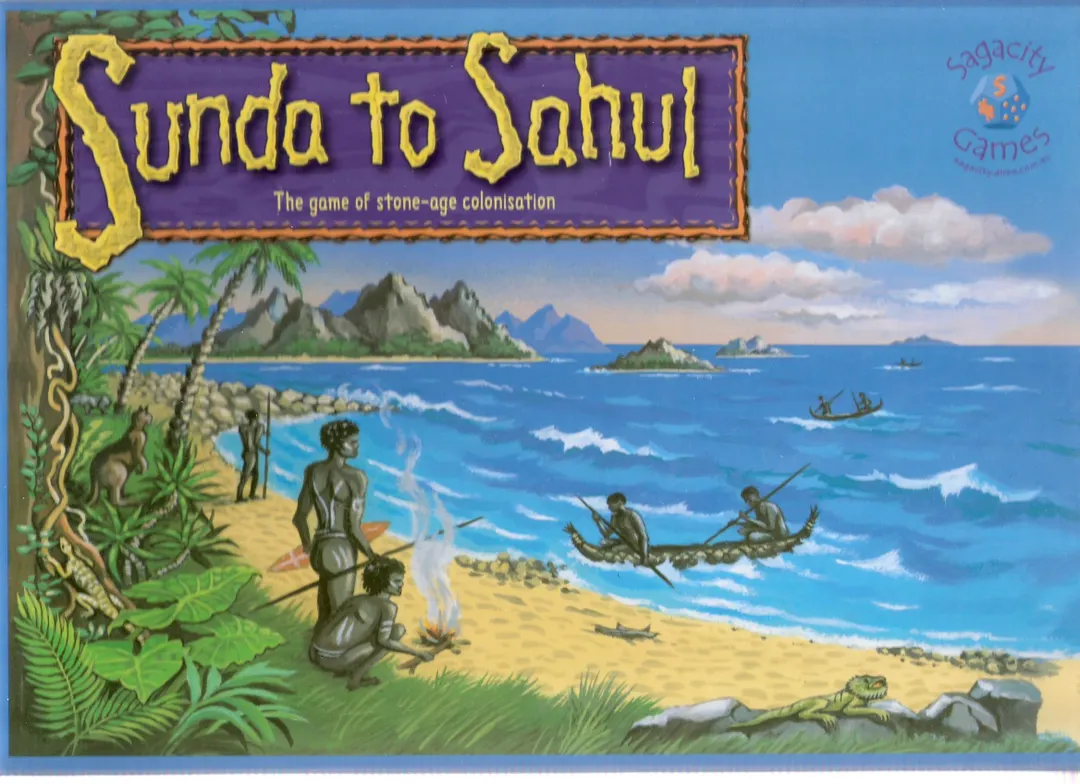
Sunda to Sahul est un jeu de société sorti en 2002 pour 1 à 4 joueurs, avec des parties de 45 minutes et à partir de 10 ans. Il a été conçu par Don Bone et ses principales mécaniques sont Tile Placement.


En anglais
This is a lightweight strategy game for 2 to 4 people which also includes a number of challenging puzzles for 1 player. The theme of the game is the migration of people down the Indonesian archipelago into New Guinea and Australia. The games is based on a set of 136 laser cut wooden jigsaw like tiles which go together in a multitude of ways to form a set of islands. The game starts with all of the tiles face up on the playing surface and one tile in a cleared space in the center of the playing surface to start play. Players select a tile from the pool of upturned tiles and try to join tiles to it to extend the islands of an archipelago, 'discovering' a different set of islands each time they play the game. Each player has a number of tokens for his clan or totem. The aim of the game is to claim nodes (points on the land of the islands where the corners of a number of tiles come together). The player who places the last tile at a node may claim that node for his clan. If an island is completed then all of the tokens on the island double in value. There is therefore an incentive for players who have tokens on an island to cooperate to complete the island, but of course each is trying to get more out of the cooperation than the others. The game ends when one player has used all of his tokens or when no further tiles can be placed, or when the players agree to finish. The game can be played either as a race game with all players working simultaneously or as a turns based game. The race game takes about 30-45 minutes to play, while the turns based games takes 60-90 minutes to play. There are a number of optional game elements that can be added once players are comfortable with the basic game: fresh water rights (for water surrounded by land), tribes (clan tokens in a tribe are worth more than on their own), challenges (where a player can try to convert a token to their clan), and resources (owned by the player with the most tokens on the island at the end of the game). Some of these game elements result in a more cooperative styled game while some result in more conflict. Players can mix and match the game elements to produce a style of game that suits their mood or style of play. The publisher's website http://sagacity.aires.com.au formerly had more information but appears to be defunct as of mid-2010.
Selon le catalogue, Sunda to Sahul se joue de 1 à 4 personnes. Cette fourchette correspond au nombre de joueurs indiqué par l’éditeur : le jeu s’installe donc pour toute taille de groupe dans cette limite. La mise en place, certaines règles et le décompte peuvent varier selon l’effectif ; vérifiez la configuration exacte dans la règle de votre édition.
La durée indiquée pour Sunda to Sahul est de 45 minutes, selon l’estimation de l’éditeur pour une partie complète. La durée réelle dépend du groupe, de l’effectif et de la connaissance des règles : les premières parties sont plus longues, les groupes expérimentés terminent plus vite. Mise en place et explication des règles ne sont pas comprises.
Le catalogue indique Sunda to Sahul à partir de 10 ans. C’est la recommandation de l’éditeur ; elle tient compte de la lecture nécessaire, de la complexité des règles et des petits composants, pas seulement du thème. Les plus jeunes peuvent souvent participer avec l’aide d’un adulte : vérifiez l’âge indiqué sur votre édition et tenez compte de l’expérience de votre groupe.
Sunda to Sahul obtient une note de complexité de 2,2 sur 5 auprès des joueurs de BoardGameGeek, ce qui en fait un jeu plutôt léger. Cette note reflète la quantité de règles, de planification et de décisions qu’exige une partie typique. Prévoyez une explication plus longue pour les jeux exigeants et utilisez un guide de préparation avant la soirée.
Sunda to Sahul appartient à ces catégories : Territory Building, Exploration et Puzzle. Ses principales mécaniques sont Tile Placement. Les catégories décrivent le thème et l’univers d’un jeu, tandis que les mécaniques décrivent ce que les joueurs font réellement pendant leur tour. Chaque mécanique mène à une page du catalogue avec des jeux similaires.
Les auteurs crédités pour Sunda to Sahul sont : Don Bone. Ces crédits proviennent des données publiées du jeu et désignent les personnes responsables de sa conception, et non les illustrateurs ou les éditeurs. Les pages d’auteurs sur MeepleRules regroupent les autres titres des mêmes auteurs, ce qui est utile lorsqu’un jeu vous plaît et que vous en cherchez de similaires.
Le catalogue présente Sunda to Sahul comme un jeu de base. Il se joue seul avec le matériel contenu dans la boîte et ne nécessite aucun autre titre. Les extensions, s’il en existe, y ajoutent du contenu ou des règles et sont répertoriées séparément dans le catalogue, avec un lien vers ce jeu de base.