

- Rang BGG
- BGG #4 078
- Note BGG
- 7,1
Flames of War: The World War II Miniatures Game
- 2 joueurs
- 120 min
- Complexité 3,3/5
- 2002
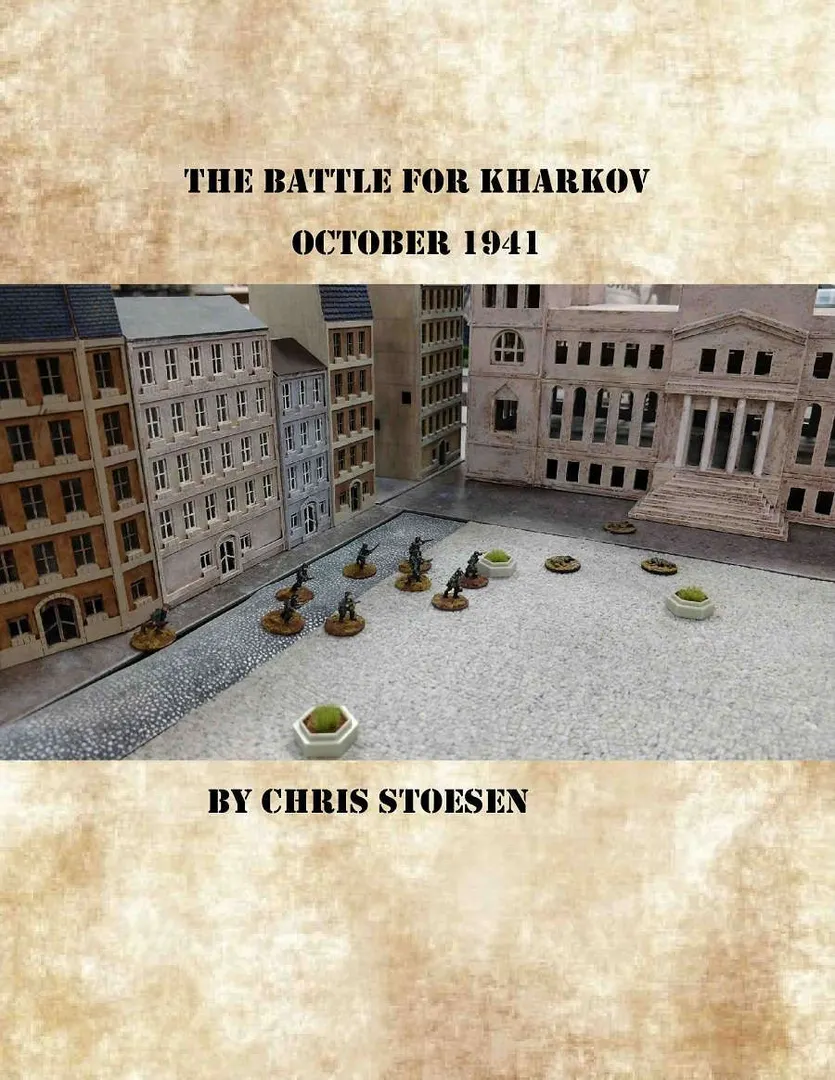
Aide aux règles de The Battle for Kharkov: October 1941
Des explications claires des tours, effets de cartes et situations litigieuses, avec des références aux sources officielles et un historique des questions sauvegardé.
Que voulez-vous savoir ?
Les réponses viennent du livret officiel, avec la page à vérifier.
The Battle for Kharkov: October 1941 est une extension de Chain of Command sortie en 2017 pour 2 joueurs, avec des parties de 120 à 180 minutes et à partir de 14 ans. Il a été conçu par Chris Stoesen et ses principales mécaniques sont Simulation et Scenario / Mission / Campaign Game.







En anglais
The Campaign for Kharkov contains two pint sized campaigns designed for the TooFatLardies Chain of Command rules. They are easily converted to any skirmish ruleset such as Bolt Action. One covers the advance of the German 57th Infantry Division and the other the German 101st Light Division. The attack came in October of 1941. This city would be the site of three major battles for the city. The interesting aspect of the October 1941 battle is in the nature of the troops involved. The Soviets had superiority in armor. The Germans advanced with only a single STUG battalion in support of the 57th ID. The Soviets fielded the T34 as well as several improvised armored vehicles such as the KhTZ-16. While not a success on the battlefield, it demonstrated the Soviet inventiveness under the extreme pressure of the blitzkrieg. There are twelve total scenarios in the campaign. Full force lists are available for both German Divisions and the Soviet troops present. Maps are based on aerial reconnaissance photographs taken by German troops in September 1941. —description from the publisher
Selon le catalogue, The Battle for Kharkov: October 1941 se joue à 2 personnes. C’est le nombre de joueurs indiqué par l’éditeur : le jeu est donc conçu pour exactement ce nombre de participants. Les variantes pour d’autres tailles de groupe, s’il en existe, sont décrites dans la règle de votre édition ; consultez-la avant d’installer une autre configuration.
La durée indiquée pour The Battle for Kharkov: October 1941 est de 120 à 180 minutes, selon l’estimation de l’éditeur pour une partie complète. La durée réelle dépend du groupe, de l’effectif et de la connaissance des règles : les premières parties sont plus longues, les groupes expérimentés terminent plus vite. Mise en place et explication des règles ne sont pas comprises.
Le catalogue indique The Battle for Kharkov: October 1941 à partir de 14 ans. C’est la recommandation de l’éditeur ; elle tient compte de la lecture nécessaire, de la complexité des règles et des petits composants, pas seulement du thème. Les plus jeunes peuvent souvent participer avec l’aide d’un adulte : vérifiez l’âge indiqué sur votre édition et tenez compte de l’expérience de votre groupe.
The Battle for Kharkov: October 1941 appartient à ces catégories : Wargame, Miniatures et World War II. Ses principales mécaniques sont Simulation et Scenario / Mission / Campaign Game. Les catégories décrivent le thème et l’univers d’un jeu, tandis que les mécaniques décrivent ce que les joueurs font réellement pendant leur tour. Chaque mécanique mène à une page du catalogue avec des jeux similaires.
Les auteurs crédités pour The Battle for Kharkov: October 1941 sont : Chris Stoesen. Ces crédits proviennent des données publiées du jeu et désignent les personnes responsables de sa conception, et non les illustrateurs ou les éditeurs. Les pages d’auteurs sur MeepleRules regroupent les autres titres des mêmes auteurs, ce qui est utile lorsqu’un jeu vous plaît et que vous en cherchez de similaires.
Le catalogue présente The Battle for Kharkov: October 1941 comme une extension de Chain of Command. Les extensions ajoutent du contenu, des règles ou des scénarios au jeu de base et ne se jouent généralement pas seules : il vous faut donc Chain of Command pour l’utiliser. Vérifiez que votre édition de Chain of Command est compatible, car certaines extensions ont été révisées d’une édition à l’autre.