
- Rang BGG
- BGG #1 423
- Note BGG
- 7,5
Ambush!
- 1 joueur
- 180–240 min
- Complexité 3,3/5
- 1983
1981
Aide aux règles de The Sword and the Stars
Des explications claires des tours, effets de cartes et situations litigieuses, avec des références aux sources officielles et un historique des questions sauvegardé.
Pour 1 joueur
Que voulez-vous savoir ?
Les réponses viennent du livret officiel, avec la page à vérifier.
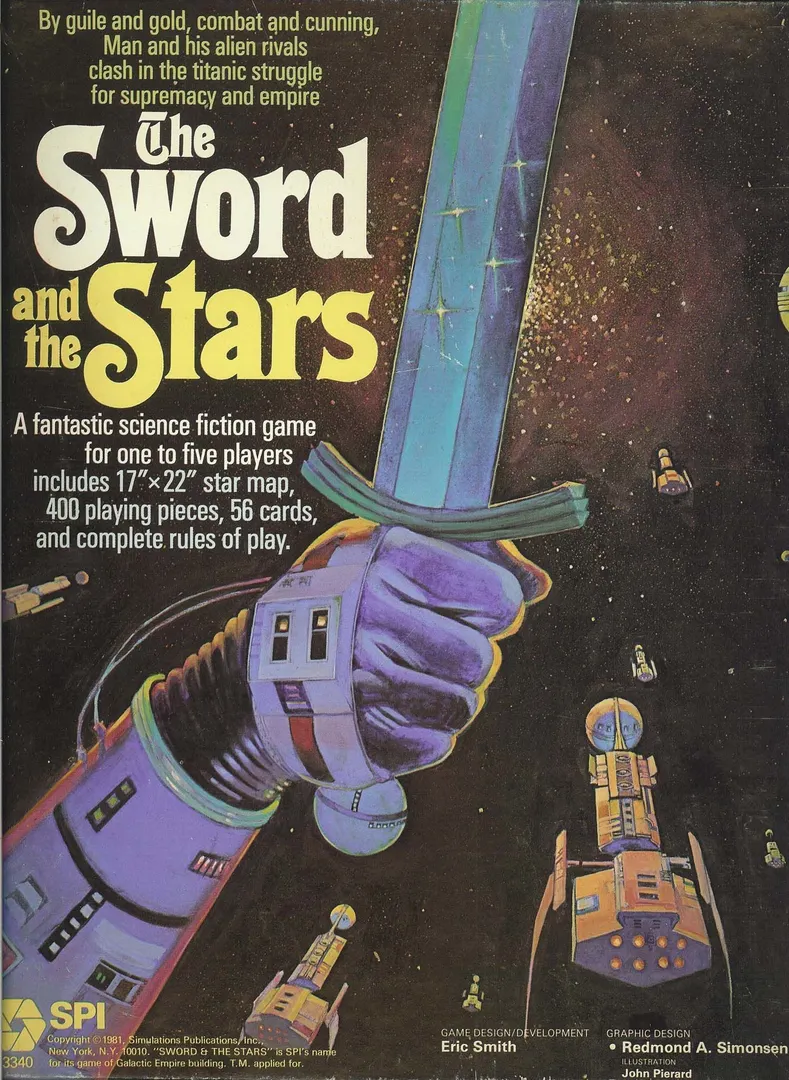
The Sword and the Stars est un jeu de société sorti en 1981 pour 1 à 5 joueurs, avec des parties de 240 minutes et à partir de 12 ans. Il a été conçu par Eric Lee Smith et ses principales mécaniques sont Voting et Action Points.
En anglais
Sword and the Stars sets the stage for interstellar conflict between vying empires on such a scale (the map depicts about 1/4 of a spiral galaxy) that individual ships and even fleets become insignificant. You pay for and resolve entire interstellar campaigns with cards representing massive scale investment of manpower and resources over 4 Earth years of operations, each player round representing the passage of 20 years. Players direct the fate of interstellar empires through expansion or consolidation by means of conquests, raids, governing, building planetary defenses, commerce, and diplomacy. The game was derived from two existing popular SPI titles. While adding many subtle changes in its own right, it combines the highly successful system used in Empires of the Middle Ages with the graphic layout used for Freedom in the Galaxy. Technology and economics are abstracted, but both play a large role in just about every aspect of the game. Stargates allow players to conduct interstellar operations against any star system, free of range constraints. This means that in an interstellar war, nowhere is safe from your enemies. Includes a mechanism for a sort of Galactic Security Council, where players can scheme all sorts of mischief against each other. Ten scenarios (including the "Galactic Cycle" campaign game) are supplied. A "short" game will depict a period lasting about 200 years, while for the long "grand campaign" scenario it is recommended to play "at least" 1000 years. The Sword and the Stars is more compact than Empires. Includes 400 counters, 56 year cards, a 17 x 22" map depicting a total of 42 star systems. Maximum 5 players (3-4 recommended). Historical Note: Writing about SPI's Empires of the Middle Ages (q.v.), editor Kula included a sidebar quote from Redmond Simonsen to the effect that "a good number of people...would really enjoy the game if they'd just imagine that it's a science fictional or fantastic continent instead of Europe". Well, in 1981, the year after Empires of the Middle Ages was released, SPI produced another game using the same system and the missing science fiction premise, and The Sword and the Stars was born.
Selon le catalogue, The Sword and the Stars se joue de 1 à 5 personnes. Cette fourchette correspond au nombre de joueurs indiqué par l’éditeur : le jeu s’installe donc pour toute taille de groupe dans cette limite. La mise en place, certaines règles et le décompte peuvent varier selon l’effectif ; vérifiez la configuration exacte dans la règle de votre édition.
La durée indiquée pour The Sword and the Stars est de 240 minutes, selon l’estimation de l’éditeur pour une partie complète. La durée réelle dépend du groupe, de l’effectif et de la connaissance des règles : les premières parties sont plus longues, les groupes expérimentés terminent plus vite. Mise en place et explication des règles ne sont pas comprises.
Le catalogue indique The Sword and the Stars à partir de 12 ans. C’est la recommandation de l’éditeur ; elle tient compte de la lecture nécessaire, de la complexité des règles et des petits composants, pas seulement du thème. Les plus jeunes peuvent souvent participer avec l’aide d’un adulte : vérifiez l’âge indiqué sur votre édition et tenez compte de l’expérience de votre groupe.
The Sword and the Stars obtient une note de complexité de 2,9 sur 5 auprès des joueurs de BoardGameGeek, ce qui en fait un jeu plutôt léger. Cette note reflète la quantité de règles, de planification et de décisions qu’exige une partie typique. Prévoyez une explication plus longue pour les jeux exigeants et utilisez un guide de préparation avant la soirée.
The Sword and the Stars appartient à ces catégories : Economic, Wargame et Political. Ses principales mécaniques sont Voting et Action Points. Les catégories décrivent le thème et l’univers d’un jeu, tandis que les mécaniques décrivent ce que les joueurs font réellement pendant leur tour. Chaque mécanique mène à une page du catalogue avec des jeux similaires.
Les auteurs crédités pour The Sword and the Stars sont : Eric Lee Smith. Ces crédits proviennent des données publiées du jeu et désignent les personnes responsables de sa conception, et non les illustrateurs ou les éditeurs. Les pages d’auteurs sur MeepleRules regroupent les autres titres des mêmes auteurs, ce qui est utile lorsqu’un jeu vous plaît et que vous en cherchez de similaires.
Le catalogue présente The Sword and the Stars comme un jeu de base. Il se joue seul avec le matériel contenu dans la boîte et ne nécessite aucun autre titre. Les extensions, s’il en existe, y ajoutent du contenu ou des règles et sont répertoriées séparément dans le catalogue, avec un lien vers ce jeu de base.