
- Rang BGG
- BGG #4 065
- Note BGG
- 6,8
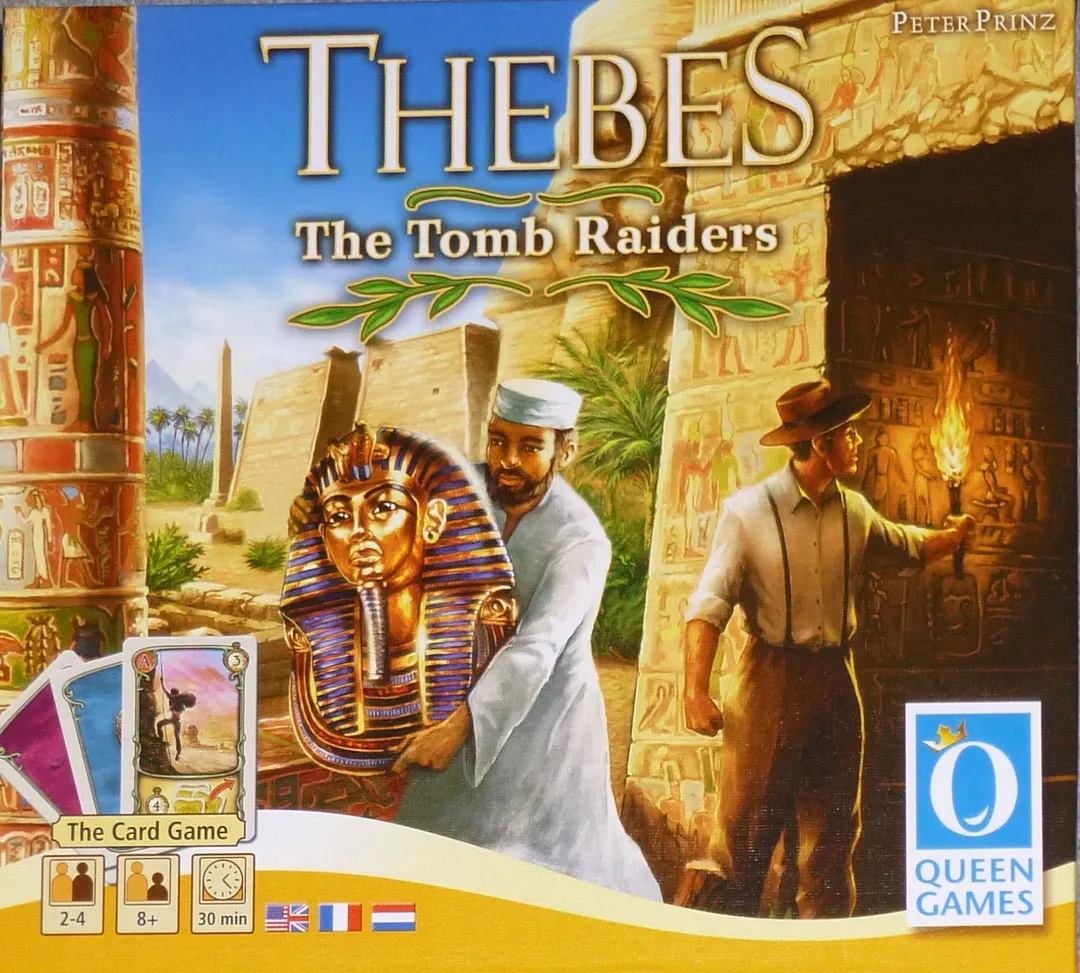
Thebes: The Tomb Raiders
- 2–4 joueurs
- 30 min
- Complexité 2,0/5
- 2013
2007
Aide aux règles de Thebes
Des explications claires des tours, effets de cartes et situations litigieuses, avec des références aux sources officielles et un historique des questions sauvegardé.
Pour 2 joueurs
Que voulez-vous savoir ?
Les réponses viennent du livret officiel, avec la page à vérifier.
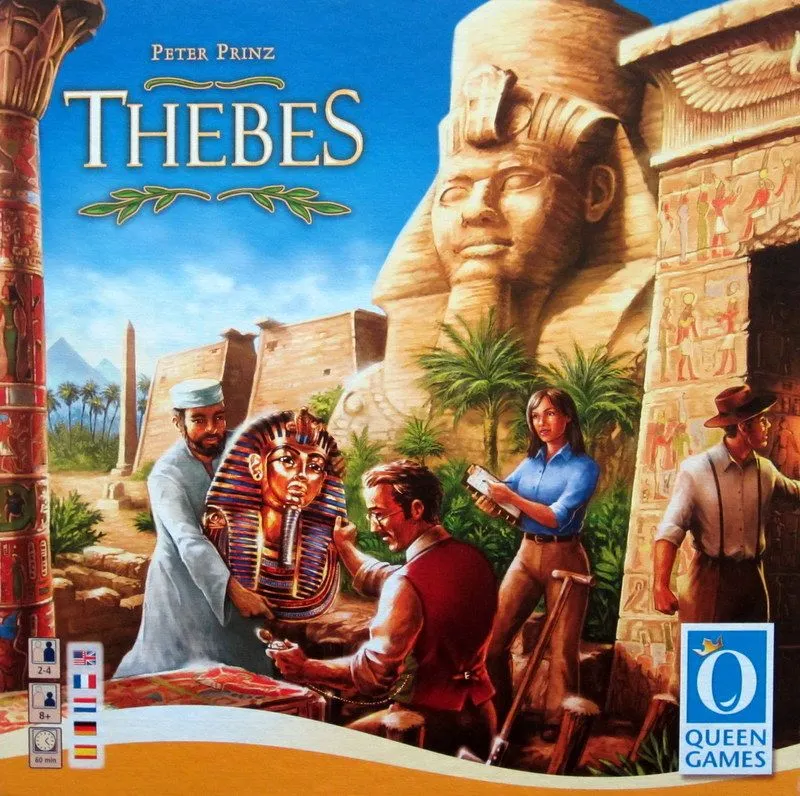
Thebes est un jeu de société sorti en 2007 pour 2 à 4 joueurs, avec des parties de 60 minutes et à partir de 8 ans. Il a été conçu par Peter Prinz et ses principales mécaniques sont Set Collection, Point to Point Movement et Turn Order: Time Track.







En anglais
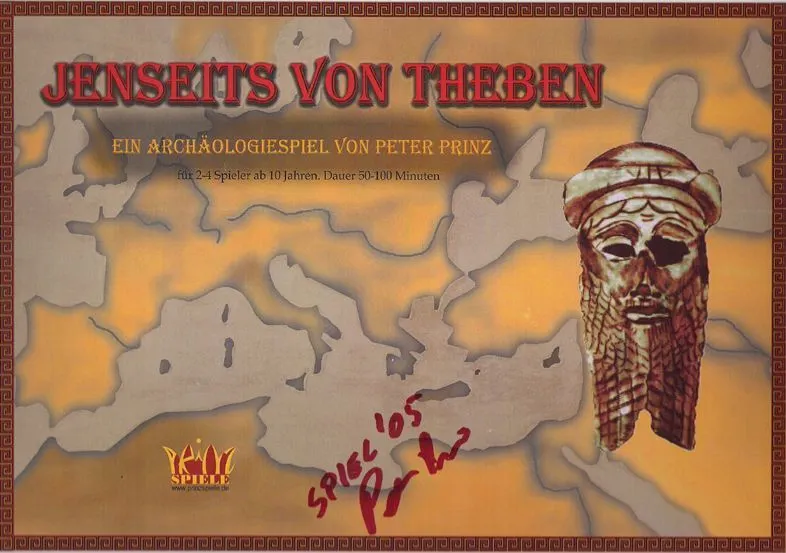
Thebes is a game of competitive archeology. Players are archaeologists who must travel around Europe, northern Africa, and the Middle East to acquire knowledge about five ancient civilizations -- the Greeks, the Cretans, the Egyptians, the Palestinians, and the Mesopotamians -- and then must use this knowledge to excavate historical sites in the areas of these civilizations. Through the course of the game, expositions are revealed, and an archaeologist who has treasures from the requisite civilizations may claim the prize (this is a change from the first edition's handling of exhibitions). The archaeologist who learns the most about the civilizations, claims the greatest-valued artifacts, and collects the most exhibitions will win out over his or her colleagues. The key element to the game is that it is played out over a period of two (or three) years, and each action a player performs takes a certain amount of time -- traveling is a week between cities, gathering knowledge takes time for the level of the knowledge, and actually digging at a cultural site takes time to yield a certain number of artifact tiles. The game uses a novel mechanism to keep track of this. There is a track of 52 spaces around the outside of the board. Each time a player moves and takes an action, he or she moves their player token forward in time. Players take turns based on being the one who is furthest back in "time". So, a player can go to an excavation site and spend 10 weeks digging for artifacts, but that will also mean that the other players will likely be taking several actions in the interim while that player waits for the "time" to catch up. In addition, the artifact tiles for each civilization are drawn from a bag that also contains dirt. When a player excavates a site, that player pulls tiles from the bag, but some may only be worthless dirt instead of valuable treasure. That dirt is then returned to the bag, making the first draw more likely to provide useful tiles. This is the new entry for the Queen printing of Jenseits von Theben. As the new game changes several mechanisms of the original, and is available in a much wider release, the two games should be regarded as separate entities. Re-implements: Jenseits von Theben
Selon le catalogue, Thebes se joue de 2 à 4 personnes. Cette fourchette correspond au nombre de joueurs indiqué par l’éditeur : le jeu s’installe donc pour toute taille de groupe dans cette limite. La mise en place, certaines règles et le décompte peuvent varier selon l’effectif ; vérifiez la configuration exacte dans la règle de votre édition.
La durée indiquée pour Thebes est de 60 minutes, selon l’estimation de l’éditeur pour une partie complète. La durée réelle dépend du groupe, de l’effectif et de la connaissance des règles : les premières parties sont plus longues, les groupes expérimentés terminent plus vite. Mise en place et explication des règles ne sont pas comprises.
Le catalogue indique Thebes à partir de 8 ans. C’est la recommandation de l’éditeur ; elle tient compte de la lecture nécessaire, de la complexité des règles et des petits composants, pas seulement du thème. Les plus jeunes peuvent souvent participer avec l’aide d’un adulte : vérifiez l’âge indiqué sur votre édition et tenez compte de l’expérience de votre groupe.
Thebes obtient une note de complexité de 2,2 sur 5 auprès des joueurs de BoardGameGeek, ce qui en fait un jeu plutôt léger. Cette note reflète la quantité de règles, de planification et de décisions qu’exige une partie typique. Prévoyez une explication plus longue pour les jeux exigeants et utilisez un guide de préparation avant la soirée.
Thebes appartient à ces catégories : Travel, Exploration et Ancient. Ses principales mécaniques sont Set Collection, Point to Point Movement et Turn Order: Time Track. Les catégories décrivent le thème et l’univers d’un jeu, tandis que les mécaniques décrivent ce que les joueurs font réellement pendant leur tour. Chaque mécanique mène à une page du catalogue avec des jeux similaires.
Les auteurs crédités pour Thebes sont : Peter Prinz. Ces crédits proviennent des données publiées du jeu et désignent les personnes responsables de sa conception, et non les illustrateurs ou les éditeurs. Les pages d’auteurs sur MeepleRules regroupent les autres titres des mêmes auteurs, ce qui est utile lorsqu’un jeu vous plaît et que vous en cherchez de similaires.
Le catalogue présente Thebes comme un jeu de base. Il se joue seul avec le matériel contenu dans la boîte et ne nécessite aucun autre titre. Les extensions, s’il en existe, y ajoutent du contenu ou des règles et sont répertoriées séparément dans le catalogue, avec un lien vers ce jeu de base.